Hanania Subaru of Orange Park

Blog / Subaru Models

How Much Can a Subaru Outback Tow?

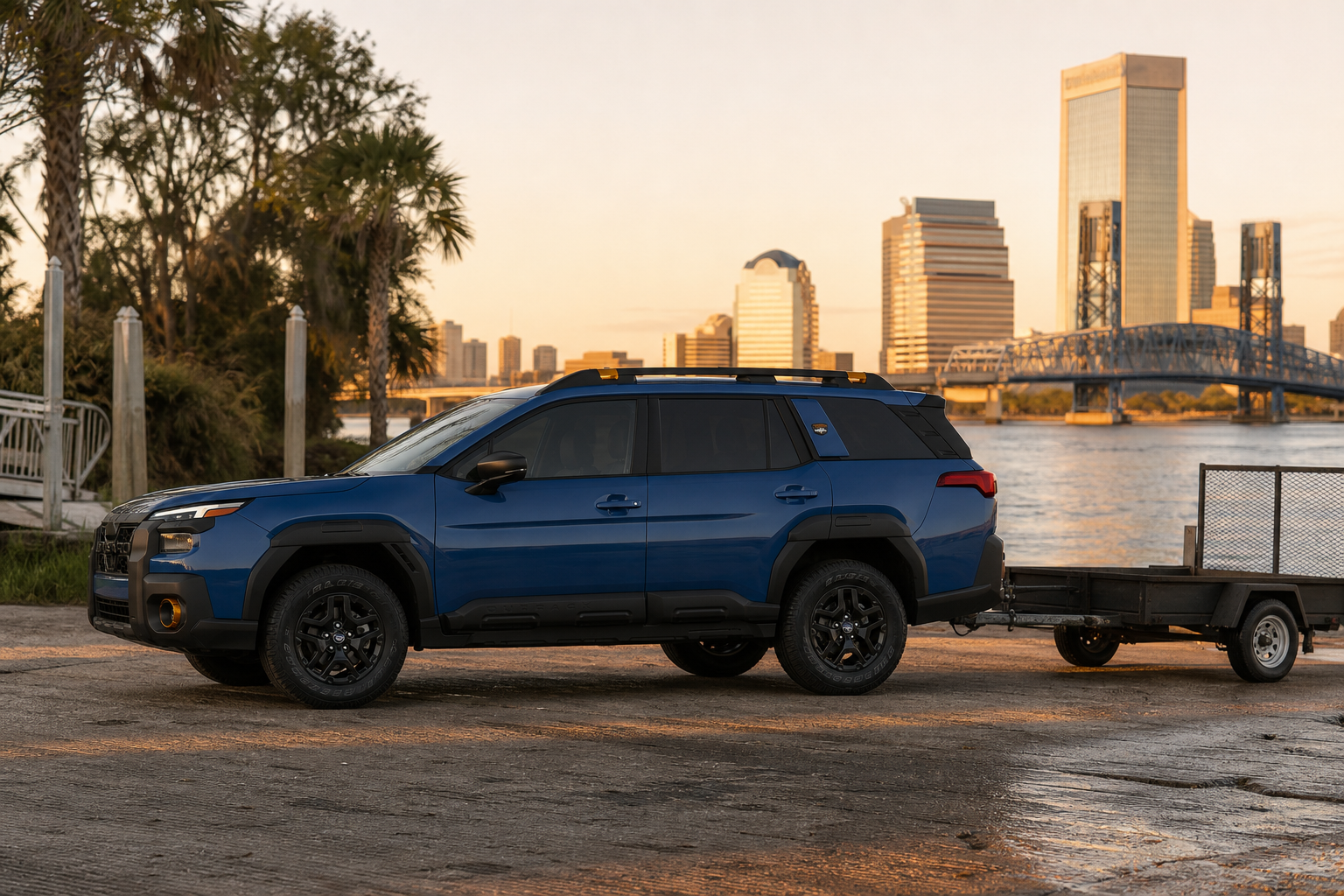
Wagon-style SUV parked at a riverside boat ramp near a small utility trailer at sunset

If you're eyeing a Subaru Outback for weekend trips to the boat ramp, a small camper, or hauling gear to the coast, the towing number matters. The short version: it depends on the engine under the hood. Here's the honest, trim-by-trim breakdown, plus what those pounds actually let you pull around Jacksonville.

How much can a Subaru Outback tow?

A Subaru Outback tows between 2,700 and 3,500 pounds depending on the trim and engine. Standard 2.5-liter models are rated at 2,700 pounds. Trims with the turbocharged 2.4-liter engine, including the XT versions and the Wilderness, step up to 3,500 pounds. Always match the number to the specific trim you're buying.

Which Outback trims tow the most?

The turbocharged Outback trims tow the most. Any XT-badged model and the Wilderness use the 2.4-liter turbo and carry a 3,500-pound rating, while the naturally aspirated 2.5-liter trims are rated at 2,700 pounds. If towing is your priority, the extra torque of the turbo is what buys you that higher number.

The Outback's turbocharged trims are rated to tow 3,500 pounds, per Subaru of America's published specifications, compared with 2,700 pounds on the standard-engine trims.

Engine / Trim groupTowing rating
2.5L (Base, Premium, Limited, Touring)2,700 lbs
2.4L Turbo XT trims (Onyx Edition XT, Limited XT, Touring XT)3,500 lbs
Wilderness (2.4L Turbo)3,500 lbs

Note on the newest model year: Subaru refreshed the Outback lineup for the 2026 model year, and we recommend confirming the exact rating for any 2026 trim against that vehicle's window sticker and Subaru of America's current specifications before you hitch up. If you're shopping our lot, just ask a Hanania Subaru of Orange Park team member to pull the figure for the specific VIN.

What can you actually tow with 2,700 or 3,500 pounds?

Plenty of common loads fit under those ratings. A 2,700-pound Outback comfortably handles a small utility trailer, two personal watercraft, or a lightweight pop-up camper. A 3,500-pound turbo Outback opens up single small boats on a trailer, teardrop and compact travel trailers, and heavier hauls to the beach or campground.

  • Small utility trailer with yard gear: typically 1,000–1,800 lbs loaded — fine for any Outback.
  • Two personal watercraft on a trailer: often 1,800–2,400 lbs — within the 2,700 lb trims.
  • Teardrop or compact travel trailer: commonly 1,500–3,000 lbs — best matched to a 3,500 lb turbo trim.
  • Small aluminum fishing boat and trailer: often 1,500–2,500 lbs — comfortable for turbo trims, doable on standard trims if you stay under the rating.

One rule that trips people up: the towing rating includes the weight of the loaded trailer, not just the empty trailer. Add your cargo, fuel, water, and gear before you compare against the number.

How do you tow safely with an Outback in Jacksonville?

Tow safely by staying under your trim's rating, distributing weight so about 10–15% sits on the tongue, and using the factory-style hitch and proper wiring for your load. In Florida heat, watch your transmission and engine temperatures on longer pulls, and give yourself extra stopping distance on I-295 and the Buckman Bridge.

A few practical Jacksonville notes:

  • Boat ramps along the St. Johns River and Intracoastal get busy on weekends — a backup camera and the Outback's ground clearance help on wet, sloped ramps.
  • Summer afternoon storms mean slick roads; a lighter, balanced trailer is much easier to control.
  • For anything near your maximum rating, have the hitch, wiring, brakes, and cooling checked before a long trip. Our service team can inspect the setup and confirm your specific trim's rating.

Florida law also requires trailer brakes on heavier trailers, so confirm your trailer's requirements before you load up. When in doubt, the lighter turbo trims give you the most margin for the kinds of loads most local drivers actually pull.

Is the turbo Outback worth it just for towing?

For many buyers, yes. The 2.4-liter turbo adds roughly 800 pounds of towing capacity and noticeably more low-end pull, which makes hills, on-ramps, and loaded trailers feel easier. If you tow only a light utility trailer a few times a year, the standard 2.5-liter trim and its 2,700-pound rating may be all you need.

Come by Hanania Subaru of Orange Park and we'll walk you through the trims, show you the exact ratings, and help you match an Outback to what you actually plan to tow.
Posted in:

Related Posts

Loaded crossover parked at a coastal highway overlook at sunset, ready for a long road trip

Best Subaru for Long Road Trips: A Jacksonville Owner's Guide

Florida is built for road trips. From the beaches at Amelia Island to the Blue Ridge Parkway a day's drive north, folks in Jacksonville put real miles on their vehicles. If you're shopping for a Subaru that can eat up I-95 and I-10 without wearing you out, here's a plain look at which models earn their keep on a long haul. Which Subaru is best for long road trips? For most Jacksonville drivers, the 2026 Subaru Outback is the sweet spot for long trips. It pairs a comfortable ride, roughly 500-plus highway miles per tank, and generous cargo room with standard all-wheel drive. If you need three rows, the Ascent is the better call. For tighter budgets, the Forester still travels well. The Outback rides like a wagon but sits a little higher, so you get car-like handling with SUV visibility. On a five-hour drive to the Panhandle, that combination keeps you fresh instead of fighting the road. How do the Outback, Ascent, and Forester compare for a road trip? They serve different travelers. The 2026 Outback wins on efficiency and cargo for two to four people. The 2026 Ascent seats up to eight and hauls family gear for a week at the coast. The 2026 Forester splits the difference with a smaller footprint that's easy to park downtown but still comfortable for two. Model (2026) Seating Best for Standout trait Outback 5 Couples, small families Long fuel range, low load floor Ascent 7–8 Big families, group trips Third row and towing capacity Forester 5 Solo drivers, weekend duos Great outward visibility, easy parking All three come with symmetrical all-wheel drive and the EyeSight driver-assist suite, which includes adaptive cruise control and lane centering. That adaptive cruise is the feature you'll appreciate most on flat, monotonous stretches like I-10 heading west. What features actually matter most for highway comfort? Focus on the things you'll feel every hour: adaptive cruise control to ease your right foot, supportive seats to save your back, strong fuel range to cut fill-up stops, and quiet cabin insulation. Cargo flexibility matters too, so gear doesn't pile up on passengers during a multi-day trip. Adaptive cruise control: reduces fatigue on long, steady highway runs. Fuel range: fewer stops means more ground covered before dark. Seat support: heated seats and lumbar adjustment pay off after hour three. Cargo room: a flat load floor beats cramming bags around passengers. All-wheel drive: steady footing when a summer downpour hits I-95. Traffic deaths tend to spike around holiday travel; the National Safety Council estimated 407 traffic fatalities over the 2024 Fourth of July holiday period, per the NSC. Driver-assist features and a rested, alert driver both help you avoid becoming a statistic on a busy travel weekend. How should I prep my Subaru before a long drive from Jacksonville? Give yourself about a week's lead time. Check tire pressure and tread, top off fluids, test your battery, and confirm your oil is within its service interval. Florida heat is hard on batteries and tires, so a quick inspection before you leave beats a roadside wait in August. Set tire pressure to the door-jamb spec when tires are cold. Verify oil life and coolant level, especially in summer heat. Have the battery tested if it's over three years old. Check wiper blades before afternoon thunderstorm season. Pack a basic kit: water, phone charger, and a small first-aid bag. Our service team at Hanania Subaru of Orange Park can knock out a pre-trip inspection in a single visit. We'd rather catch a soft battery in the shop than have you catch it in a rest-stop parking lot near the state line. Is all-wheel drive worth it for flat Florida highways? Yes, more for weather than terrain. Florida is flat, but sudden heavy rain is common, and standing water on the interstate can cause hydroplaning. Standard all-wheel drive on every Subaru helps keep power distributed for steadier grip in those conditions, which is reassuring when a storm rolls over I-95 at highway speed. It also pays off the moment you leave the state. If your trip heads toward the North Georgia mountains or a rainy stretch of the Carolinas, that same system earns its keep on wet, winding roads. Want to sit in an Outback, Ascent, and Forester back to back before your next trip? Stop by Hanania Subaru of Orange Park and we'll help you match the right one to how you actually travel.

Sport sedan parked on a sunny coastal road near a Florida beach access under clear blue skies

Subaru WRX Gas Mileage: What Jacksonville Drivers Really Get

The Subaru WRX is built for grip and quick throttle response, not for topping fuel-economy charts. Still, plenty of Jacksonville drivers want honest numbers before they commit. Here's what the WRX actually returns, why it sits where it does, and how your driving habits move the needle around town and on the highway to St. Augustine. What is the Subaru WRX gas mileage rating? Per EPA estimates, the 2025 Subaru WRX with the six-speed manual returns about 19 mpg city, 26 mpg highway, and 22 mpg combined. Fitted with the Subaru Performance Transmission (automatic), it lands near 18 city, 25 highway, and 21 combined. Real-world Jacksonville numbers usually track close to those figures. 2025 WRX Transmission City Highway Combined 6-speed manual 19 mpg 26 mpg 22 mpg Subaru Performance Transmission (auto) 18 mpg 25 mpg 21 mpg These are EPA-rated estimates. Your own average depends on traffic, how hard you use the boost, and how much idling you do in summer heat with the air conditioning running. Why isn't the WRX gas mileage higher? The WRX runs a turbocharged 2.4-liter boxer engine paired with standard all-wheel drive. That combination adds power and traction but also weight and drivetrain drag, which pulls fuel economy below a typical front-wheel-drive commuter car. You're trading efficiency for performance and all-weather grip on purpose. A few factors that keep the numbers where they are: Turbocharged engine: Rewards a heavy foot, and it's tempting to use that power in a car this responsive. Standard all-wheel drive: Great for wet Florida roads, but it moves more hardware than a two-wheel-drive setup. Performance tuning: The WRX is geared and calibrated for acceleration, not for coasting economy. Premium fuel: Subaru recommends premium unleaded, which affects your cost per mile even when mpg stays steady. How can I improve my WRX fuel economy in Jacksonville? Smooth, steady driving does the most. Ease into the throttle instead of chasing boost, keep tires at the door-jamb pressure, and use cruise control on I-295 and I-95. Cutting hard acceleration and long idle time can meaningfully raise your combined average across a typical week of stop-and-go commuting. Simple habits that pay off: Check tire pressure monthly; underinflated tires waste fuel and wear faster in summer heat. Stay on top of oil changes and air filters so the turbo engine breathes and runs clean. Combine errands to avoid repeated cold starts in short trips. Remove roof racks or extra cargo weight you're not using. Use the recommended premium fuel to keep the engine mapping happy. According to the U.S. Department of Energy, aggressive driving—rapid acceleration and hard braking—can lower gas mileage by roughly 15% to 30% at highway speeds, so a lighter foot is the cheapest upgrade you can make. Does the WRX require premium gas? Yes. Subaru recommends premium unleaded fuel (91 octane or higher) for the WRX's turbocharged engine to deliver its rated power and protect long-term reliability. Running lower octane regularly can trigger the engine to pull timing, reducing performance and potentially efficiency. Budget for premium when you're comparing running costs against a non-turbo model. Is the WRX a good daily driver for a Jacksonville commute? For many drivers, yes. The WRX handles I-95 traffic, summer downpours, and weekend trips to the beach with confidence thanks to standard all-wheel drive. The trade-off is fuel economy in the low-20s mpg range and a preference for premium gas. If a longer commute is your priority, weigh those costs honestly before you buy. Want to see the current WRX in person and talk real ownership costs? Stop by Hanania Subaru of Orange Park in Jacksonville and our team will walk you through fuel expectations, trims, and a test drive on local roads.

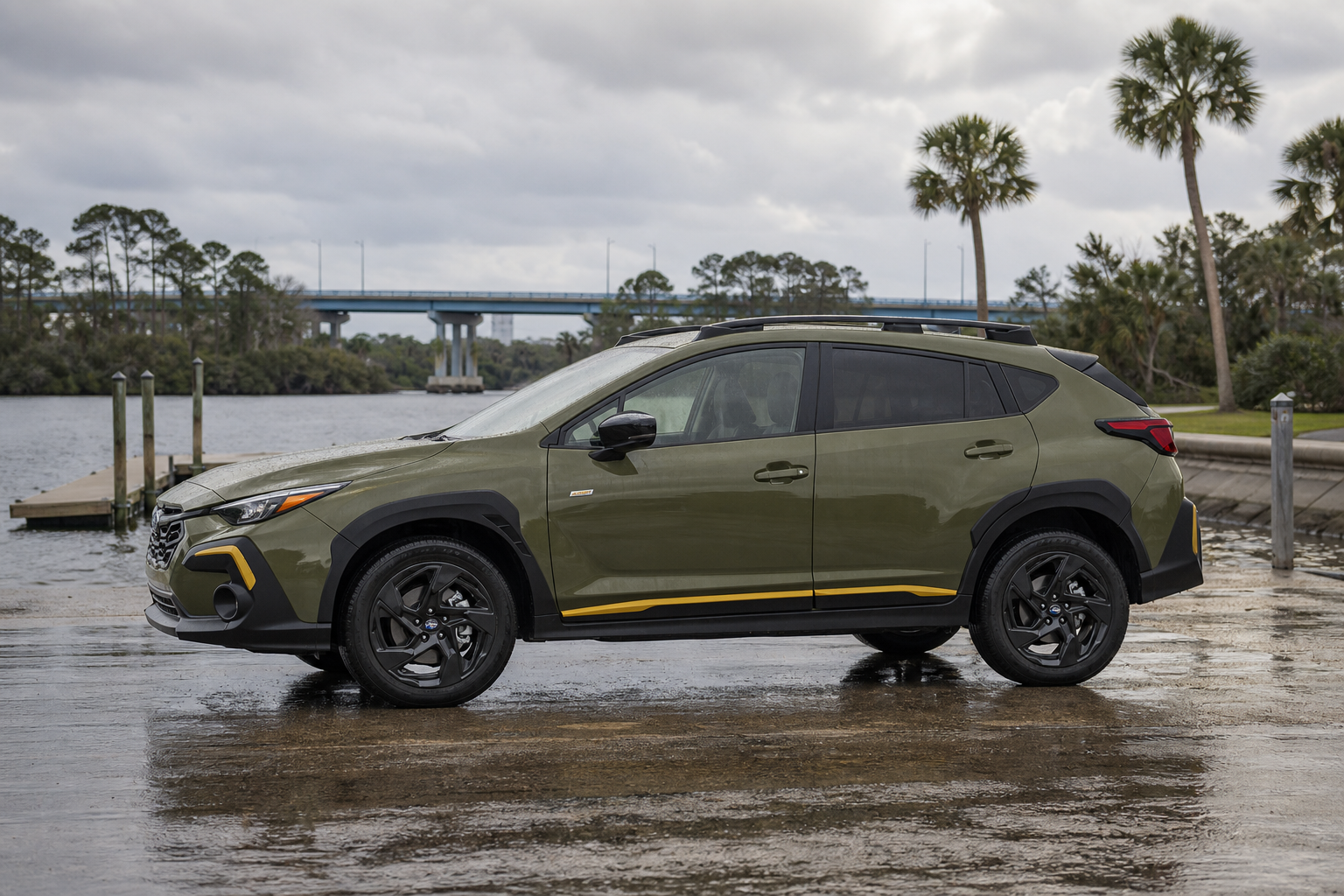
Compact crossover parked at a wet Jacksonville boat launch under a cloudy sky after summer rain

Subaru Crosstrek vs Impreza: Which Fits Your Jacksonville Drive?

The Crosstrek and the Impreza share a lot of DNA, which is exactly why so many Jacksonville shoppers get stuck deciding between them. They ride on the same platform, use similar engines, and look like cousins in the parking lot. But the differences that matter show up when you load the dog, hit a flooded intersection off Blanding, or check the monthly payment. Here's a plain look at how they compare. What's the real difference between the Crosstrek and the Impreza? The 2026 Subaru Crosstrek is a raised, rugged crossover built for clearance and cargo, while the 2026 Subaru Impreza is a lower, lighter hatchback tuned for easy city driving and fuel efficiency. The Crosstrek sits higher, adds standard cladding, and gives you more room behind the seats. Ground clearance: Crosstrek offers about 8.7 inches; Impreza sits closer to 5.1 inches. Drivetrain: Crosstrek comes standard with Symmetrical All-Wheel Drive across the lineup; the current Impreza also includes standard all-wheel drive. Body style: Crosstrek is a taller crossover; Impreza is a compact five-door hatchback. Cargo: Crosstrek gives you more usable space behind the rear seats for gear. Which one handles Jacksonville roads and weather better? For our area, the Crosstrek's extra clearance is the standout. Jacksonville sees heavy summer downpours, and standing water pools fast on roads near the St. Johns and low-lying neighborhoods. That added height gives more confidence in flooded intersections. The Impreza, meanwhile, is easier to park downtown and lighter on gas for daily commuters. According to the National Weather Service, Jacksonville averages roughly 52 inches of rain per year, well above the U.S. average of about 38 inches. That means water management matters here. Both models carry standard all-wheel drive for traction, but the Crosstrek's ground clearance is the difference-maker when a street floods during an afternoon storm. How do the Crosstrek and Impreza compare on price and value? The Impreza is the more affordable of the two, typically carrying a lower starting MSRP than the Crosstrek, which makes it a strong pick for budget-focused buyers. The Crosstrek costs more but adds clearance, cargo room, and available trims aimed at outdoor use. Your best value depends on how you actually drive. Feature 2026 Crosstrek Base 2026 Impreza Base Body style Crossover Hatchback Ground clearance ~8.7 in ~5.1 in Standard AWD Yes Yes Best for Cargo, clearance, gear Commuting, parking, MPG We'd rather you pick the model that fits your week than the one with the flashier badge. If you haul kayaks to the coast or drive gravel out to a launch, the Crosstrek earns its price. If you're mostly commuting the Buckman or running errands around Orange Park, the Impreza can save you money up front and at the pump. Stop by and drive both back to back. Which Subaru is better for families in Jacksonville? For growing families, the Crosstrek usually wins on practicality thanks to its taller roofline, easier child-seat access, and larger cargo area for strollers and beach gear. The Impreza still seats five and works well for smaller households or couples who prioritize efficiency and a lower price over maximum cargo space. Do both models come with standard all-wheel drive? Yes. Both the 2026 Subaru Crosstrek and the 2026 Subaru Impreza come with Subaru's Symmetrical All-Wheel Drive as standard equipment. That's a genuine advantage in wet Jacksonville weather, since many competing compact cars charge extra for all-wheel drive or don't offer it at all. Traction is built in on both. Whichever way you lean, our team at Hanania Subaru of Orange Park can line both up side by side so you can feel the seating height, load your own gear, and compare the ride before you decide.