
Trading in a vehicle is a major financial step that often comes with unnecessary anxiety, but entering the dealership with the right information completely changes the dynamic. To help you navigate this process with absolute certainty, we sat down with Kyle Nelson, Sales Consultant at Hanania Subaru, who has spent 3 years helping buyers maximize their trade-in power. In this exclusive interview, Kyle breaks down the exact mechanics of dealership appraisals, local market factors, and the financial advantages that can help you secure a highly competitive offer for your current vehicle.
Q: Kyle, what are the primary steps a vehicle owner should expect when they decide to trade in their current car for a new Subaru?
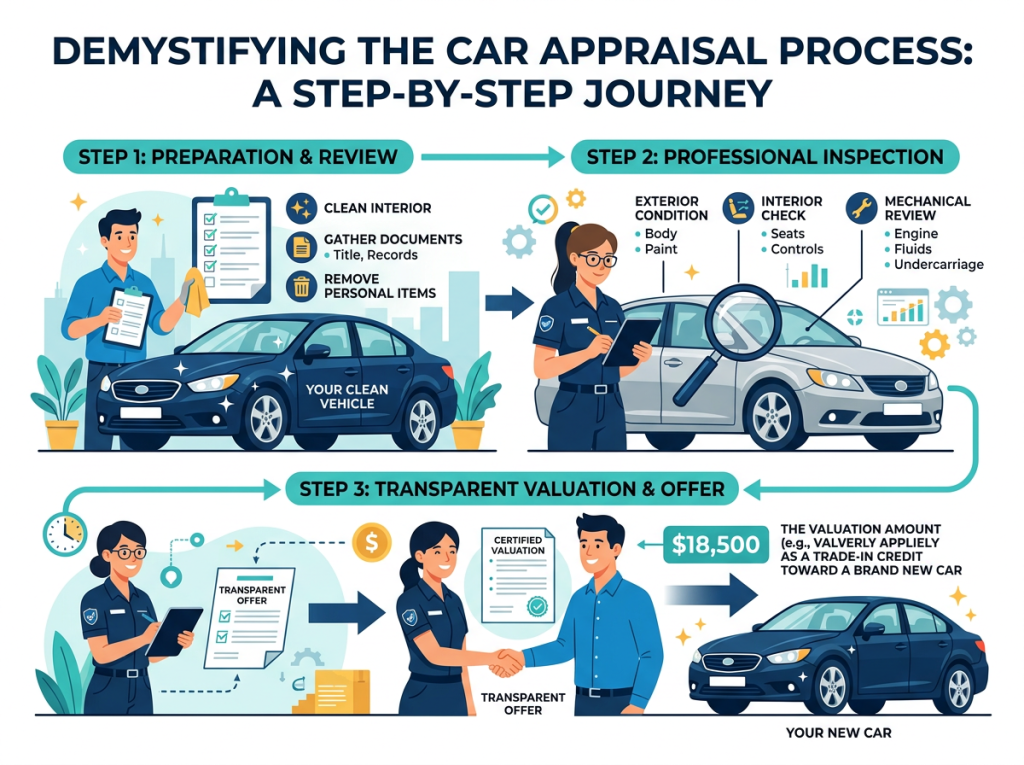
A: When you decide to transition into a new vehicle, the trade-in path is designed to operate as a seamless, single-day transaction. The process begins when you arrive at our showroom to explore the new Subaru inventory and select the vehicle that matches your lifestyle. While you are test-driving a potential new vehicle, our professional appraisal team will perform a physical evaluation of your trade-in to establish its current market value.
Once the appraisal is complete, we present you with a written valuation that can be applied directly as a down payment toward your purchase. If you accept the offer, we deduct that exact amount from the purchase price of your new vehicle, which immediately lowers your total loan balance or cash outlay. This entire process allows you to drop off your old keys and drive home in a new model in just a single visit, avoiding the weeks of detailing, listing, and meeting strangers that come with selling a vehicle on your own.
For drivers who want to get a head start before visiting us, we highly recommend using our online tool to value your trade-in from the comfort of home. Knowing your estimated value beforehand helps you plan your budget more effectively, whether you are eyeing the versatile new Forester inventory or looking at the family-sized new Ascent inventory. If you want to discuss your trade-in options directly with our team, you can easily reach out by giving us a quick call or dropping by our showroom.
Q: Why is it so important for local car owners to use their specific regional ZIP code when they are gathering trade-in estimates online?
A: Many vehicle owners do not realize that vehicle valuations are highly regionalized, meaning a national average estimate rarely reflects what your car is actually worth in Northeast Florida. When you enter your local ZIP code into an online valuation tool, the software automatically adjusts the pricing algorithm to account for regional supply, demand, and localized inventory shortages. For example, in our coastal environment, vehicles equipped with standard Symmetrical All-Wheel Drive are highly sought after by outdoor enthusiasts who frequent the sandy coastal plains and maritime forests of Ponte Vedra Beach.
This localized demand directly inflates the trade-in value of pre-owned all-wheel-drive models in our area compared to flat, dry regions of the country where all-wheel drive is considered a luxury rather than a necessity. The same principle applies to our used-vehicle inventory, where highly reliable crossovers maintain exceptionally strong resale values due to our active local lifestyle.
To illustrate how well these vehicles hold their value, third-party automotive analytics from CarEdge show that brand-new Subaru vehicles depreciate only about 39% after five years, retaining roughly 61% of their original value. This impressive value retention places the brand among the slowest-depreciating mainstream manufacturers in the industry, meaning your trade-in is likely worth more in our local market than national estimators might suggest.
Q: Walk us through the physical appraisal. What specific components and vehicle conditions do your appraisers inspect at the dealership?
A: The physical appraisal is a highly systematic process where our team looks at both the cosmetic and mechanical health of your vehicle to determine its true wholesale value. We begin with a comprehensive exterior walk-around, looking for paint inconsistencies, body panel alignment issues, dents, and any signs of previous structural repairs. We also inspect the tires for even tread wear, as uneven patterns can point to underlying alignment or suspension issues that would need to be addressed before we can resell the vehicle.
Inside the cabin, our appraisers evaluate the condition of the upholstery, dashboard, and electronic controls, ensuring that safety systems, climate control, and infotainment features function exactly as intended. We also conduct a short test drive to assess engine performance, transmission smoothness, and braking responsiveness.
If your vehicle has minor cosmetic blemishes, we generally advise against spending money on major repairs before trading it in, as our service department can perform reconditioning work far more cost-effectively than a retail consumer can. However, bringing your vehicle in clean and presenting a complete folder of its maintenance history can significantly boost an appraiser’s confidence in the vehicle’s long-term durability. If your current vehicle is due for a pre-trade check or minor maintenance, you can easily schedule a service appointment online to ensure everything is in top shape before your appraisal.
Q: How do you calculate the sales tax savings of a trade-in, and how does that impact the overall deal?
A: One of the most significant financial advantages of trading in your vehicle at a dealership is the state sales tax credit, which is a benefit you completely lose when selling a car privately. In Florida, you are only required to pay sales tax on the net difference between the purchase price of your new vehicle and the value of your trade-in.
To put this into perspective, if you are purchasing a new vehicle for $40,000 and our team values your trade-in at $15,000, your taxable balance is reduced to just $25,000. Assuming a standard local sales tax rate of 6%, you would only pay $1,500 in sales tax instead of the $2,400 you would owe without a trade-in, instantly saving you $900 on the transaction.
“The sales tax credit is essentially free money from the state that immediately boosts the real-world value of your trade-in by hundreds, sometimes thousands, of dollars.”
This tax advantage makes trading in an incredibly lucrative option, especially for busy professionals and families who want to maximize their purchasing power. These tax savings can also be applied when transitioning into our high-quality certified pre-owned inventory, allowing you to secure a highly reliable, thoroughly inspected vehicle while keeping your upfront acquisition costs as low as possible.
Q: What happens to your monthly payments when rolling negative equity into a new auto loan?
A: Rolling negative equity into a new loan is a common solution for drivers who need to exit their current vehicle but owe more on their auto loan than the vehicle is currently worth. When you have negative equity, the dealership pays off your existing loan in full, and the outstanding balance—the difference between your loan payoff and the trade-in value—is added to the principal of your new auto loan.
While this is a highly convenient way to consolidate your debt into a single monthly payment, it is important to understand that it will increase your new monthly payments and immediately put you in an underwater position on your new vehicle. Because you are financing a larger sum than the retail value of the new car, we always encourage buyers to carefully evaluate how this affects their long-term financial health.
To offset this added principal, we recommend choosing a highly reliable vehicle with slow depreciation, such as the models found in our new Outback inventory or our new Crosstrek inventory, which help protect your equity over time. Before making any decisions, you can easily apply for financing online to see what loan terms, interest rates, and structures you qualify for, allowing you to make a highly informed decision.
Q: In what situations is trading in your vehicle a better option than trying to sell it yourself?
A: While selling a vehicle privately can sometimes yield a slightly higher nominal offer, the sheer amount of time, effort, and financial risk involved makes trading in the superior choice for the vast majority of drivers. Selling a car privately requires you to detail the vehicle, take high-quality photos, list it on multiple online platforms, and field dozens of inquiries from unserious buyers. You also have to coordinate test drives with strangers, navigate the legal complexities of transferring a title, and handle the payoff of any existing lien on the vehicle yourself.
For commuters who rely on their vehicles daily to travel from growing suburban areas like Yulee into the city, being without a car during a private sale transition is simply not an option. Trading in your vehicle at a dealership eliminates all of these logistical headaches in a single afternoon.
We handle all of the DMV paperwork, coordinate directly with your lienholder to pay off your existing loan, and ensure that you seamlessly transition from your old vehicle directly into your new one without a single day of downtime. The convenience of a guaranteed transaction, combined with the substantial sales tax savings, often completely bridges the gap between a private-party valuation and a dealer trade-in offer.
Q: What key details should be clearly itemized in a written trade-in offer from a dealership?
A: When you receive a written trade-in offer, transparency is paramount, and you should always ensure that every financial element of the transaction is clearly and separately itemized on the buyer’s order. A professional, trustworthy written offer should explicitly state the exact wholesale valuation of your trade-in vehicle, completely separate from any dealer discounts, manufacturer incentives, or the purchase price of the new vehicle.
You should also look for a clear line item showing the calculated sales tax savings, which confirms that the tax credit has been properly applied to reduce your taxable balance. Ensure that there are no hidden reconditioning fees or administrative charges deducted from your vehicle’s valuation unless they were clearly discussed and justified during the physical appraisal.
At Hanania Subaru, we pride ourselves on providing completely transparent, line-by-line breakdowns of every deal so you can see exactly where your money is going. If you are ready to experience a stress-free, transparent trade-in process, we invite you to stop by our showroom at 6400 Blanding Blvd to meet our team. Whether you want to explore our new Subaru performance inventory or simply want a professional, no-obligation appraisal of your current car, we are here to help you drive home with absolute confidence.
Pricing
Pricing by trim
| Feature | Limited | Limited XT | Premium | Touring | Touring XT | Wilderness |
|---|---|---|---|---|---|---|
| Base MSRP | $41,715 | $44,365 | $34,995 | $45,395 | $47,995 | $44,995 |
| Destination charge | $1,450 | $1,450 | $1,450 | $1,450 | $1,450 | $1,450 |
Engine & Performance
Powertrain specs by trim
| Feature | Limited | Limited XT | Premium | Touring | Touring XT | Wilderness |
|---|---|---|---|---|---|---|
| Engine | 2.5L | 2.4L | 2.5L | 2.5L | 2.4L | 2.4L |
| Horsepower | 180 hp | 260 hp | 180 hp | 180 hp | 260 hp | 260 hp |
| Torque | 178 lb-ft | 277 lb-ft | 178 lb-ft | 178 lb-ft | 277 lb-ft | 277 lb-ft |
| Transmission | Lineartronic CVT | Lineartronic CVT | Lineartronic CVT | Lineartronic CVT | High-torque Lineartronic CVT | Lineartronic CVT |
| Drivetrain | All-wheel drive | All-wheel drive | All-wheel drive | All-wheel drive | All-wheel drive | All-wheel drive |
Keep Your Vehicle Running Strong
Keep your vehicle performing at its best with our service team:
© 2026 Hanania Subaru. All rights reserved.
Connect with us


- Automotive Partnerships & Collaborations
- Buying & Leasing
- Buying Guides
- Community & Outreach Initiatives
- Event Highlights & Celebrations
- Family Vehicles
- Hanania Subaru of Orange Park Service
- Jacksonville Subaru Dealer
- Jacksonville Subaru Service
- Local Dealership News & Activities
- Local Living
- Local Ownership Tips
- Maintenance & Service
- Model Comparisons
- Model Research
- New Vehicle Reviews
- Off-Road Adventures
- Outdoor Lifestyle
- Ownership
- Ownership & Service
- Pet-Friendly Vehicle Features
- Safety Features
- Safety Recall
- Service & Maintenance
- Subaru Care & Maintenance
- Subaru Models
- Subaru Ownership
- Subaru Technology
- Technology & Innovation
- Trade in
- Uncategorized
- Vehicle Comparisons
- Vehicle Guides
- Vehicle Research
- Vehicle Safety
Categories