
Florida throws a specific set of challenges at any used car: relentless heat, salt air near the coast, flooding roads in hurricane season, and stop-and-go traffic on I-95. The good news is that several used Subaru models handle all of it well and hold their value while doing it. Here is our honest read on which ones make the most sense for Jacksonville drivers, and what to look at before you sign.
Which used Subaru models hold up best in Florida heat and humidity?
For Florida conditions, the Outback, Forester, and Crosstrek are the standouts. All three run Subaru’s naturally aspirated 2.0L or 2.5L boxer engines that tolerate heat well, ride high enough to clear standing water, and have simple, durable cabins that shrug off humidity. The Legacy and Impreza are strong value picks too.
- Subaru Outback (2015 and newer) — roomy, comfortable, and easy to find in clean condition.
- Subaru Forester (2014 and newer) — tall glass, great visibility, and cargo room for beach and errand runs.
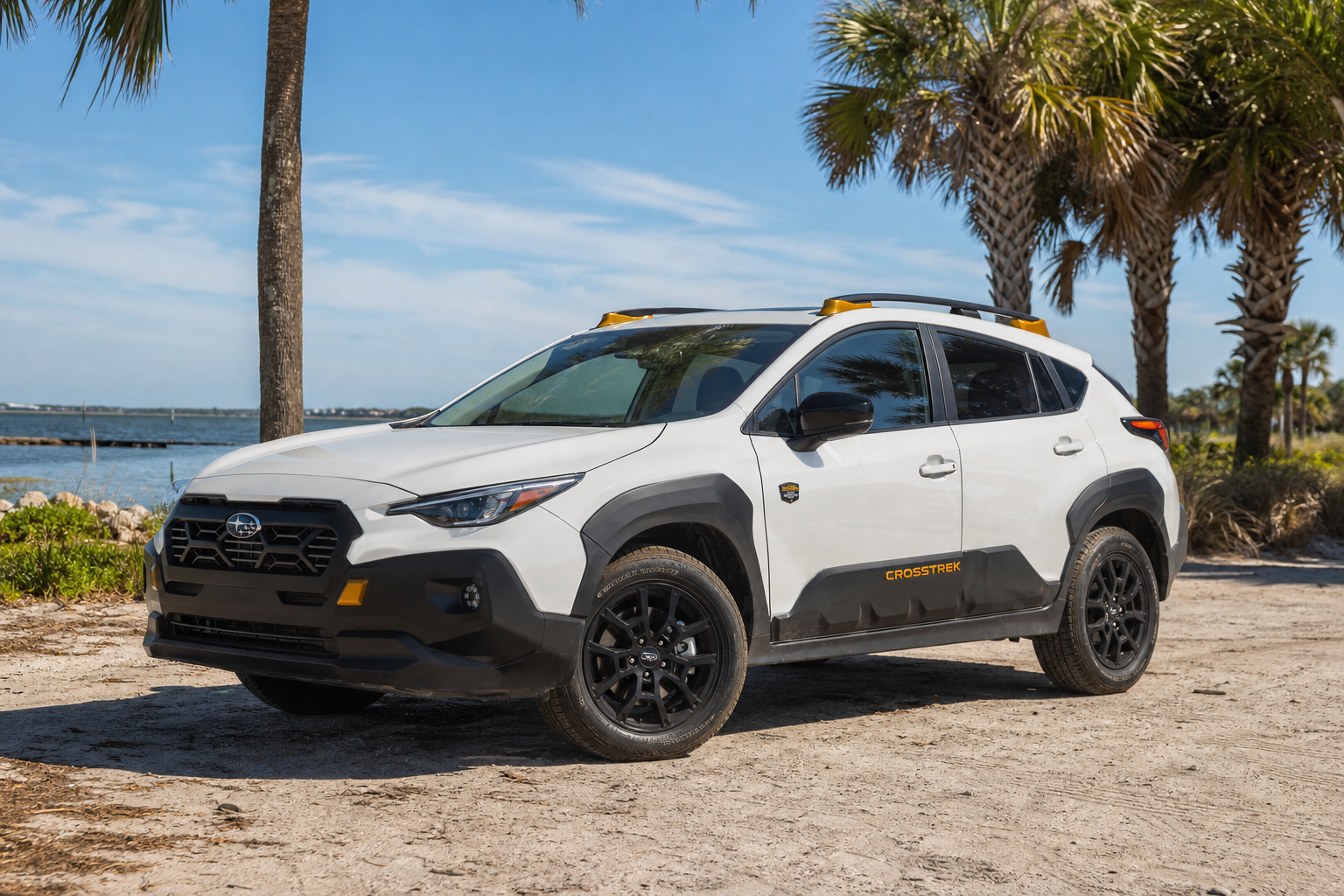
- Subaru Crosstrek (2018 and newer) — compact, fuel-friendly, and ideal for tight downtown parking.
- Subaru Legacy (2015 and newer) — the sedan option, often priced below the SUVs.
- Subaru Impreza (2017 and newer) — the budget entry point with standard all-wheel drive.
Do you really need all-wheel drive in flat Florida?
Yes, more than you’d think. Nearly every Subaru comes with symmetrical all-wheel drive standard, and that traction matters most during Florida’s sudden downpours and slick summer roads, not snow. It also helps on soft sand near coastal access points and pays off at resale, since buyers here specifically look for it.
Florida sees a lot of wet pavement. According to the National Weather Service, Jacksonville averages roughly 52 inches of rain per year, much of it in short, heavy afternoon storms between June and September. That constant traction demand is exactly where a Subaru’s all-wheel-drive system earns its keep compared with a front-wheel-drive competitor.
What should you check before buying a used Subaru in Florida?
Focus on four areas: the head gasket history on older 2.5L engines, the CVT transmission behavior, any rust underneath on coastal cars, and the air conditioning. A used Subaru that shifts smoothly, blows cold air, and has clean service records is usually a safe bet. Always get a pre-purchase inspection.
| Check | Why it matters in Florida |
|---|---|
| A/C performance | Non-negotiable in the heat; repairs add up fast. |
| CVT operation | Should feel smooth with no shudder; confirm fluid service history. |
| Undercarriage rust | Coastal salt air can corrode components on neglected cars. |
| Head gaskets (older 2.5L) | Ask about repairs on pre-2013 engines; heat accelerates wear. |
| Tire condition | All-wheel drive needs matched tires with even wear. |
Which used Subaru gives the best value for the money?
For most Jacksonville shoppers, a certified pre-owned Forester or Outback from the 2018 to 2021 model years hits the sweet spot. They pair modern safety tech and the EyeSight driver-assist system with prices well below new. If your budget is tighter, a well-kept Impreza or Crosstrek delivers the same all-wheel drive for less.
Certified pre-owned models also carry an extended factory-backed warranty, which takes some of the guesswork out of buying used. When you stop by Hanania Subaru of Orange Park, we’ll walk you through the inspection records and pricing on each specific model year and trim so there are no surprises at the counter.
How many miles is too many on a used Subaru?
A properly maintained Subaru with 100,000 to 150,000 miles can still have plenty of life left, especially the newer CVT-equipped models. What matters more than the odometer is documented maintenance: regular oil changes, CVT fluid service, and no history of overheating. A low-mileage car with gaps in service can be a bigger risk.
Ask for the maintenance history and match it against the recommended service intervals. A car that’s had consistent care at 120,000 miles is often a smarter buy than a neglected one at 70,000.
Connect with us


- Automotive Partnerships & Collaborations
- Buying & Leasing
- Buying Guide
- Buying Guides
- Community & Outreach Initiatives
- Electric Vehicles
- Event Highlights & Celebrations
- Family Vehicles
- Hanania Subaru of Orange Park Service
- Hybrid & Electric
- Jacksonville Subaru Dealer
- Jacksonville Subaru Service
- Lifestyle
- Local Dealership News & Activities
- Local Living
- Local Ownership Tips
- Maintenance & Service
- Model Comparisons
- Model Research
- New Inventory
- New Vehicle Reviews
- Off-Road Adventures
- Outdoor Lifestyle
- Ownership
- Ownership & Service
- Pet-Friendly Vehicle Features
- Safety Features
- Safety Recall
- Service & Maintenance
- Subaru Care & Maintenance
- Subaru Models
- Subaru Ownership
- Subaru Technology
- Technology & Innovation
- Trade in
- Uncategorized
- Used Vehicles
- Vehicle Comparisons
- Vehicle Features
- Vehicle Guides
- Vehicle Research
- Vehicle Safety
Categories