
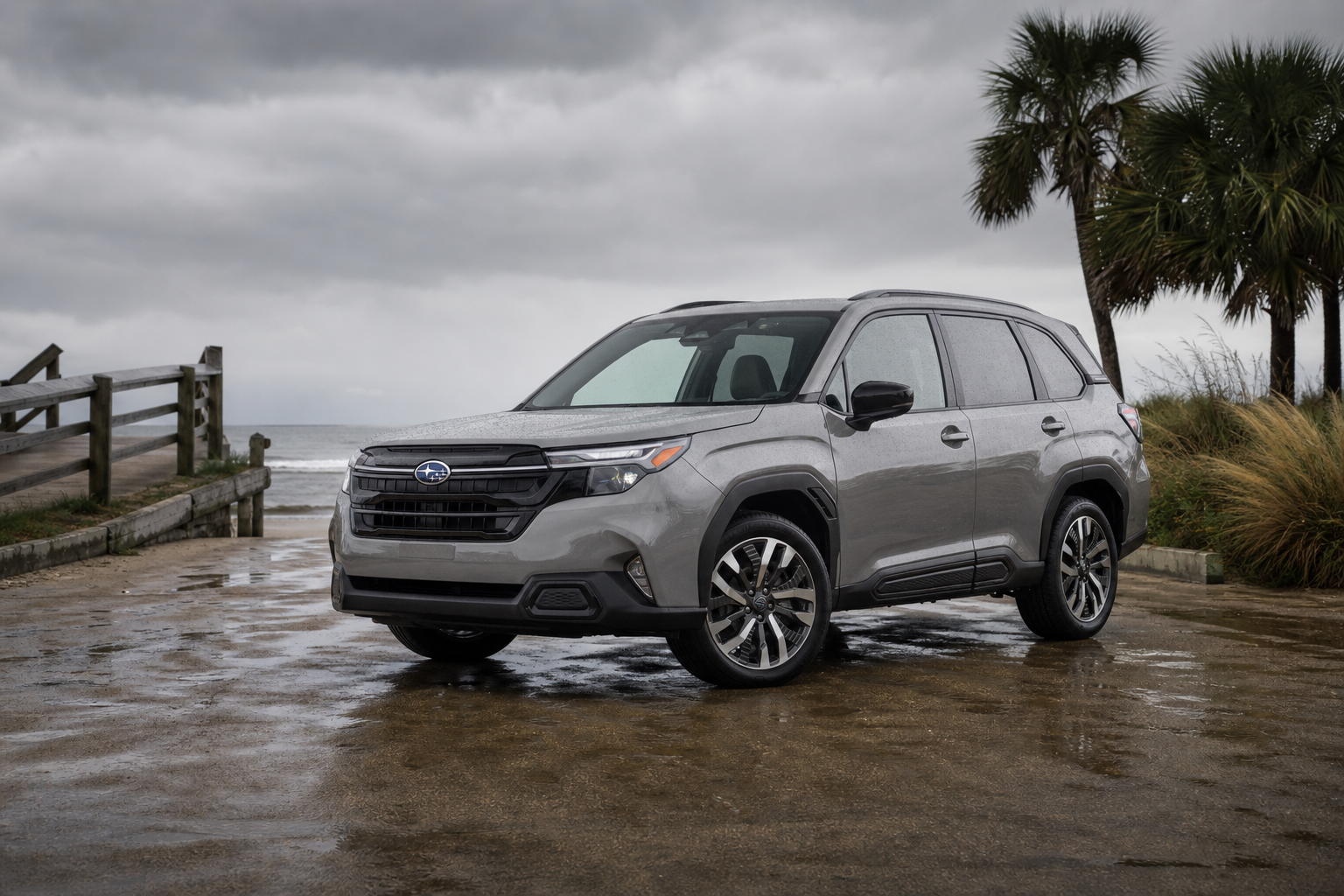
Two of the most cross-shopped compact SUVs in Northeast Florida sit right next to each other on shopping lists all over Jacksonville: the Subaru Forester and the Honda CR-V. Both are reliable, practical, and family-friendly. But they take different approaches, and those differences matter depending on whether you’re commuting on I-295, hauling gear to Amelia Island, or splitting a downpour on Beach Boulevard.
We’ll lay out where each one leads, what to weigh, and how to decide without the sales pressure.
What is the biggest difference between the Forester and the CR-V?
The clearest split is drivetrain. Every 2026 Subaru Forester comes with standard symmetrical all-wheel drive on all trims. The 2026 Honda CR-V is front-wheel drive standard, with all-wheel drive offered as an option. For Jacksonville’s sudden storms and occasional wet-road traction issues, that standard setup is a real distinction.
Which SUV handles Jacksonville weather and roads better?
For our climate, the Forester’s standard all-wheel drive gives it a slight edge in heavy rain and on slick on-ramps, since power reaches all four wheels without you selecting anything. The CR-V drives well and rides comfortably too, but its base trims are front-wheel drive, so match the trim to your traction needs.
Jacksonville gets roughly 52 inches of rain a year, well above the national average of about 38 inches, according to National Weather Service climate data. That’s a lot of wet pavement between Mandarin and the Beaches, so traction confidence is worth thinking about here more than in drier metros.
- Standard AWD: Forester (all trims) vs CR-V (optional)
- Ground clearance: Forester sits a bit higher, useful for flooded intersections
- Visibility: Forester’s upright glass area is generous; CR-V’s is also strong
- Ride comfort: CR-V leans slightly quieter and more cushioned on the highway
How do cargo space and interior room compare?
Both are genuinely spacious compact SUVs, and families rarely feel cramped in either. The Honda CR-V generally offers a touch more maximum cargo volume behind the front seats, while the Subaru Forester counters with wide door openings, an airy cabin, and easy rear-seat access for car seats and coolers alike.
| Feature | 2026 Subaru Forester | 2026 Honda CR-V |
|---|---|---|
| Standard drivetrain | All-wheel drive | Front-wheel drive |
| Rear-seat access | Very wide door openings | Wide, family-friendly |
| Max cargo volume | Generous | Slightly larger |
| Hybrid option | Available | Available |
| Driver-assist suite | EyeSight standard | Honda Sensing standard |
Which one is the smarter long-term buy in Jacksonville?
It comes down to priorities. If you want standard all-wheel drive, higher ground clearance, and a cabin built around outdoor use, the Forester fits. If maximum cargo room and a slightly plusher highway ride top your list, the CR-V makes sense. Both hold value well, so test-drive both before deciding.
Ownership cost is close between the two, and both brands have earned strong reliability reputations. We’d rather you drive each back-to-back on local roads than take our word for it. Bring your car seats, your golf clubs, or whatever you actually haul, and see which one loads easier for your life.
If you’d like to compare a specific 2026 Forester trim like the Premium or Wilderness against a comparable CR-V, we’re happy to walk through pricing, features, and financing openly at Hanania Subaru of Orange Park. Every price we quote comes with the model year and trim spelled out, so there are no surprises at the counter.
Connect with us


- Automotive Partnerships & Collaborations
- Buying & Leasing
- Buying Guides
- Community & Outreach Initiatives
- Electric Vehicles
- Event Highlights & Celebrations
- Family Vehicles
- Hanania Subaru of Orange Park Service
- Hybrid & Electric
- Jacksonville Subaru Dealer
- Jacksonville Subaru Service
- Lifestyle
- Local Dealership News & Activities
- Local Living
- Local Ownership Tips
- Maintenance & Service
- Model Comparisons
- Model Research
- New Inventory
- New Vehicle Reviews
- Off-Road Adventures
- Outdoor Lifestyle
- Ownership
- Ownership & Service
- Pet-Friendly Vehicle Features
- Safety Features
- Safety Recall
- Service & Maintenance
- Subaru Care & Maintenance
- Subaru Models
- Subaru Ownership
- Subaru Technology
- Technology & Innovation
- Trade in
- Uncategorized
- Vehicle Comparisons
- Vehicle Features
- Vehicle Guides
- Vehicle Research
- Vehicle Safety
Categories