

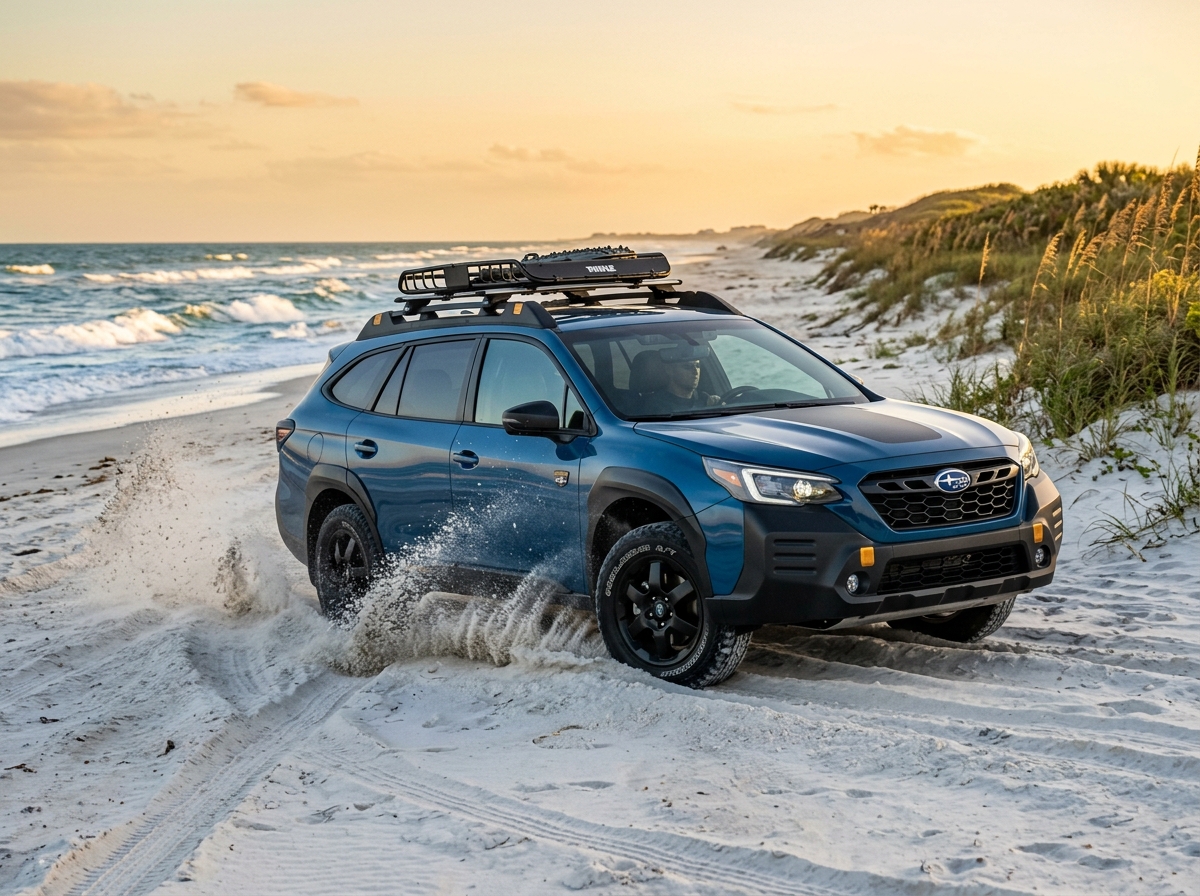
Driving on the coastal sands of Florida requires more than just a capable vehicle; it demands an understanding of how your drivetrain interacts with shifting surfaces. Today, we are speaking with Emil Becirevic, a Service Advisor at Hanania Subaru with 5 years of experience helping local drivers maintain their vehicles for the unique challenges of our shoreline. In this interview, Emil shares professional insights on navigating soft sand, utilizing advanced drive modes, and protecting your investment from the corrosive effects of salt and sea air.
Q: Emil, many drivers assume all-wheel drive is a universal solution for the sand, but how does the Subaru system specifically handle the unique coastal terrain around Ponte Vedra Beach?
A: Many people assume that every all-wheel drive system operates the same way on the sand, but that is a common misconception I clarify for owners. Subaru’s **Symmetrical All-Wheel Drive** is a **full-time AWD system that continuously distributes power to all four wheels**, which is fundamentally different from reactive systems that wait for a slip to occur before engaging the secondary axle. Because the **BOXER engine** is mounted longitudinally, the drivetrain has a nearly straight, symmetrical layout that provides better balance and stability when the sand starts to shift under your tires.
In our local coastal environment, especially for those visiting Ponte Vedra Beach where the sand can vary from packed to quite loose, this constant power delivery is vital for maintaining momentum. Most 2026 Subaru models equipped with the **Lineartronic CVT** utilize an **Active Torque Split system, which uses a multi-plate center clutch to vary a nominal 60/40 front-to-rear torque split**. This means the vehicle is always proactive, ensuring that power is already at the wheels with the most grip before you even realize the surface is getting soft. If you are planning a trip to the shore, finding our Jacksonville showroom is a great first step to seeing these systems in person.
Maintaining a steady speed is the most important factor once you leave the pavement. I tell drivers to avoid sudden acceleration or sharp braking, as these actions can cause the tires to dig into the sand rather than float on top of it. If you have questions about your specific model’s capabilities, (904) 906-1235 is the best way to reach our service team for a quick consultation before you head out for the weekend.
Q: Have you considered how the height of your vehicle and your tire setup affect your ability to navigate the softer patches of sand often found in areas like Yulee?
A: That is a great point to bring up because ground clearance is often the deciding factor between a successful beach day and needing a recovery. Most 2026 Subaru SUVs, such as the 2026 Subaru Outback and 2026 Subaru Forester, provide **about 9 inches of ground clearance on most trims**, which is usually sufficient for designated beach driving lanes. However, if you are exploring areas around Yulee where the proximity to natural preserves often means encountering deeper ruts, the extra height found on Wilderness trims becomes a massive advantage.
Preparation starts with your tires, and I always recommend lowering your tire pressure to between 15 and 20 psi before entering soft sand. This increases the tire’s footprint, providing better flotation and preventing the vehicle from digging in and getting bogged down. You can find high-quality pumps and gauges through our certified Subaru service center to ensure you can air back up before returning to the highway. For those who want the best possible beach experience, we often point shoppers toward our certified pre-owned Subaru models that already feature robust all-terrain setups.
While models like the 2026 Subaru Crosstrek are excellent for light-duty beach trips, drivers looking for the ultimate in sand performance might also look at our performance-oriented Subaru vehicles for different types of traction technology. Regardless of which model you drive, having that clearance ensures the underbody doesn’t act like a shovel, which is exactly what happens when a lower vehicle bottoms out in the soft stuff.
Q: A common error drivers make is leaving their standard safety systems fully active when they hit the deep stuff; Emil, what is the best way to use X-MODE in those scenarios?
A: We get asked that a lot, and the answer lies in understanding how **X-MODE** optimizes the engine output and AWD torque distribution. When you are in deep sand, you should use the **Deep Snow/Mud** setting if your vehicle is so equipped, as this mode relaxes the wheel-slip limits. This is counterintuitive to some, but in deep sand, you actually need some wheelspin to maintain momentum and clear the treads. Standard traction control can cut power when it detects a slip, which is exactly the opposite of what you want when trying to stay on top of a soft surface.
“In deep sand, you actually need some wheelspin to maintain momentum and clear the treads, which is why specialized drive modes are so critical.”
If you find yourself in a particularly soft patch, it is often better to turn off the standard traction control manually if you don’t have the dual-mode **X-MODE** system. This allows the **2.5L H4** engine in a 2026 Subaru Forester to deliver the torque needed to climb out of a rut without the computer pulling back the throttle. We have a variety of these capable vehicles in our current pre-owned inventory if you want to test these modes yourself. If you ever feel the system isn’t engaging correctly, you can find genuine Subaru components and sensors at our parts counter.
I also remind drivers that **X-MODE** includes a very effective hill-descent control feature. While we don’t have many mountains here, it works like a low-speed cruise control on uneven sand dunes, allowing you to focus entirely on steering while the vehicle manages the braking and engine torque. If you’re unsure how to toggle these settings, I recommend scheduling a service visit for a full walk-through of your vehicle’s off-road tech.
Q: When comparing a standard crossover to the specialized Wilderness variants, the differences in mechanical tuning become obvious on the shoreline; is the Crosstrek Wilderness specifically better for these trips?
A: The 2024 Crosstrek Wilderness is a significant step up for sand driving because it doesn’t just add height; it changes the way power is delivered. It features **9.5 inches** of clearance and a revised CVT gear ratio that improves low-speed climbing and torque delivery. This is particularly helpful in soft sand where the engine needs to stay in its power band to keep the vehicle moving. You can see these differences across our new vehicle selection when comparing the various adventure-ready trims.
The Wilderness models also come with standard all-terrain tires and an improved approach angle, which means you are less likely to scrape the front bumper when transitioning from the access ramp to the beach. For many of our customers, the new Subaru Crosstrek in this trim is the perfect balance of a daily commuter and a weekend beach explorer. The **Lineartronic CVT** in these models is designed for smooth torque delivery, and as long as you avoid prolonged high-load wheelspin, it is robust enough for low-speed sand driving.
If you need more space for the whole family and their gear, the new Subaru Outback also offers a Wilderness trim with similar upgrades. Both vehicles utilize the **Active Torque Vectoring** system to help tuck the nose into turns on loose surfaces. The internal components of the CVT in these trims are specifically cooled and reinforced to handle the higher thermal loads that come with driving through high-resistance surfaces like deep, hot sand.
Q: Emil, Subaru provides a Rust Perforation Limited Warranty for 5 years with unlimited mileage, but what should owners be doing after a beach day to prevent long-term damage?
A: A recent observation in our service bay is that many owners think a standard automatic car wash is enough, but it rarely reaches the pockets where salt and sand accumulate. Subaru maintenance guidance is very clear: you must thoroughly wash the underbody and suspension components with fresh water after driving on beaches. Salt is incredibly corrosive, and sand can trap moisture against metal parts, leading to premature wear on control arms and subframes. Before your next trip, you can complete a financing application to upgrade to a newer model with the latest protective coatings.
I tell owners to use a high-pressure hose at home to rinse the wheel wells, the inside of the wheels, and the entire undercarriage. Pay special attention to the brake lines and the exhaust system. If you are driving a new Subaru Forester, you’ll find that the body cladding helps protect the paint, but the metal underneath still needs that fresh water rinse. For those with larger vehicles like the new Subaru Ascent, the surface area is even larger, making a thorough cleaning even more critical.
Frequent beach drivers should also consider more frequent inspections of their cabin air filters and engine air filters. Salt air and fine sand can clog these filters faster than normal city driving. We recommend a professional underbody detailing at least once a season if you are a regular at the drive-on beaches. This proactive care ensures that your vehicle remains reliable for years to come, even in our harsh coastal climate.
Q: Where do you see the value of these beach-capable vehicles heading as more people move to the area, and what should be the first question a buyer asks on a test drive?
A: As our community grows, the demand for vehicles that can handle both the I-295 commute and a Sunday on the sand is only increasing. Subaru vehicles are exceptional at retaining their value, often besting rivals in the segment for resale. When you come in, getting directions to our facility will allow you to experience how a vehicle with **25 city / 31 hwy** feels on the road. The first thing you should ask about is the **24-hour roadside assistance**, which is included for **3 years or 36,000 miles**, providing peace of mind if you ever run into trouble away from the pavement.
I always suggest that buyers ask to see the **X-MODE** engagement process during their test drive. Understanding how the vehicle transitions from highway mode to off-road mode is the best way to feel confident before you ever hit the sand. You can start the process by calling (904) 906-1235 to speak with a specialist about which model fits your lifestyle. If you are looking to upgrade, our team is ready to assist with evaluating your trade-in to see how much equity you have in your current ride.
Looking forward, the integration of more electrified components will only improve the low-end torque available for sand driving. For now, the mechanical reliability of our current lineup remains the gold standard for Florida adventure seekers. We invite you to visit us and see why so many of your neighbors trust their coastal journeys to a Subaru.
© 2026 Hanania Subaru. All rights reserved.
Connect with us


- Automotive Partnerships & Collaborations
- Buying & Leasing
- Buying Guides
- Community & Outreach Initiatives
- Electric Vehicles
- Event Highlights & Celebrations
- Family Vehicles
- Hanania Subaru of Orange Park Service
- Hybrid & Electric
- Jacksonville Subaru Dealer
- Jacksonville Subaru Service
- Lifestyle
- Local Dealership News & Activities
- Local Living
- Local Ownership Tips
- Maintenance & Service
- Model Comparisons
- Model Research
- New Inventory
- New Vehicle Reviews
- Off-Road Adventures
- Outdoor Lifestyle
- Ownership
- Ownership & Service
- Pet-Friendly Vehicle Features
- Safety Features
- Safety Recall
- Service & Maintenance
- Subaru Care & Maintenance
- Subaru Models
- Subaru Ownership
- Subaru Technology
- Technology & Innovation
- Trade in
- Uncategorized
- Vehicle Comparisons
- Vehicle Features
- Vehicle Guides
- Vehicle Research
- Vehicle Safety
Categories