
The Real Cost of What Goes Under Your Subaru Hood
There is a viral video floating around showing an aftermarket parts truck making a delivery to a dealership, and it usually sparks a lot of questions from my customers. I’ve spent 6 years as a Parts Manager, and I can tell you that what you’re seeing in those videos is almost always related to used car reconditioning for other brands or a very specific customer request. When it comes to your actual Subaru maintenance, we don’t cut corners with “universal” components because your vehicle wasn’t built with universal logic. Every Genuine Subaru Part is an exact replica of what was installed on the assembly line, engineered to handle the specific stresses of your drivetrain.
Choosing a cheaper alternative might save a few dollars at the counter, but the long-term math rarely works out in the driver’s favor. For example, if you are driving a 2026 Subaru Outback with the 2.5L H4 engine, every component from the spark plugs to the serpentine belt is designed to meet a specific thermal and vibration threshold. Aftermarket manufacturers often use “consolidated” designs, meaning one part is made to fit ten different vehicle brands. That “close enough” fit is often why we see premature wear or mysterious rattles that weren’t there before the repair.
For families living in Ponte Vedra Beach, the salt air and coastal humidity add an extra layer of strain on your vehicle’s exterior and mechanical bits. I always recommend staying ahead of corrosion with components designed to withstand those specific environmental factors. If you have questions about a specific repair or want to see the quality of our components for yourself, you can always find our Jacksonville showroom easily or give our team a quick call at (904) 906-1235. We also keep a great selection of the new Subaru performance inventory on hand for those who want to see how these high-spec parts perform in the real world.
Table of Contents
- Why BOXER Engines and Symmetrical AWD Demand Exact Engineering
- The EyeSight Calibration Factor in Windshield and Sensor Repairs
- Navigating the Warranty and Insurance Realities of Aftermarket Parts
- Spotting the Difference: How to Identify Genuine Subaru Components
- Why Professional Installation Safeguards Your Subaru Investment
Why BOXER Engines and Symmetrical AWD Demand Exact Engineering
The horizontal layout of Subaru BOXER engines creates a specific set of physics that standard upright engines just don’t have to deal with. Because the cylinders are laid flat, oil flow and pressure management are absolutely critical. I often point out to my team that a Subaru Genuine Oil Filter isn’t just a canister with paper inside; it is built with a specific bypass valve pressure designed for the 2.5L H4 or 2.4L H4 engines. Many aftermarket filters have a much lower bypass pressure, which can lead to unfiltered oil circulating through your engine or, worse, restricted flow during a cold start.
The same precision is required for your Symmetrical All-Wheel Drive system. Subaru is very strict about tire matching because the system relies on all four wheels having the exact same rolling circumference. If you replace just one tire with an aftermarket brand that has a slightly different tread depth or carcass shape, it can cause heat buildup in the center differential. This is a common issue we see when people try to save money on a single tire rather than maintaining a matched set. We see this often with high-mileage commuters coming from Yulee who put heavy miles on US Highway 17; that constant high-speed travel makes even a tiny difference in tire diameter a major mechanical risk.
Whether you are looking at our new Crosstrek inventory or exploring our certified pre-owned inventory, you’ll notice that every vehicle we stand behind uses these exact-spec components. The goal is to maintain the original balance of the car. When you start swapping in parts that weren’t validated by the factory, you’re essentially redesigning the car’s engineering on the fly, and that’s rarely a good idea for reliability.
The EyeSight Calibration Factor in Windshield and Sensor Repairs
A customer came in recently because their cruise control and pre-collision braking stopped working after they had a “bargain” windshield installed by a mobile glass van. This is becoming one of the most frequent conversations I have because of EyeSight Driver Assist Technology. On models like the 2026 Subaru Forester, the EyeSight cameras are mounted behind the rearview mirror and “look” through the glass. Subaru specifies that only an OEM windshield should be used because the glass must have precise optical properties and specific mounting points for the cameras to calibrate correctly.
Aftermarket glass often has slight distortions or different thicknesses that the cameras can’t compensate for. If the cameras can’t see perfectly, the system may shut down or, even worse, react incorrectly to an obstacle. It isn’t just about the glass, either; it’s about the sensors. Genuine Subaru brake pads and rotors are tested to work specifically with the ABS and Vehicle Dynamics Control systems. An aftermarket pad might have a different “bite” or friction coefficient, which can change how the safety systems intervene during an emergency maneuver.
Our Subaru service center is equipped with the specialized diagnostic tools needed to recalibrate these systems after a repair, something most independent shops simply don’t have access to. We always use genuine Subaru parts for these critical safety systems because there is no room for error when it comes to your family’s protection. If you’re curious about the latest safety tech, you can check out the features in our new Forester inventory to see how integrated these systems have become.
Navigating the Warranty and Insurance Realities of Aftermarket Parts
Does using a non-factory part automatically kill your protection? This is a question that gets asked every single day in the service drive. The short answer is no, thanks to the Magnuson-Moss Warranty Act, but there is a major catch that many people overlook. While a manufacturer cannot void your entire warranty just because you used an aftermarket air filter, they can absolutely deny a specific claim if that aftermarket part caused the failure. If a cheap aftermarket radiator hose bursts and causes your engine to overheat, the resulting engine damage won’t be covered under your 5 years / 60,000 miles powertrain warranty.
Insurance companies are another factor. They often push for the cheapest possible parts—sometimes even salvaged components—to keep their repair costs down after an accident. I always tell my customers to check their policy language. You have the right to request Genuine Subaru Parts for your repair. This is especially vital for structural components and crumple zones. An aftermarket bumper or hood might look the same on the outside, but it may not have the same crash-test performance as the parts that earned the 2026 Subaru Outback its IIHS Top Safety Pick+ rating.
Using factory parts also helps maintain your vehicle’s resale value. When it comes time to trade in your car, a history of dealership service with factory parts is a major selling point. It shows you didn’t cut corners on maintenance. If you’re nearing a service interval or need a repair estimate, you can schedule your service appointment online to have our experts take a look. We can provide a full breakdown of what your vehicle needs to stay within its warranty guidelines.
Spotting the Difference: How to Identify Genuine Subaru Components
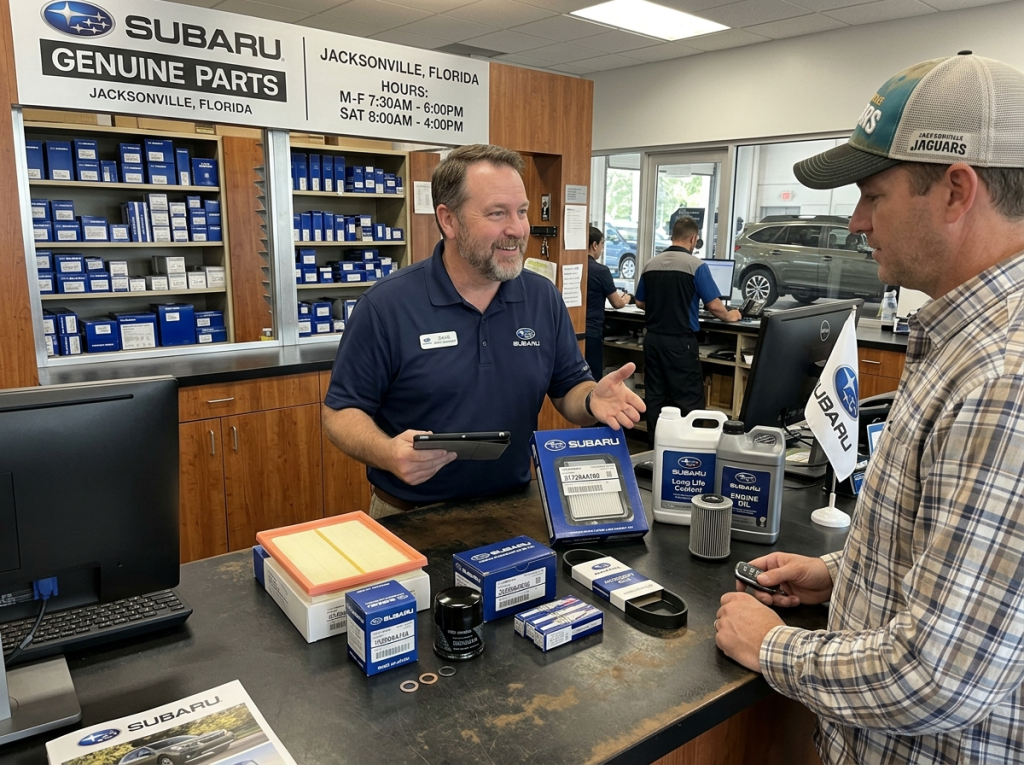
I often see people trying to save money by ordering parts from unverified websites, only to bring them to us when they realize the part doesn’t fit. Identifying a real component is usually pretty straightforward if you know what to look for. Genuine Subaru Parts will always come in branded packaging with a specific part number sticker that includes a barcode. Most of these components are stamped with the Subaru logo directly on the metal or plastic, and you’ll often see “Made in Japan” or “Made in USA” labels depending on the specific item.
Another hallmark of the real deal is the minimum 12 month manufacturer’s warranty that comes with the part. If you buy a “universal” part online and it fails in three months, you’re often stuck buying a second one. When we pull a part for a 2026 Subaru Crosstrek, we verify it against your VIN to ensure the fitment is guaranteed. This is critical for things like All-Weather Floor Liners or Splash Guards, which are custom-molded to the exact contours of the floorboards and wheel wells.
If you are looking at the accessories in our new Outback inventory, you can see the difference in how these items integrate with the vehicle. From the Auto-Dimming Mirror with Compass and HomeLink to the LED Upgrade, factory accessories don’t require “hacking” into the wiring harness. They use plug-and-play connectors designed for your specific model year, which prevents the electrical gremlins that often follow aftermarket installations.
Why Professional Installation Safeguards Your Subaru Investment
Subaru vehicles are known for having 96% of models sold in the last 10 years still on the road, and a big part of that longevity is how they are maintained. Our factory-trained technicians spend hundreds of hours learning the specific nuances of the CVT and the EyeSight systems. When we install a part, we aren’t just bolting it on; we’re ensuring it meets the factory torque specs and is properly calibrated to the vehicle’s computer. This level of detail is what keeps your 3 years / 36,000 miles basic warranty and roadside assistance protections fully intact.
We also offer benefits you won’t find at a generic repair shop, like our 24-Month Tire Protection Plan. This comes free with any tire purchase and covers replacement or repair, plus it includes complimentary roadside assistance. Whether you’re driving a 2026 Subaru Ascent with the 2.4L H4 engine or a smaller crossover, having that peace of mind on the road is invaluable. Using specialized tools and having a direct line to factory technical support allows us to get the job done right the first time.
If you’re ready to experience the difference that expert care makes, you can find our Jacksonville location for a visit. You can also reach our parts and service experts at (904) 906-1235 to discuss your maintenance needs. If you’re looking for a vehicle with enough room for the whole family and the reliability to match, I highly recommend checking out our new Ascent inventory. We’re here to help you keep your Subaru performing at its best for all the miles ahead.
© 2026 Hanania Subaru. All rights reserved.
Connect with us


- Automotive Partnerships & Collaborations
- Buying & Leasing
- Buying Guides
- Community & Outreach Initiatives
- Event Highlights & Celebrations
- Family Vehicles
- Hanania Subaru of Orange Park Service
- Jacksonville Subaru Dealer
- Jacksonville Subaru Service
- Local Dealership News & Activities
- Local Living
- Local Ownership Tips
- Maintenance & Service
- Model Comparisons
- Model Research
- New Vehicle Reviews
- Off-Road Adventures
- Outdoor Lifestyle
- Ownership
- Ownership & Service
- Pet-Friendly Vehicle Features
- Safety Features
- Safety Recall
- Service & Maintenance
- Subaru Care & Maintenance
- Subaru Models
- Subaru Ownership
- Subaru Technology
- Technology & Innovation
- Trade in
- Uncategorized
- Vehicle Comparisons
- Vehicle Guides
- Vehicle Research
- Vehicle Safety
Categories