Hanania Subaru of Orange Park

Blog / Buying Guides

Evaluating Jacksonville’s EV Charging Network for the 2026 Subaru Solterra

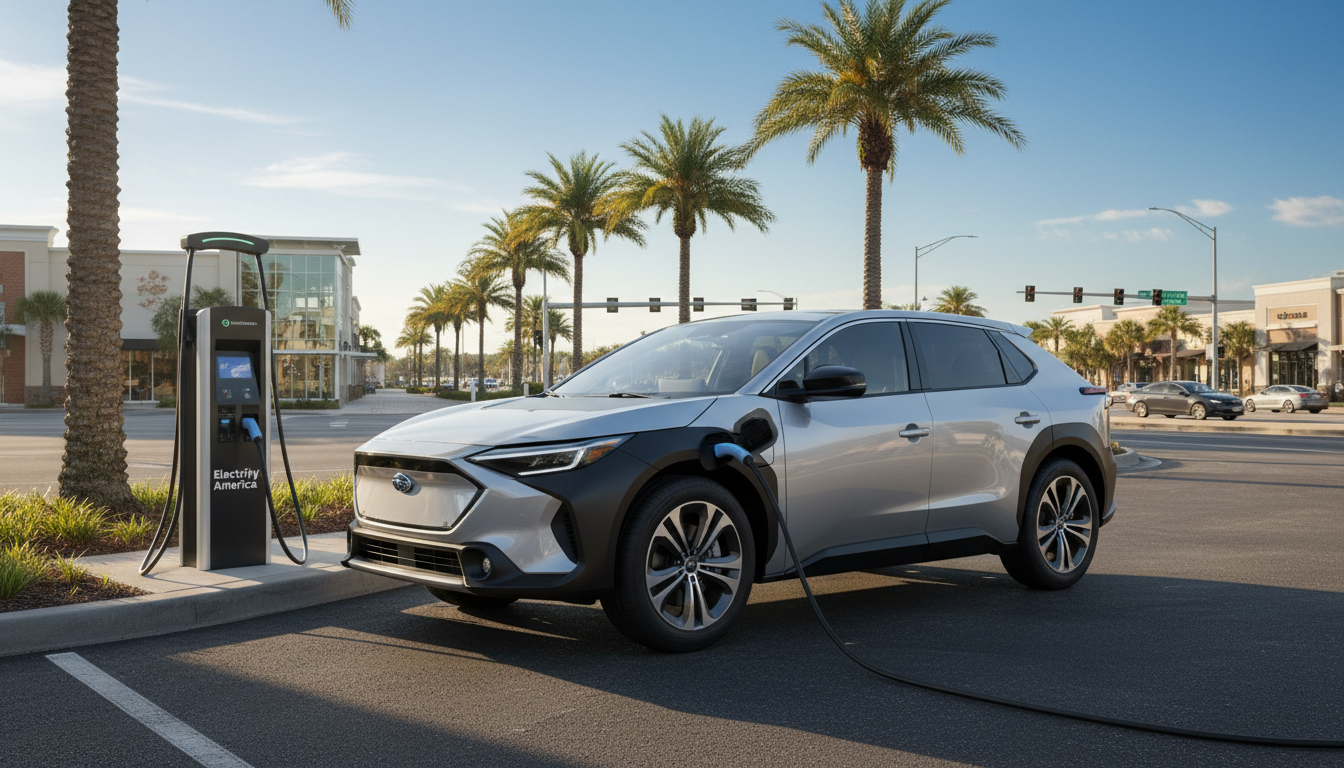
AI generated: A sleek, metallic silver 2026 Subaru Solterra electric SUV is prominently parked and actively charging at a state-of-the-art Electrify America DC fast charging station in a bustling commercial hub of Jacksonville, Florida, its charging cable clearly connected, bathed in warm, bright la

As electric vehicles (EVs) steadily gain traction across the United States, Jacksonville’s evolving charging infrastructure plays a pivotal role in supporting the growing number of EV owners. The 2026 Subaru Solterra, Subaru's latest fully electric SUV, arrives with promising range and performance, but its real-world usability hinges on the availability and convenience of charging stations throughout the Jacksonville area. For prospective Solterra buyers in communities like Orange Park and Neptune Beach, understanding how well Jacksonville’s charging network aligns with the vehicle's capabilities is essential to making a confident transition to electric driving.

Jacksonville’s charging network is a mix of public and private stations featuring Level 2 chargers and DC fast chargers, strategically scattered across key commercial hubs, shopping centers, and highway corridors. The city benefits from several major charging providers, including Electrify America and ChargePoint, which operate stations capable of delivering up to 150 kW of DC fast charging. This capacity aligns well with the 2026 Solterra’s upgraded charging capabilities, which include a peak DC fast charge rate of 150 kW—allowing the vehicle to recharge its battery to approximately 80% in about 30 minutes under optimal conditions. This rapid charging capability is critical for drivers in Jacksonville who may need convenient charging sessions during weekend trips to Ponte Vedra Beach or commuting from Middleburg.

However, challenges remain in Jacksonville’s EV charging landscape, especially when considering coverage density. While urban areas like Jacksonville Beach offer relatively robust access, suburban and outlying regions may present gaps that require some degree of planning. For Solterra owners living in Neptune Beach or Orange Park, where daily commutes and errands largely revolve around local errands and family activities, Level 2 chargers spread throughout shopping districts and workplaces provide sufficient opportunity to maintain battery levels for typical driving needs. Yet, longer highway journeys heading toward St. Marys or Kingsland necessitate reliance on DC fast chargers, which are fewer and often clustered near major interchanges.

Another factor favoring Solterra owners is the vehicle’s adoption of the North American Charging Standard (NACS) port—a recent industry shift that enables compatibility with Tesla Superchargers. Jacksonville hosts several Tesla Supercharger locations, broadening the Solterra’s access to fast charging beyond traditional CCS and CHAdeMO networks. This compatibility enhances the vehicle’s practicality for those venturing beyond city limits, providing more options and reducing range anxiety significantly.

Still, potential Solterra drivers should remain mindful of local challenges such as charger availability during peak times, the occasional lack of maintenance at public stations, and the need for ongoing infrastructure expansion to keep pace with growing EV adoption. The City of Jacksonville and regional utility companies have initiated programs to expand public charging networks, but the pace of development will be a determining factor in how seamless daily EV use becomes.

For residents considering the Solterra in Jacksonville’s suburban neighborhoods, pairing the vehicle’s capabilities with home charging solutions can mitigate many public network limitations. Installing a Level 2 home charger offers convenience and peace of mind, ensuring that daily driving needs are met without frequent public stops. Given Jacksonville’s mix of suburban homes and condos, this is a practical approach for many families and professionals.

As the 2026 Subaru Solterra blends Subaru’s hallmark all-wheel-drive confidence with electric efficiency, Jacksonville’s charging network presents both opportunities and considerations for local drivers. Its compatibility with fast chargers, expanding public infrastructure, and home charging options collectively support a smooth transition to electric driving. Prospective buyers in the Jacksonville area are encouraged to weigh these factors carefully as they explore the Solterra’s potential to meet their commuting and adventure needs. To further assist in this transition,please visit New Subaru Inventory at 6400 Blanding Blvd, Jacksonville, FL 32244 or call us at (904) 906-1235 to learn more.

Table of Contents

Unpacking the 2026 Subaru Solterra: Range, Performance, and Specs

The 2026 Subaru Solterra stands out as a compelling choice for Jacksonville drivers seeking a reliable, all-electric SUV that balances everyday practicality with environmental responsibility. Its estimated range varies between 222 to 288 miles depending on the trim, making it well-suited for both urban commutes and weekend escapes to nearby Ponte Vedra Beach or Neptune Beach. The model’s dual-motor all-wheel drive comes standard, delivering confident traction for the region’s sometimes unpredictable weather patterns.

In terms of power, the base trims offer 233 horsepower, while the new XT variant boosts output to a spirited 338 horsepower. This enhancement makes the Solterra one of Subaru's quickest models, sprinting from 0 to 60 mph in as little as 4.3 seconds on the XT trim. While not the most thrilling EV in its class, this power increase provides ample performance for merging on busy Jacksonville highways or navigating the rolling terrain near Orange Park.

Battery capacity is modest but efficient, with a 75 kWh liquid-cooled lithium-ion pack that supports a peak DC fast-charging rate of 150 kW. This means the Solterra can recharge from 10% to 80% in approximately 30 to 40 minutes at compatible stations, a practical feature for Jacksonville residents venturing beyond city limits. Additionally, the Solterra now features the North American Charging Standard (NACS), enabling compatibility with Tesla Superchargers—a significant convenience given the expanding charging infrastructure in Northeast Florida.

Inside, the cabin offers a spacious and user-friendly environment highlighted by a 14-inch touchscreen infotainment system supporting Apple CarPlay and Android Auto. The interior design includes a wider center console with dual wireless charging pads, although taller drivers might find the console a bit snug. Cargo space is competitive, offering 24 cubic feet behind the rear seats and expanding to 64 cubic feet when folded, ample for beach gear or grocery runs from Jacksonville's local markets.

For those interested in exploring the 2026 Solterra firsthand or browsing other Subaru models like the New Outback Inventory or New CrossTrek Inventory, Hanania Subaru invites you to visit our dealership at 6400 Blanding Blvd, Jacksonville, FL 32244 or call us at (904) 906-1235 to schedule your personalized test drive today.

Comparing the 2026 Solterra with the Ford Mustang Mach-E: Which EV Fits Jacksonville Best?

When evaluating electric vehicles for Jacksonville’s suburban lifestyle, the 2026 Subaru Solterra and Ford Mustang Mach-E stand out as strong contenders, each with distinct advantages tailored to different driver priorities. The Solterra’s dual-motor all-wheel-drive system and 8.3 inches of ground clearance make it well-suited for Jacksonville residents who appreciate versatility, whether navigating the city streets or venturing onto sandy trails near Ponte Vedra Beach. Its standard AWD and Subaru’s signature X-MODE technology provide confident traction in varied conditions, a valuable feature for those facing occasional wet roads or light off-road excursions.

In contrast, the Mustang Mach-E offers a sportier driving experience with higher horsepower—up to 370 hp in its Premium AWD Extended Range variant—and a longer EPA-rated range of approximately 300 miles. This makes the Mach-E appealing for Jacksonville commuters who prioritize acceleration and extended highway travel, such as professionals driving between Orange Park and downtown. However, Mach-E’s focus on performance and range sometimes comes at the cost of off-road capability and cargo flexibility.

Charging infrastructure compatibility is another consideration. The Solterra embraces the North American Charging Standard (NACS), enabling access to Tesla Superchargers, which are increasingly common in the Jacksonville area. This compatibility simplifies long-distance travel and reduces charging wait times, a practical benefit for owners traveling to nearby cities like Neptune Beach. The Mach-E uses the Combined Charging System (CCS), which also enjoys broad support but lacks Tesla’s unique network advantage.

For suburban families or individuals valuing dependable all-weather performance and moderate cargo space, the Solterra’s balance between utility and electric efficiency is compelling. Meanwhile, those prioritizing longer range and sportier handling might find the Mach-E more aligned with their needs.

To explore the 2026 Subaru Solterra and compare it directly with other models, visit Hanania Subaru’s New Subaru Inventory at 6400 Blanding Blvd, Jacksonville, FL 32244, browse our Certified Pre-Owned Inventory and Genuine Subaru Parts, or schedule your service appointment

Maximizing Your Electric Experience: Home Charger Installation Costs and Incentives in Jacksonville

For Jacksonville residents investing in the 2026 Subaru Solterra, installing a home Level 2 charger is an essential step to fully enjoy the convenience of electric driving. Unlike relying solely on public chargers, a dedicated home charging station offers faster, more reliable charging—typically adding 25 to 40 miles of range per hour. However, understanding the installation costs and available incentives is key to making a smart, affordable transition.

Home charger installation costs in Jacksonville generally range between $1,000 and $3,500. This includes equipment, labor, permits, and any necessary electrical upgrades. Equipment prices for Level 2 chargers typically fall between $350 and $1,200, depending on the brand and features such as smart controls or solar integration. Labor costs vary based on the complexity of wiring and distance from the electrical panel, with rates commonly between $125 and $200 per hour. Permit fees, which ensure compliance with local safety codes, range from $50 to $300.

Jacksonville homeowners may also encounter additional expenses if their electrical panel needs upgrading to support the charger’s power demand, which can add $2,000 or more to the project. For properties with detached garages or long cable runs, trenching and conduit installation can increase costs further.

Fortunately, 2026 brings several incentives to ease the financial impact. The federal Alternative Fuel Vehicle Refueling Property Credit can cover up to 30% of hardware and installation costs, capped at $1,000, though eligibility depends on location specifics within Florida. Local utility providers often offer rebates ranging from $200 to $500 for home charger installations or off-peak charging programs, helping Jacksonville drivers reduce costs.

Planning ahead is crucial. Partnering with licensed electricians experienced in EV charger installations guarantees compliance, safety, and warranty protection. For those considering a new Subaru Solterra, applying for financing through Hanania Subaru’s Apply for Financing can simplify budgeting for both the vehicle and charger installation. Additionally, if you’re thinking about trading in your current vehicle, use our Get Trade Value tool to understand your options.

By investing wisely in home charging infrastructure, Jacksonville Solterra owners can enjoy the full benefits of electric driving with minimal hassle and maximum convenience. For expert advice or to schedule your installation consultation, visit Hanania Subaru at 6400 Blanding Blvd, Jacksonville, FL 32244 or call us at (904) 906-1235 to learn more.


© 2026 Hanania Subaru. All rights reserved.
Posted in:

Related Posts

Interior view of a driver steering a Subaru WRX with manual transmission on a winding mountain road. (Representative image for illustration purposes only. Actual vehicle may vary based on trim and configuration.)

Analyzing the Evolution of Three-Pedal Performance in the Modern Subaru Lineup

The automotive landscape has shifted dramatically over the last decade, with automatic gearboxes and continuously variable transmissions replacing traditional manual setups in almost every vehicle segment. For drivers who value the mechanical connection of a third pedal, it often feels like options are disappearing entirely. We recognize this shifting tide at Hanania Subaru, where we help performance enthusiasts find vehicles that match their driving style. Subaru has consolidated its manual transmission strategy to focus purely on dedicated sports cars. While the brand discontinued the manual option in the Impreza after the 2023 model year, leaving the modern Sport and RS trims equipped exclusively with the Lineartronic CVT, the dedication to three-pedal performance remains alive in the brand's engineering division. To support this enthusiast community, the newly formed Sports Vehicle Planning Office in Japan is actively researching ways to expand performance offerings. This specialized team is exploring heavy-duty manual gearboxes, such as the legendary TY85 design, which is capable of managing over 440 lb-ft of torque and supporting higher horsepower outputs than standard automatic options. Drivers who want to explore these performance developments can browse our new Subaru inventory online or view our new Subaru performance inventory to see the latest arrivals. For those who want to discuss upcoming performance options with our knowledgeable team, please give us a quick call or visit our physical showroom at 6400 Blanding Blvd to experience our lineup firsthand. Table of Contents The Remaining Three-Pedal Champions: Demystifying the Manual Options in the WRX and BRZ Deciding Between the Turbocharged WRX and the Agile BRZ for Your Daily Commute Comparing the Performance Dynamics of Subaru and Mazda Manual Gearboxes Protecting Your Investment: Gear Oil Maintenance, Powertrain Warranties, and Resale Value Quick Answers to Common Manual Subaru Questions Taking the Next Step Toward Your Three-Pedal Subaru Adventure The Remaining Three-Pedal Champions: Demystifying the Manual Options in the WRX and BRZ For driving enthusiasts who still want to operate a clutch pedal, the current lineup features two dedicated performance models. The first is the rear-wheel-drive BRZ, which provides a classic sports car layout. Every manual-equipped BRZ features a 2.4L Subaru BOXER engine that delivers 228 hp and 184 lb-ft of torque. This powertrain is standard on the Limited trim, which starts at $35,860, the track-focused tS trim at $38,360 with its STI-tuned suspension and Brembo high-performance braking system, and the exclusive Series Yellow special edition at $39,360. For a weekend cruise past the scenic golf courses and coastal dunes of Ponte Vedra Beach, the lightweight, rear-wheel-drive BRZ offers pure sports car dynamics. The second option is the turbocharged WRX, which pairs engaging performance with everyday utility. The WRX utilizes standard Symmetrical All-Wheel Drive and a 2.4-liter turbocharged BOXER engine generating 271 hp and 258 lb-ft of torque. A 6-speed manual transmission is standard on the Base, Premium, Limited, and tS trims, as well as the limited-production Series Yellow trim. The high-end GT trim is configured exclusively with the Subaru Performance Transmission for drivers who prefer rapid automatic shifting. If you are looking for a high-quality used model, you can explore our used car inventory, or if you require a larger family vehicle, you can browse our new Outback inventory to find the perfect fit for your household. Engine & Performance Powertrain specs by trim Feature Limited Series Yellow tS Engine 2.4L 2.4L 2.4L Horsepower 228 hp 228 hp 228 hp Torque 184 lb-ft 184 lb-ft 184 lb-ft Transmission 6-speed manual 6-speed manual 6-speed manual Drivetrain Rear-wheel drive Rear-wheel drive Rear-wheel drive ​ Deciding Between the Turbocharged WRX and the Agile BRZ for Your Daily Commute Selecting the ideal daily driver requires balancing raw performance with everyday comfort and cargo space. The WRX serves as a highly versatile four-door sedan, offering comfortable seating for five passengers and a trunk with about 13 cubic feet of cargo space. This practical layout makes it easy to load groceries or sports gear while maintaining a spirited drive. Commuters driving from Yulee down US Highway 17 appreciate the WRX's secure traction and turbocharged acceleration during heavy rainstorms. The manual WRX is rated at 19 mpg city and 26 mpg highway, making it a viable commuter that handles wet pavement with ease. In contrast, the BRZ is designed for drivers who prioritize lightweight agility and cornering precision. This two-door coupe features a low center of gravity, highly bolstered front seats, and about 6 cubic feet of trunk space, which can be expanded by folding down the rear seatback. The manual BRZ achieves an EPA-estimated 20 mpg city and 27 mpg highway, offering efficient performance for spirited weekend drives. While the BRZ delivers an incredibly engaging driving experience, its compact dimensions and rear-wheel-drive setup make it a more specialized choice compared to the all-weather capability of the WRX. Drivers looking to customize their performance vehicles can order genuine Subaru parts through our department, while those who need maximum passenger capacity can look at our new Ascent inventory to accommodate up to eight passengers. Fuel Economy Fuel economy and range by trim Feature Limited Series.Yellow tS MPG 20 city / 27 hwy / 22 combined 20 city / 27 hwy / 22 combined 20 city / 27 hwy / 22 combined ​ Comparing the Performance Dynamics of Subaru and Mazda Manual Gearboxes Comparing manual performance cars often leads enthusiasts to contrast the engineering philosophies of different Japanese brands. The BRZ competes directly with the Mazda MX-5 Miata, but it offers a distinct set of advantages. While the manual Miata starts at $31,665 and produces 181 hp from its 2.0-liter engine, the manual BRZ Limited starts at $35,860 and delivers 228 hp from its 2.4L Subaru BOXER engine. Additionally, the BRZ features a standard rear seat and a more stable wheelbase, providing a level of daily usability that the strict two-seat Miata layout cannot match. When comparing the WRX to Mazda's current manual offerings, the contrast is even more pronounced. Mazda restricts its manual gearbox to the front-wheel-drive Mazda3 hatchback, which starts at $38,225 in its premium manual trim. The WRX provides a standard 6-speed manual transmission paired with standard Symmetrical All-Wheel Drive and a 2.4-liter turbocharged BOXER engine that produces 271 hp. This easily surpasses the Mazda3's naturally aspirated 2.5-liter engine, which generates 191 hp and lacks the all-weather grip of standard all-wheel drive. Enthusiasts who want to secure their next performance car can apply for financing online to streamline the process, or they can browse our certified pre-owned Subaru inventory to find factory-backed manual models. ​ Protecting Your Investment: Gear Oil Maintenance, Powertrain Warranties, and Resale Value Proper maintenance is the foundation of long-term sports car reliability, especially in hot climates. Subaru recommends inspecting the manual transmission gear oil every 30,000 miles or 30 months, with a complete fluid replacement typically suggested between 30,000 and 60,000 miles depending on driving habits and environmental conditions. Keeping fresh gear oil in the manual transmission prevents premature wear on the syncros and gears, ensuring smooth shifts during high-temperature summer drives. When performance enthusiasts visit our finance desk to custom-order a manual sports car, they often ask if a deposit is required to secure the build from the factory. At Hanania Subaru, please contact us for current custom factory order and deposit details. Protecting your investment also involves understanding your warranty coverage. The five-year or 60,000-mile powertrain warranty covers the internal mechanical components of the manual transmission, including the gears, shafts, and bearings. However, traditional wear items like the clutch disc, pressure plate, and throwout bearing are covered under the three-year or 36,000-mile Subaru Limited Warranty. Because manual-equipped sports cars are increasingly rare, well-maintained models tend to hold their resale value exceptionally well. To prepare for your upgrade, you can evaluate your trade-in value online, and then schedule an appointment with our authorized Subaru service center to keep your current vehicle in top condition. If you decide that a utility-focused vehicle is a better fit for your lifestyle, you can also explore our new Forester inventory to find a spacious, all-road crossover. Pricing Pricing by trim Feature Limited Series.Yellow tS Base MSRP $35,860 $39,360 $38,360 Destination charge $1,195 $1,195 $1,195 ​ Quick Answers to Common Manual Subaru Questions Navigating the options and maintenance requirements of a performance vehicle often brings up specific questions for prospective buyers. If you are also considering other versatile options in our lineup, you can browse our new Crosstrek inventory to compare different utility setups. Q: Does the Subaru WRX still offer a manual transmission? Yes, the WRX remains highly committed to three-pedal driving. The 6-speed manual transmission comes standard on the Base, Premium, Limited, and tS trims, as well as the limited-run Series.Yellow edition. Only the GT trim is restricted to an automatic transmission. Q: How does Subaru's EyeSight driver assist technology work with manual transmissions? The advanced safety suite has been carefully engineered to integrate with manual gearboxes. The system utilizes standard features like automated emergency braking, lane-keeping assist, and adaptive cruise control while allowing the driver to depress the clutch pedal during safety interventions without stalling the engine. Q: What is the 0-60 mph time of the manual Subaru WRX? The manual WRX accelerates from 0 to 60 mph in approximately 5.6 seconds. This sprint showcase highlights the immediate power delivery of the turbocharged flat-four engine when paired with a precise manual gearbox. Q: Is Subaru planning any new manual models beyond the current lineup? While mainstream models have transitioned to CVT-only configurations, Subaru continues to support performance-oriented vehicles for driving enthusiasts in the future. Q: What is the price difference between a manual and automatic Subaru BRZ? The manual transmission serves as the standard configuration for the BRZ, representing the purest driving setup. Opting for the six-speed automatic transmission may increase the vehicle's MSRP, depending on the chosen trim level. ​ Taking the Next Step Toward Your Three-Pedal Subaru Adventure Finding the perfect sports car comes down to experiencing the mechanical connection firsthand on the road. At Hanania Subaru, we are dedicated to helping you find a vehicle that brings excitement back to your daily driving. Every new vehicle purchase from our dealership is supported by our team, and current warranty and maintenance details are available upon request. Additionally, every new vehicle is backed by the comprehensive three-year or 36,000-mile Subaru Limited Warranty, which includes access to 24-hour emergency assistance. If you ever experience a flat tire, dead battery, or require emergency towing, you can call Subaru Roadside Assistance: 1-800-261-2155 for manufacturer-backed support utilizing brand-specific expertise and genuine OEM parts. Our team is ready to assist you with every phase of your automotive journey, from initial research to long-term care. You can schedule a service appointment online to keep your current vehicle running smoothly, or you can contact our sales team at (904) 906-1235 to discuss our current performance options. When you are ready to take a test drive, visit our physical showroom at 6400 Blanding Blvd to explore our inventory and meet our dedicated team of automotive experts. © 2026 Hanania Subaru. All rights reserved.
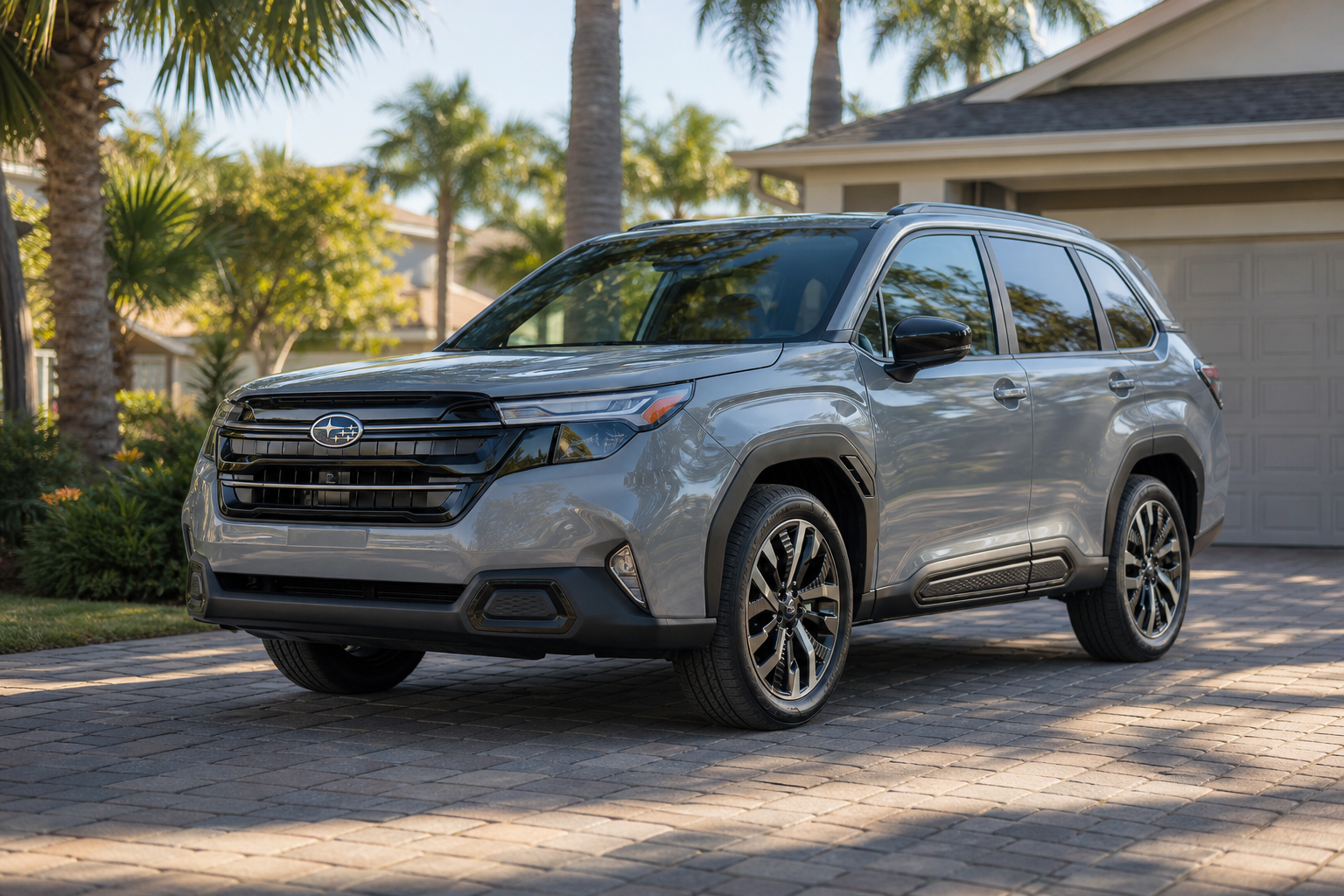
Unbadged SUV parked on a sunlit coastal road near a Jacksonville beach access point on a summer day

Subaru Touring vs Limited Trim: What You Actually Get

When you're shopping a Subaru at the top of the lineup, the choice usually comes down to the Limited and the Touring. Both are loaded compared to the base trims, but the gap between them is smaller than a lot of shoppers expect. Here's an honest look at what actually changes when you step up, so you can decide whether the Touring is worth it for how you drive around Jacksonville. What is the difference between Subaru Touring and Limited trims? The Limited is the leather-and-tech sweet spot: heated seats, upgraded audio, and driver aids. The Touring sits above it with finishing touches like ventilated front seats, a Harman Kardon audio system on several models, unique wheels, and premium interior trim. Mechanically the two are nearly identical; the differences are comfort and cosmetics. Which Subaru trim gives you the most for your money? For most Jacksonville drivers, the Limited delivers the strongest value because it already includes leather-trimmed upholstery, heated front seats, and the full EyeSight suite. The Touring earns its price if you want ventilated seats for summer, a premium sound system, and the nicer cabin materials. If you commute long and love comfort, the step up pays off. Limited highlights: Leather-trimmed seating, heated front seats, power liftgate on SUVs, upgraded infotainment, and the full EyeSight driver-assist package. Touring adds: Ventilated front seats, Harman Kardon premium audio on many models, Nappa or premium leather accents, exclusive wheel finishes, and heated rear seats or steering wheel depending on the model. Ventilated seats deserve a mention here in Florida. On a July afternoon when the cabin bakes, cooled seats are one of those features you use every single drive, not once a year. Is the Subaru Touring worth it in Jacksonville's climate? If your daily reality includes long hot commutes on I-295 or beach trips down to Ponte Vedra, the Touring's ventilated seats and premium climate touches genuinely earn their keep. If you rarely sit in traffic and don't care about the audio upgrade, the Limited covers almost everything you'd use day to day. It really comes down to comfort priorities. Feature Limited Touring Leather-trimmed seats Yes Yes (premium accents) Heated front seats Yes Yes Ventilated front seats No Yes Premium audio (Harman Kardon) Optional/No Standard on many models EyeSight driver assist Yes Yes Exclusive wheels/trim No Yes Availability of specific features varies by model line and by model year, so confirm the exact 2026 equipment on the trim you're considering before you decide. How much more does the Touring cost over the Limited? The jump is typically a few thousand dollars depending on the model line and model year. Exact pricing on a 2026 Subaru Outback Touring versus a 2026 Subaru Outback Limited, for example, changes with equipment and current incentives, so we'd rather show you real numbers on the specific vehicle than quote a figure that won't match the window sticker. According to Experian's State of the Automotive Finance Market, the average new-vehicle monthly payment recently topped 700 dollars, which is exactly why the trim decision matters. A modest jump in price can move your payment by 30 to 50 dollars a month over a typical loan term, so it's worth deciding whether the Touring features fit your budget and how you actually use the car. The best move is to sit in both trims and feel the difference. The materials, the seat comfort, and the audio are the kind of things a spec sheet can't fully convey. Stop by Hanania Subaru of Orange Park and we'll walk you through the exact equipment and pricing on the model year you want, no surprises at the counter.

An unbadged crossover parked at a sunny Florida beach access lot with palm trees and clear skies overhead

Best Used Subaru Models to Buy in Florida

Florida throws a specific set of challenges at any used car: relentless heat, salt air near the coast, flooding roads in hurricane season, and stop-and-go traffic on I-95. The good news is that several used Subaru models handle all of it well and hold their value while doing it. Here is our honest read on which ones make the most sense for Jacksonville drivers, and what to look at before you sign. Which used Subaru models hold up best in Florida heat and humidity? For Florida conditions, the Outback, Forester, and Crosstrek are the standouts. All three run Subaru's naturally aspirated 2.0L or 2.5L boxer engines that tolerate heat well, ride high enough to clear standing water, and have simple, durable cabins that shrug off humidity. The Legacy and Impreza are strong value picks too. Subaru Outback (2015 and newer) — roomy, comfortable, and easy to find in clean condition. Subaru Forester (2014 and newer) — tall glass, great visibility, and cargo room for beach and errand runs. Subaru Crosstrek (2018 and newer) — compact, fuel-friendly, and ideal for tight downtown parking. Subaru Legacy (2015 and newer) — the sedan option, often priced below the SUVs. Subaru Impreza (2017 and newer) — the budget entry point with standard all-wheel drive. Do you really need all-wheel drive in flat Florida? Yes, more than you'd think. Nearly every Subaru comes with symmetrical all-wheel drive standard, and that traction matters most during Florida's sudden downpours and slick summer roads, not snow. It also helps on soft sand near coastal access points and pays off at resale, since buyers here specifically look for it. Florida sees a lot of wet pavement. According to the National Weather Service, Jacksonville averages roughly 52 inches of rain per year, much of it in short, heavy afternoon storms between June and September. That constant traction demand is exactly where a Subaru's all-wheel-drive system earns its keep compared with a front-wheel-drive competitor. What should you check before buying a used Subaru in Florida? Focus on four areas: the head gasket history on older 2.5L engines, the CVT transmission behavior, any rust underneath on coastal cars, and the air conditioning. A used Subaru that shifts smoothly, blows cold air, and has clean service records is usually a safe bet. Always get a pre-purchase inspection. Check Why it matters in Florida A/C performance Non-negotiable in the heat; repairs add up fast. CVT operation Should feel smooth with no shudder; confirm fluid service history. Undercarriage rust Coastal salt air can corrode components on neglected cars. Head gaskets (older 2.5L) Ask about repairs on pre-2013 engines; heat accelerates wear. Tire condition All-wheel drive needs matched tires with even wear. Which used Subaru gives the best value for the money? For most Jacksonville shoppers, a certified pre-owned Forester or Outback from the 2018 to 2021 model years hits the sweet spot. They pair modern safety tech and the EyeSight driver-assist system with prices well below new. If your budget is tighter, a well-kept Impreza or Crosstrek delivers the same all-wheel drive for less. Certified pre-owned models also carry an extended factory-backed warranty, which takes some of the guesswork out of buying used. When you stop by Hanania Subaru of Orange Park, we'll walk you through the inspection records and pricing on each specific model year and trim so there are no surprises at the counter. How many miles is too many on a used Subaru? A properly maintained Subaru with 100,000 to 150,000 miles can still have plenty of life left, especially the newer CVT-equipped models. What matters more than the odometer is documented maintenance: regular oil changes, CVT fluid service, and no history of overheating. A low-mileage car with gaps in service can be a bigger risk. Ask for the maintenance history and match it against the recommended service intervals. A car that's had consistent care at 120,000 miles is often a smarter buy than a neglected one at 70,000.