

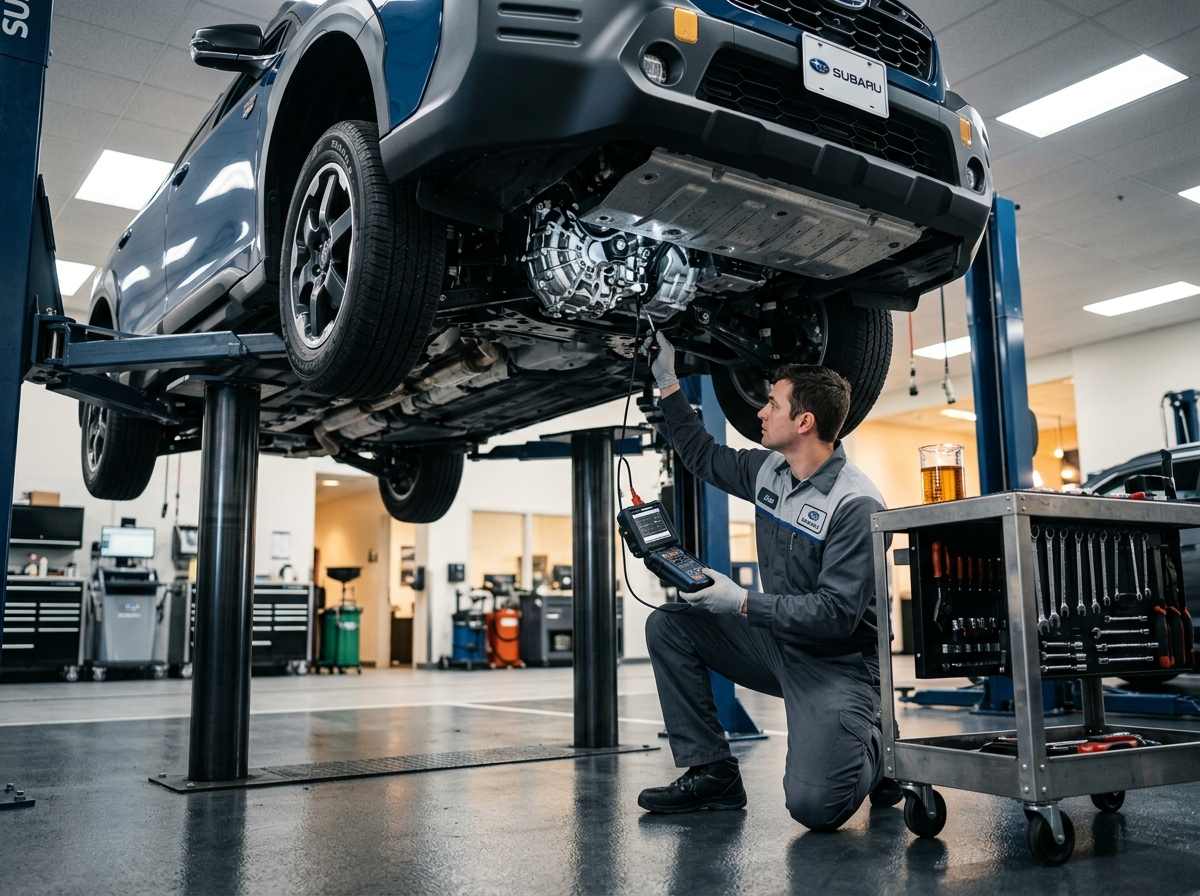
Today, we are sitting down with Daniel Renfroe, a dedicated Service Advisor at Hanania Subaru with 5 years of experience helping local drivers maintain their vehicles. Transmission care is one of the most discussed topics in our service bays, particularly regarding the specialized Lineartronic systems found in modern models. In this interview, Daniel provides professional clarity on service intervals, the reality of lifetime fluids, and how to protect the long-term reliability of your drivetrain. Readers will gain a comprehensive understanding of when to schedule maintenance and why specific fluid requirements are critical for Subaru performance.
Q: Daniel, the question we hear most often from owners is simply how frequently they actually need to change the CVT oil in their Subaru.
A: That is a great starting point because there is often a bit of a gap between what you see in a standard maintenance booklet and what we recommend for long-term durability. For most late-model vehicles like the 2026 Subaru Crosstrek, the official manufacturer guidance lists the fluid as an inspection-only item under normal driving conditions. This means our technicians will check the level and clarity during your regular intervals, but there isn’t a hard requirement to swap it out at a specific mileage if you are just doing light commuting. However, if you want to be proactive about the health of your CVT, many enthusiasts and technicians suggest a service every 60,000 miles to ensure the additives in the lubricant remain effective.
For those driving a vehicle from our new Subaru performance inventory or a standard crossover, the Lineartronic CVT relies on very specific hydraulic pressures and friction coefficients. If you are ever unsure about the current state of your transmission, you can always visit our Subaru Service Center for a professional evaluation. We can pull a sample and see if there is any evidence of thermal breakdown or contamination that would warrant an early change. If you are ready to stop by, our Jacksonville location is easy to find on Blanding Blvd, or you can give our team a quick call to discuss your specific model year and mileage.
Q: There is a lot of talk about “lifetime fluid” in modern transmissions. Does Subaru actually consider the CVT fluid in a 2024 or 2026 model to be a permanent part of the car?
A: The term lifetime fluid is one of the most misunderstood labels in the automotive world today. When a manufacturer uses that phrasing, they are generally referring to the anticipated life of the vehicle under ideal circumstances, which is often defined by the 5 years / 60,000 miles powertrain warranty period. In the technical literature, you will see it described as a long-life fluid rather than a permanent one. It is designed to be incredibly robust, but any lubricant will eventually lose its ability to manage heat and protect the metal surfaces inside the transmission case as the years go by.
It is also vital to remember that these systems are highly sensitive to the type of oil used. We exclusively use Subaru Genuine Lineartronic CVT Fluid because it is chemically formulated to work with the specific chain and pulley materials in your drivetrain. Using a generic or incorrect fluid can lead to slippage, shuddering, or even a total mechanical failure that might not be covered under your basic 3 years / 36,000 miles warranty. If you are a DIY enthusiast looking for the correct supplies, our team can help you source genuine Subaru parts to ensure you have exactly what the factory requires for your specific transmission code.
Q: You mentioned “ideal circumstances” earlier, but many people don’t drive in a perfect environment. What counts as severe driving for those of us in Florida?
A: Living in a place like Ponte Vedra Beach brings some specific challenges that move a vehicle into the severe use category. The primary factor here is heat. Our sustained high ambient temperatures during the summer months mean the transmission cooling system is working overtime to keep the CVT within its optimal operating range. If you are frequently sitting in stop-and-go traffic on the way to the coast or driving on sandy coastal roads, the fluid is under much higher thermal stress than it would be in a milder climate. For these drivers, we often recommend a fluid change every 30,000 miles to prevent the oil from oxidizing.
Towing is the other major factor that changes the service schedule. If you use the 2.5L H4 engine in a 2026 Subaru Crosstrek to pull a small trailer or a pair of jet skis, the internal temperatures of the transmission rise significantly. Subaru documentation specifically states that if the vehicle is used for towing, the fluid should be replaced at 30,000-mile intervals. When you are ready for that check-up, it is best to schedule your service appointment online to ensure we have a lift ready for you. We see many owners of our new Crosstrek inventory who love the outdoor lifestyle, and keeping that transmission fresh is the best way to ensure those adventures continue for years.
“The fluid is the lifeblood of the chain-driven system, and while it is engineered for longevity, heat is the ultimate enemy of any lubricant.”
Q: When it comes to the actual service, is a full CVT fluid exchange better than a standard drain and fill?
A: This is a point of debate, but the answer really depends on the history of the vehicle. A standard drain and fill typically replaces about one-third to one-half of the total fluid volume because a significant amount remains trapped in the torque converter and the cooling lines. For a well-maintained 2026 Subaru Forester that has received regular attention, a drain and fill is usually sufficient to refresh the additive package and keep the system clean. It is a less invasive procedure that provides a great balance of cost and protection for the average commuter driving in from Yulee every day.
A full exchange, often performed with a specialized machine, replaces almost the entire volume of fluid. While this sounds superior, it is a more complex process that requires precise temperature monitoring to ensure the fluid level is exactly right. If the level is off by even a small amount, it can cause foaming or pressure issues. Most of the time, we find that regular, consistent drain and fill services are the most reliable way to maintain a vehicle from our new Forester inventory. It keeps the fluid chemistry stable without the risks associated with high-pressure flushes that some independent shops might push.
Q: Why is it so important to use a dealership for this service rather than a local independent mechanic?
A: The main reason is the specialized equipment and training required for the Lineartronic CVT. Unlike an old-school automatic where you just pull a dipstick to check the level, a Subaru transmission requires the fluid to be at a very specific temperature—usually between 95 and 113 degrees Fahrenheit—before the level can be accurately set. Our technicians use the Subaru Select Monitor to read the internal temperature sensors in real-time. If a shop in Orange Park tries to fill the transmission while it is too hot or too cold, the level will be incorrect once the car reaches operating temperature, which can lead to long-term damage.
Furthermore, we have direct access to the latest technical service bulletins and software updates. Sometimes a perceived transmission issue isn’t a mechanical problem at all, but rather a need for a software re-learn or an update to the control logic. When you bring in a vehicle like the 2026 Subaru Outback, we aren’t just changing oil; we are performing a comprehensive health check on the entire drivetrain. Owners of our new Outback inventory appreciate that we use the exact factory-spec high-torque fluid required for the turbocharged models, which is something many independent shops don’t keep in stock.
Q: For those planning their maintenance budget, what should a driver in Jacksonville expect to pay for a CVT fluid service?
A: While prices can vary based on the specific model and the amount of fluid required, a professional CVT service in our region typically ranges from $250 to $450. This covers the cost of the specialized Subaru Genuine Lineartronic CVT Fluid, a new drain plug gasket, and the labor for the precise temperature-sensitive fill process. It is a specialized service, but when you consider that a full transmission replacement can cost several thousand dollars, it is one of the most cost-effective insurance policies you can buy for your vehicle’s longevity.
For larger vehicles like the 2026 Subaru Ascent, which often handle higher passenger loads and more frequent towing, we emphasize that this investment pays off in resale value and reliability. If you are browsing our new Ascent inventory, you will notice that these vehicles are built for the long haul, and maintaining the drivetrain is key to that promise. We always recommend checking our service specials online before you come in, as we frequently offer maintenance packages that can help manage the costs of keeping your Subaru in peak condition.
Q: What are the best practices for a Subaru owner who wants to ensure their transmission lasts well beyond the warranty period?
A: The most important thing is to never ignore the signs of a struggle. If you notice a delay when shifting from Park to Drive, or if you feel a slight “hunting” sensation at highway speeds, bring it in for an inspection immediately. Early intervention is often the difference between a simple fluid adjustment and a major repair. Also, be mindful of the roadside assistance: free and standard for 3 years / 36,000 miles that comes with your new vehicle; if you ever feel a major mechanical issue, it is safer to have the car towed than to risk driving it and causing further internal wear.
Regularly checking for leaks in your driveway is another simple but effective habit. Even a small drop in fluid level can affect the hydraulic pressures needed to keep the CVT belt tight. If you are looking for a vehicle with a proven track record, exploring our Certified Pre-Owned inventory is a great way to find a car that has already passed a rigorous 152-point inspection, including a full transmission check. For more personalized advice, you can visit our Jacksonville showroom or reach out to us at (904) 906-1235 to speak with a service expert about your car’s specific needs.
Maintaining a Subaru transmission requires a blend of following factory guidelines and understanding the unique demands of the Florida climate. As Daniel Renfroe explained, while the fluid is designed for long-term use, proactive inspections and specialized service at a certified dealership are the best ways to ensure your vehicle remains reliable for hundreds of thousands of miles. By choosing genuine parts and expert technicians, you protect the sophisticated engineering that makes your Subaru a leader in safety and performance. If you have questions about your specific maintenance schedule or would like to have your transmission fluid inspected, the team at Hanania Subaru is ready to provide the professional care your vehicle deserves.
© 2026 Hanania Subaru. All rights reserved.
Connect with us


- Automotive Partnerships & Collaborations
- Buying & Leasing
- Buying & Trade-In
- Buying Guide
- Buying Guides
- Community & Outreach Initiatives
- Electric Vehicles
- Event Highlights & Celebrations
- Family Vehicles
- Hanania Subaru of Orange Park Service
- Hybrid & Electric
- Jacksonville Subaru Dealer
- Jacksonville Subaru Service
- Lifestyle
- Local Dealership News & Activities
- Local Living
- Local Ownership Tips
- Maintenance & Service
- Model Comparisons
- Model Research
- New Inventory
- New Vehicle Reviews
- New Vehicles
- Off-Road Adventures
- Outdoor Lifestyle
- Ownership
- Ownership & Service
- Pet-Friendly Vehicle Features
- Safety Features
- Safety Recall
- Service & Maintenance
- Subaru Care & Maintenance
- Subaru Lineup
- Subaru Models
- Subaru Ownership
- Subaru Technology
- Technology & Innovation
- Trade in
- Uncategorized
- Used Vehicles
- Vehicle Comparisons
- Vehicle Features
- Vehicle Guides
- Vehicle Research
- Vehicle Safety
Categories