
Protecting Your Subaru From Florida Salt Air
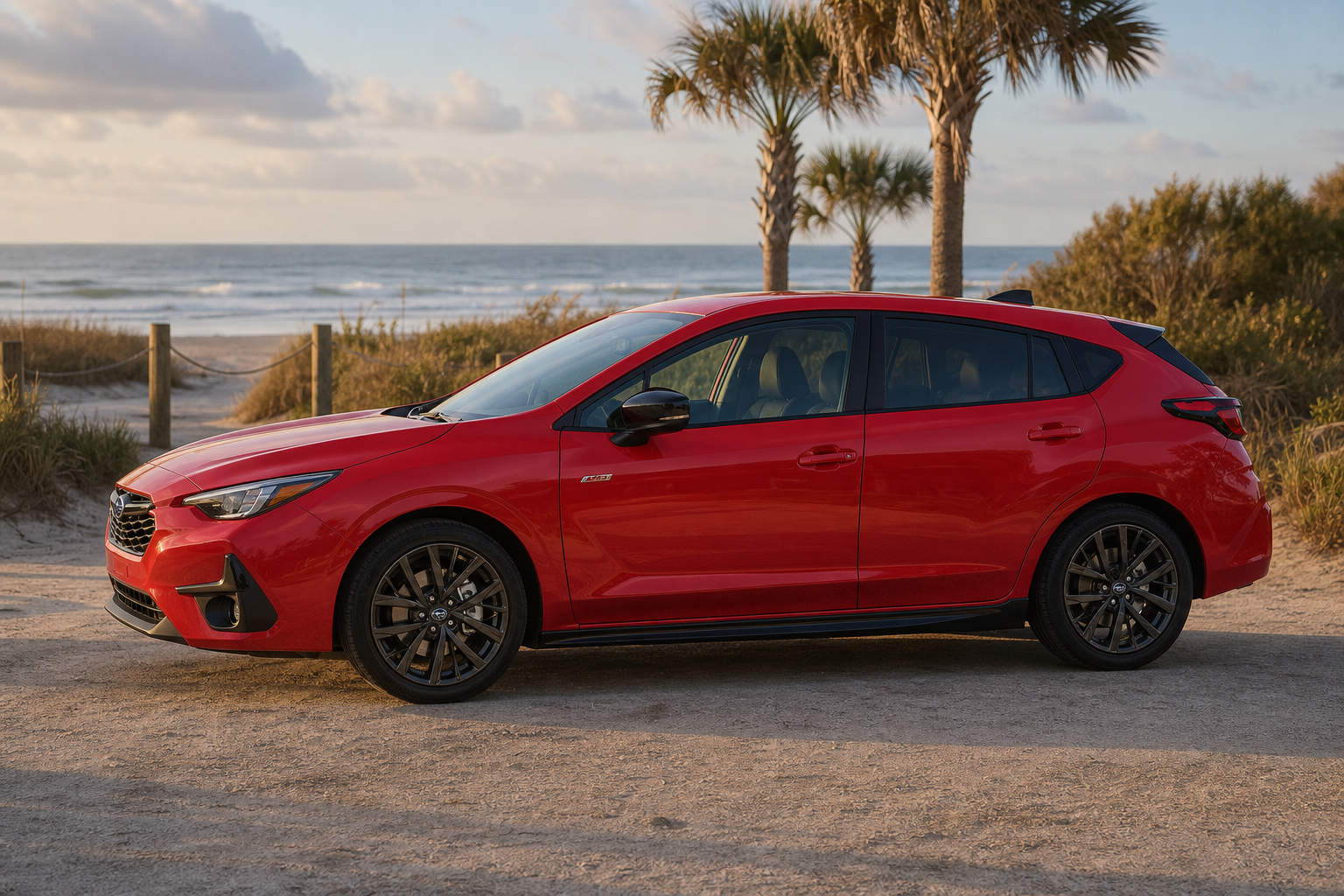
If you live anywhere near the water in Jacksonville, you already know the ocean breeze isn’t free. That salty mist rides inland for miles, settles on your paint, and works its way into every seam and bolt on your vehicle. Guarding your Subaru against coastal salt air isn’t complicated, but it does take a little routine. Here’s exactly what we tell owners who bring their vehicles to our service drive at Hanania Subaru of Orange Park, which serves the whole Jacksonville area, just across the river from the beaches.
Why does Florida salt air threaten your Subaru?
Salt in the air is hygroscopic, meaning it pulls moisture out of the humid coastal atmosphere and holds it against metal. That constant damp-salt contact speeds up oxidation, so bare metal, brake lines, and fastener heads corrode far faster near the coast than they would inland. Left alone, surface rust turns into structural rust.
According to a 2017 AAA study, corrosion damage cost U.S. drivers an estimated 15.4 billion dollars in repairs over a five-year period. Coastal and salted-road regions carry the heaviest load. Jacksonville doesn’t salt its roads for snow, but the ocean does the salting for us all year, which is why owners here see it differently than folks in central Florida.
How often should you wash your Subaru in a coastal climate?
Rinse it every one to two weeks if you park within a few miles of the water, and after any beach trip the same day. A quick freshwater rinse is more important than a full detail, because the goal is removing salt film before it sits and bonds to paint, glass, and metal. Frequency beats intensity here.
A practical washing routine for Jacksonville-area Subaru owners looks like this:
- Every 1–2 weeks: Full wash with pH-neutral soap, including wheel wells.
- After every beach or boat-ramp visit: Same-day freshwater rinse, top to bottom.
- Every wash: Blast the undercarriage and behind the wheels where salt hides.
- Every 3–4 months: Fresh coat of wax or sealant for a sacrificial barrier.
- Twice a year: Have the undercarriage inspected for early corrosion.
What undercarriage protection actually works against salt?
The undercarriage takes the worst of it because salt collects on horizontal surfaces and traps moisture out of sight. A regular undercarriage rinse plus a professional-grade corrosion-inhibiting treatment gives the best defense. Modern Subaru vehicles already ship with factory anti-corrosion coatings, but supplemental treatments and periodic inspections extend that protection in a salt-heavy environment.
| Protection method | What it does | How often |
|---|---|---|
| Undercarriage freshwater rinse | Removes salt before it bonds to metal | Every wash |
| Corrosion-inhibiting treatment | Coats bolts, lines, and seams with a barrier | Annually |
| Paint sealant or ceramic coat | Protects body panels from salt film | Every 3–6 months / yearly |
| Professional inspection | Catches early rust before it spreads | Twice a year |
Can you undo salt damage that has already started?
Yes, if you catch it early. Light surface rust on suspension parts or fastener heads can often be cleaned, treated, and sealed before it eats into structural metal. Deeper corrosion in brake lines or frame sections is more serious and may require part replacement. The sooner it’s inspected, the cheaper and simpler the fix stays.
Our technicians see plenty of coastal corrosion, and the pattern is consistent: owners who rinse regularly and get inspections have easy fixes, while those who wait end up replacing hardware. If you’re shopping rather than repairing, a well-maintained recent model like a 2026 Subaru Outback Premium trim still carries its factory corrosion coverage, which is worth confirming with our team before you buy.
Where can Jacksonville owners get salt-air service done?
Bring your Subaru to Hanania Subaru of Orange Park, on the west side of the river and an easy drive from the Jacksonville beaches and downtown. Our Subaru-certified technicians handle undercarriage rinses, corrosion treatments, and inspections, and we’ll tell you plainly what your vehicle needs and what it doesn’t.
You don’t have to fear the coast to enjoy it. A steady rinse routine, a yearly undercarriage treatment, and a couple of inspections keep a Subaru solid for a long time, even a few miles from the Atlantic.
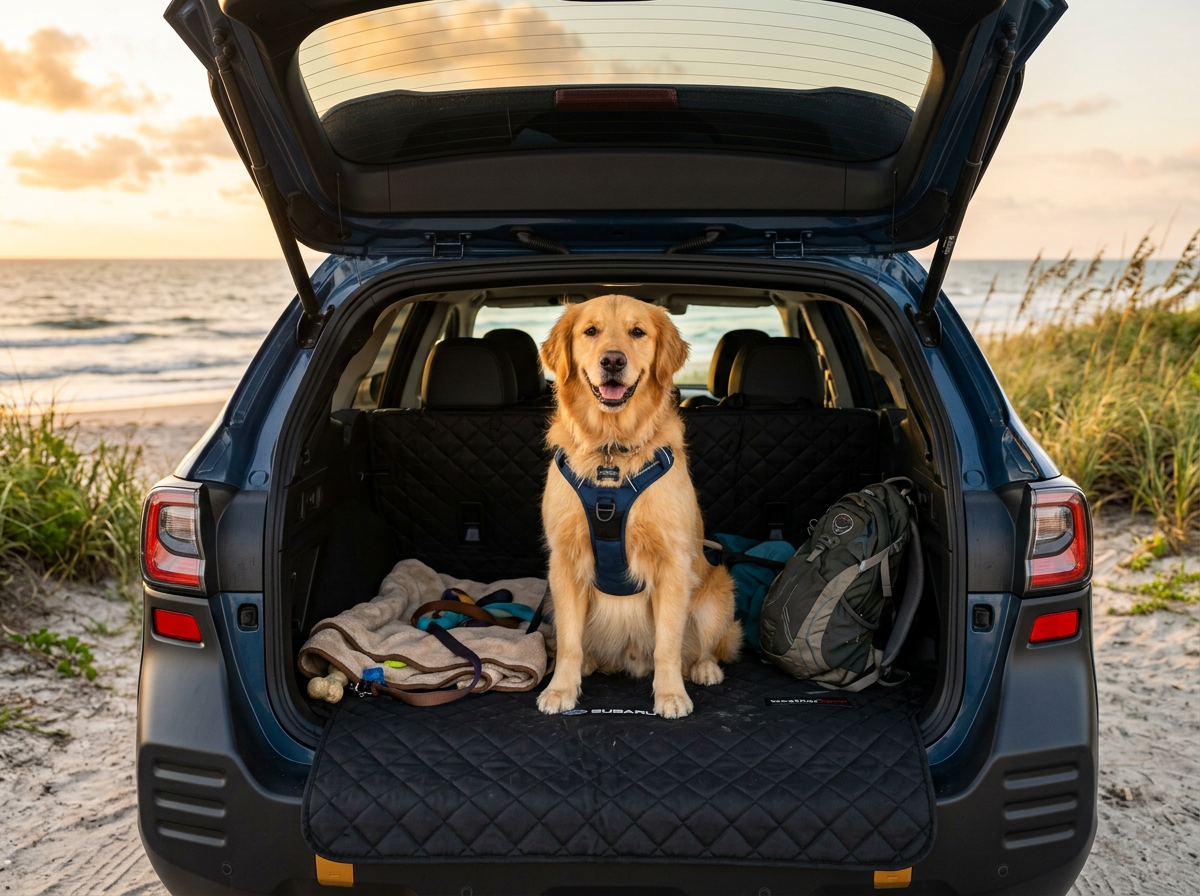
If you love embarking on outdoor adventures with your four-legged companions, keeping your vehicle clean and secure is likely a top priority. We sat down with Carter Holloway, the Parts Manager at Hanania Subaru who brings six years of specialized experience to our team, to discuss the comprehensive lineup of genuine Subaru pet accessories designed to keep your co-pilot safe and your cabin pristine.
Q: Does Subaru offer a dedicated lineup of genuine pet accessories for active owners?
A: Absolutely, Subaru takes pet safety and comfort incredibly seriously, offering a fully realized selection of engineered travel gear [1, 2]. Many pet owners who visit us from Ponte Vedra Beach are looking for ways to transition from a morning walk along the Atlantic shoreline to a clean ride home without bringing the sand and saltwater with them. Rather than relying on generic, ill-fitting aftermarket options, you can choose from a specialized catalog of genuine Subaru parts and accessories that are specifically designed for the exact dimensions of your vehicle [1].
These accessories are built with the same rigorous standards of durability as the rest of the vehicle, ensuring they can withstand heavy use from active dogs [1]. Whether you are driving a versatile SUV or exploring our new Subaru inventory to find the perfect family cruiser, there is a custom-fit solution available [1]. If you have questions about compatibility for a specific model year, you can always give our parts department a quick call or stop by our showroom at 6400 Blanding Blvd to see these items in person. We even have options for enthusiasts looking to customize their rides, which you can explore through our new Subaru performance inventory if you want to combine athletic driving with daily utility.
Q: What specific types of pet accessories does Subaru sell to protect the cabin?
A: We offer a highly targeted range of protective gear designed to shield every vulnerable surface of your vehicle’s interior [2]. One of the most popular items is the pet-friendly padded cargo liner, which covers the entire rear floor and the backs of the rear seats, allowing you to fold the seats down without exposing the carpet [2]. This liner features a durable polyester shell and thick padding, and it even includes a clever fold-out bumper protector to prevent claws from scratching the paint when your dog jumps in and out [2].
For the passenger area, the pet-friendly padded seat protector is a heavy-duty option featuring a tailored seatback and quilted pad that installs seamlessly without complex buckles or straps [6]. We also carry specialized rear-door protectors that shield the interior door panels from scratches, drool, and mud when your dog looks out the window [2]. If you are hauling a large family and a couple of dogs in our spacious new Ascent inventory, these interior guards are essential for preserving your vehicle’s resale value. For those looking to upgrade their current ride, we can help you value your trade-in online to see how much equity you can apply toward a newer model. You can also browse our used-vehicle inventory to find high-quality pre-owned SUVs that are ready to be outfitted with these protective accessories.
For example, if you are looking at the versatile Outback lineup, you have several trim options like the Premium, Limited, Touring, Limited XT, Touring XT, or the rugged Wilderness. Models equipped with the standard 2.5L engine deliver 180 hp and 178 lb-ft of torque through a smooth Lineartronic CVT, while the turbocharged 2.4L engine raises output to 260 hp and 277 lb-ft of torque, all paired with standard All-wheel drive.
Q: Are genuine Subaru pet harnesses crash-tested to protect dogs in an accident?
A: Yes, safety is the cornerstone of the brand, and that commitment extends directly to our four-legged passengers. Subaru partnered with Sleepypod to design pet harnesses and carriers that are rigorously crash-tested to the same high standards used for child safety seats. These premium harnesses are certified by the Center for Pet Safety for dogs weighing between 18 and 90 pounds, ensuring that your pet remains securely restrained during sudden stops or collisions.
By securing your dog with a crash-tested harness connected directly to the seatbelt system, you prevent them from becoming a dangerous projectile in the cabin or distracting you while driving. This hardware works hand-in-hand with our advanced driver-assist suites like EyeSight to provide complete peace of mind on every journey. If you are currently shopping for a vehicle that prioritizes this level of safety, our certified pre-owned inventory offers exceptional value on models equipped with standard Symmetrical All-Wheel Drive. Once you choose your vehicle, our factory-trained technicians at our Subaru service center can help you properly configure your cabin accessories and ensure all safety systems are operating at peak performance.
“When we design these travel accessories, we aren’t just thinking about convenience—we are engineering them to protect your family members, including the furry ones.”
Q: What is the best way to protect the cargo area from stubborn dog hair and mud?
A: The absolute best defense against the elements is combining the heavy-duty padded cargo liner with a set of all-weather floor mats [2]. Many drivers who frequently hike through the damp pine forests and wetlands around Yulee find that mud and fine pine needles are incredibly difficult to vacuum out of standard carpet fibers. The genuine padded liner is engineered with a water-resistant material that prevents moisture from seeping into the floorboards, while the quilted texture traps loose fur before it can migrate to the rest of the cabin [2, 6].
When the weekend adventure is over, you can easily remove the liner and shake it out or wipe it down with a damp cloth, saving you hours of detailing. Investing in these protective layers early on is a smart way to maintain the pristine condition of your SUV. If you are ready to secure a highly capable vehicle for your outdoor excursions, you can start the purchase path by prequalifying online to streamline your dealership visit.
Q: Can the redesigned 2026 Subaru Forester accommodate a giant breed dog crate?
A: The redesigned 2026 Subaru Forester is exceptionally spacious, but fitting a giant breed crate depends entirely on how you configure the cabin. With the rear seats in their upright position, the cargo area provides about 30 cubic feet of volume, which easily accommodates standard medium and large crates. However, because giant breed crates for dogs like Mastiffs or Great Danes require significant height and depth, you will need to utilize the 60/40 split-folding rear seats to lay the second row flat.
Once folded, the available cargo room expands to about 74 cubic feet, offering a wide, flat floor that can readily handle even the most massive travel kennels. If you are looking for a slightly more compact footprint for smaller pets, you can explore our new Crosstrek inventory to see how its versatile layout fits your lifestyle. For maximum utility and cabin height, browsing our new Forester inventory will show you why this redesigned SUV remains a top choice for pet owners who refuse to compromise on cargo flexibility.
Q: Does the 2026 CR-V offer official pet accessories that match the safety of Subaru?
A: While competitors like the Honda CR-V are highly capable vehicles, their official accessory catalogs simply do not offer the same depth of pet-focused engineering. Honda does provide basic utility items such as standard cargo trays and seat covers, but they lack a dedicated, co-branded line of safety gear that has undergone rigorous crash-testing. Subaru stands apart by offering a cohesive ecosystem of pet travel accessories, including the crash-tested harnesses and collapsible kennels developed in partnership with Sleepypod.
This means that when you outfit your vehicle, you are getting accessories that have been subjected to dynamic sled testing to ensure they perform reliably under extreme forces. For local owners who prioritize the absolute highest standard of safety for every family member, the Subaru catalog remains the strong option. If you already own a vehicle and want to ensure it is in peak mechanical shape for your next road trip, you can easily schedule your service appointment online with our factory-trained technicians.
Q: What is the warranty on genuine Subaru pet accessories, and can I have them installed at the dealership?
A: Yes, our parts department is happy to handle the installation of items like heavy-duty seat protectors, cargo barriers, and door guards to ensure a perfect, secure fit [2, 6]. When you purchase genuine accessories, they are backed by an excellent manufacturer warranty [1]. If you have them installed at the time of your new vehicle purchase, they are covered under the vehicle’s 3-year or 36,000-mile limited warranty. If you decide to add them to your vehicle later on, they carry a 1-year unlimited mileage warranty from the date of purchase.
It is important to note that while this warranty covers any defects in materials or workmanship, it does not cover direct pet damage such as chewing, clawing, or tearing. If you are interested in a highly accommodating vehicle like the Outback Limited, which starts at an MSRP of $41,715 with a standard destination charge of $1,450, outfitting it from day one is the best way to keep your cabin looking brand new. We invite you to explore our new Outback inventory online to find the perfect trim for your lifestyle. When you are ready to customize your vehicle or speak with our team, you can get easy driving directions to our dealership or reach out to us directly by calling (904) 906-1235 to speak with our parts specialists.
Pricing
Pricing by trim
| Feature | Limited | Limited XT | Premium | Touring | Touring XT | Wilderness |
|---|---|---|---|---|---|---|
| Base MSRP | $41,715 | $44,365 | $34,995 | $45,395 | $47,995 | $44,995 |
| Destination charge | $1,450 | $1,450 | $1,450 | $1,450 | $1,450 | $1,450 |
Engine & Performance
Powertrain specs by trim
| Feature | Limited | Limited XT | Premium | Touring | Touring XT | Wilderness |
|---|---|---|---|---|---|---|
| Engine | 2.5L | 2.4L | 2.5L | 2.5L | 2.4L | 2.4L |
| Horsepower | 180 hp | 260 hp | 180 hp | 180 hp | 260 hp | 260 hp |
| Torque | 178 lb-ft | 277 lb-ft | 178 lb-ft | 178 lb-ft | 277 lb-ft | 277 lb-ft |
| Transmission | Lineartronic CVT | Lineartronic CVT | Lineartronic CVT | Lineartronic CVT | High-torque Lineartronic CVT | Lineartronic CVT |
| Drivetrain | All-wheel drive | All-wheel drive | All-wheel drive | All-wheel drive | All-wheel drive | All-wheel drive |
© 2026 Hanania Subaru. All rights reserved.
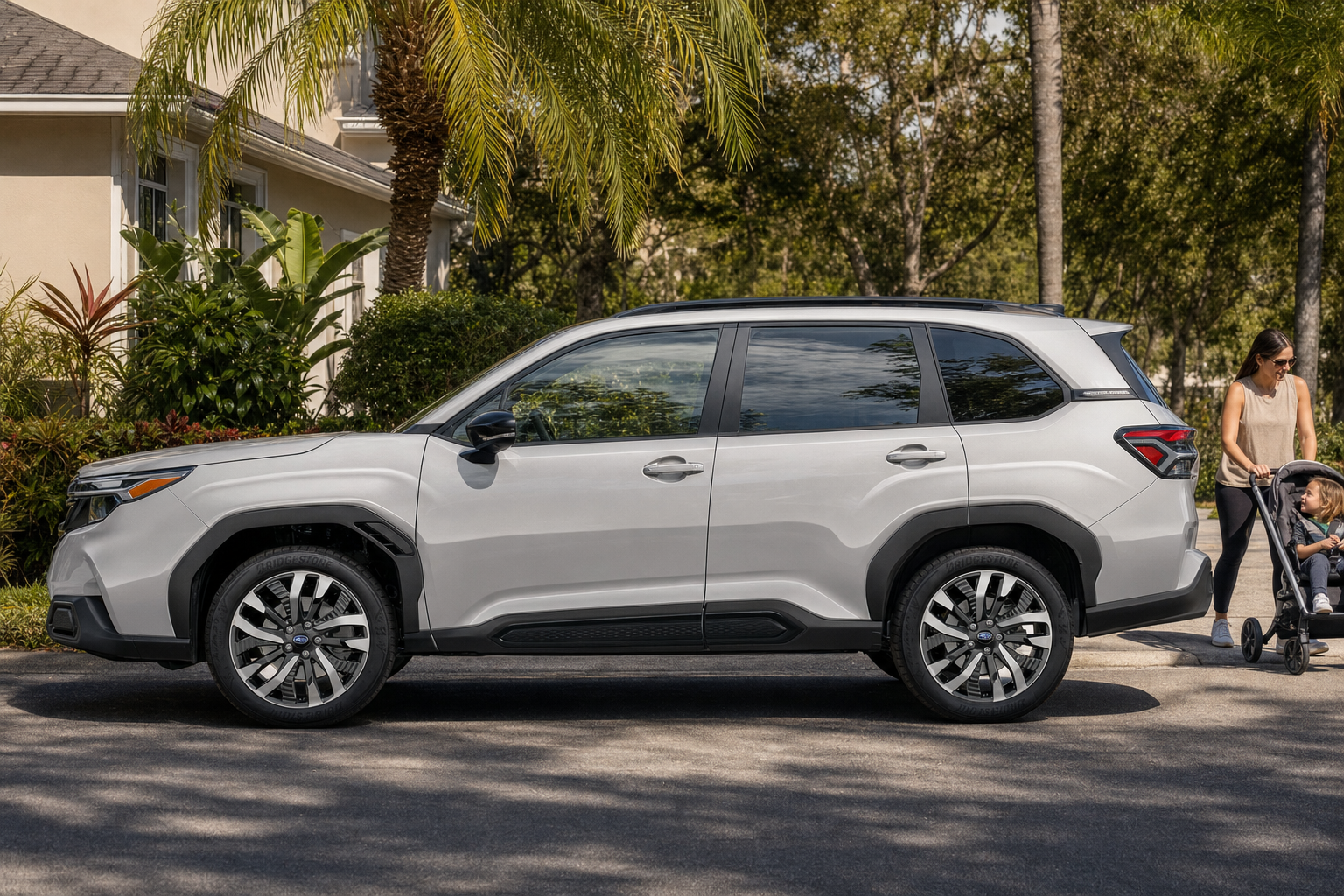
If you’re weighing the Subaru Forester vs Outback for families, you’re not choosing between a good car and a bad one. You’re choosing between two vehicles that do a lot of the same things well. The differences are real, though, and they matter more once you’re strapping in kids, loading a stroller, and driving I-295 every day. Here’s the plain-spoken breakdown from our lot in Orange Park.
What’s the real difference between the Forester and Outback for families?
Both ride on Subaru’s Global Platform with standard all-wheel drive, but the Forester is a taller, boxier compact SUV built for easy step-in access, while the Outback is a longer, wagon-style crossover with more cargo length and a lower load floor. For most Jacksonville families it comes down to seating height versus cargo stretch.
Neither has a third row, so if you need seven seats, both are off the table. For a household of four or five, either works. The Forester feels more upright and open; the Outback feels longer and more planted on the highway.
Which one has more room for car seats and cargo?
The Outback carries more cargo behind the rear seats, roughly 32.5 cubic feet versus about 26.9 in the Forester, per Subaru’s published specifications. But the Forester’s taller, more vertical door openings often make it easier to lean in and click a rear-facing car seat, which many parents value more than raw cargo numbers.
Here’s a quick side-by-side of the family-relevant numbers, based on 2026 Subaru specifications:
| Spec | 2026 Forester | 2026 Outback |
|---|---|---|
| Cargo behind rear seats | ~26.9 cu ft | ~32.5 cu ft |
| Max cargo (seats folded) | ~74.4 cu ft | ~75.7 cu ft |
| Ground clearance | 8.7 in (per Subaru) | 8.7 in (per Subaru) |
| Body style | Upright SUV | Wagon-style crossover |
Both models list 8.7 inches of ground clearance according to Subaru’s specifications, which is generous for a family vehicle and useful when a Florida afternoon storm floods the entrance to your neighborhood.
Which is better for Jacksonville driving and fuel economy?
They’re close. According to EPA estimates, the 2026 Forester with the 2.5-liter engine returns 26 mpg city and 33 mpg highway, while the 2026 Outback with the base 2.5-liter engine returns about 26 city and 32 highway. For daily St. Johns Town Center runs and Beaches commutes, you won’t notice a meaningful gap at the pump.
- Around town: The Forester’s shorter length makes tight Riverside and Avondale parking easier.
- Highway hauls: The Outback’s longer wheelbase feels calmer on a Gainesville or Savannah road trip.
- Turbo option: The Outback offers an available turbocharged engine for more passing power; the Forester’s 2026 lineup leans on its standard 2.5-liter.
Are the Forester and Outback safe enough for my family?
Both come standard with Subaru’s EyeSight driver-assist suite, including pre-collision braking and adaptive cruise, plus standard all-wheel drive. Subaru vehicles have a long history of strong crash-test results, but award status is model-year specific. Check the current ratings for your exact model and trim at iihs.org and nhtsa.gov before you decide, rather than trusting a secondhand claim.
According to IIHS data, models equipped with front crash prevention systems like EyeSight have shown large reductions in rear-end crashes, which is exactly the kind of tech that helps in Jacksonville’s stop-and-go I-95 traffic.
Which should a Jacksonville family buy?
Pick the Forester if you want the easiest car-seat access, a more upright view, and simpler parking. Pick the Outback if you regularly haul longer cargo, take highway road trips, or want the available turbo. Both handle Florida heat, rain, and the occasional dirt-road boat ramp without complaint.
The best move is to bring your actual car seats and gear to our Orange Park lot and try loading both. Any price you see should list the model year and trim, so ask us to spell out exactly what you’re looking at before you sign anything.
Every Dashboard Warning Light in Your Subaru Explained: A Service Advisor’s Perspective

Demystifying Your Subaru Instrument Panel and Warning Systems
After spending five years as a Service Advisor at Hanania Subaru, I have seen almost every dashboard illumination scenario imaginable. Modern instrument clusters are highly sophisticated communication hubs designed to monitor hundreds of vehicle functions in real time. Instead of causing panic, these indicators are meant to empower drivers with actionable data about their vehicle’s health.
When a light appears on your cluster, it is often a preventative signal rather than an immediate catastrophe. For example, high-performance models equipped with advanced powertrains from our new Subaru performance inventory rely on a complex network of sensors to monitor Symmetrical All-Wheel Drive systems and maintain optimal boost, timing, and traction. Understanding what these systems are trying to communicate is the first step toward maintaining your vehicle’s longevity and performance.
If you ever feel uncertain about an active warning light, you can easily reach our team by giving us a quick call to discuss the symptoms. For more hands-on assistance, stopping by our service department on Blanding Boulevard allows our factory-trained technicians to connect specialized diagnostic tools and pinpoint the root cause immediately. Keeping your instrument panel clear ensures that every drive remains safe and predictable.
Table of Contents
- Decoding the Color Spectrum of Subaru Dashboard Indicators
- The Subaru Check Engine Light and Critical Powertrain Alerts
- Understanding Subaru EyeSight Driver Assist Alerts and Camera Calibration
- Managing Tire Pressure Alerts and Proper Inflation Specifications
- Professional Diagnostic Standards Versus DIY Code Readers
Decoding the Color Spectrum of Subaru Dashboard Indicators
Now, when it comes to the color of a dashboard warning light, the system functions exactly like a traffic signal, immediately communicating the severity of the underlying issue. A red indicator is a critical alert signifying a serious safety or mechanical problem that requires you to safely pull over, shut off the engine, and contact Subaru Roadside Assistance: 1-800-261-2155. This complimentary service is included during your 3-year/36,000-mile Subaru Limited Warranty and provides manufacturer-backed support, including towing to the nearest authorized service center where factory-trained technicians use genuine parts. For instance, the red engine oil pressure warning light indicates dangerously low oil pressure, while the red battery icon means the charging system is failing and cannot sustain the vehicle’s electrical load.
Commuters driving daily from Orange Park along Blanding Boulevard face heavy stop-and-go traffic, which places continuous demands on the braking system and makes a red brake warning light an immediate concern. This red light can indicate low brake fluid, an engaged parking brake, or a critical hydraulic failure, meaning you should never drive if it remains illuminated after releasing the parking brake. If your system requires new pads, rotors, or master cylinders, our department always utilizes genuine OEM brake components to restore factory-spec stopping power and ensure your vehicle’s braking performance meets safety standards.
Yellow or amber lights represent advisory alerts, indicating a system malfunction, a low fluid level, or a non-critical component that requires professional inspection soon. For family-focused models like those in our new Subaru Ascent inventory, which features a standard 2.4L turbocharged engine and Symmetrical All-Wheel Drive, amber lights might signal a disabled safety system or a minor sensor fault that needs scanning before your next weekend road trip. Blue and green indicators, such as a cold coolant temperature light or an active headlight high-beam icon, simply show that a system is operating normally or that the engine is warming up to its optimal temperature.
The Subaru Check Engine Light and Critical Powertrain Alerts
Another important thing to know about your powertrain is that the check engine light, formally known as the malfunction indicator lamp, is connected directly to the engine control unit and illuminates when emissions, ignition, or fuel systems deviate from factory parameters. A steady amber check engine light typically points to a minor fault, such as a loose gas cap or a failing oxygen sensor, allowing you to drive cautiously to a service center. When drivers ask me if they can keep driving with a steady check engine light, I always explain that while a solid light means you can safely drive to the service center, a flashing light is an immediate emergency.
A flashing check engine light indicates that the engine control system has detected a severe misfire capable of destroying the catalytic converter within minutes due to unburned fuel entering the exhaust. If this occurs, drivers must immediately reduce speed, find a safe place to pull over, and turn off the engine to prevent thousands of dollars in exhaust system damage. Models like the standard 2.5L engine found in our new Subaru Forester inventory rely on precise ignition timing, and ignoring a flashing light risks catastrophic powertrain damage.
Other critical powertrain alerts include the transmission oil temperature light and the Vehicle Dynamics Control warning light. A steady Vehicle Dynamics Control light indicates a system malfunction that disables traction and stability assistance, while a flashing light simply means the system is actively working to maintain grip on slippery surfaces. Addressing these powertrain alerts promptly prevents minor sensor calibration issues from escalating into major mechanical overhauls.
Understanding Subaru EyeSight Driver Assist Alerts and Camera Calibration
Here’s what you need to know about how your vehicle’s driver-assist systems communicate with you. The advanced EyeSight Driver Assist Technology relies on dual color cameras mounted inside the upper windshield to monitor traffic patterns, detect obstacles, and manage safety features. When the EyeSight warning light illuminates in yellow or amber, it indicates that the system is temporarily disabled and cannot assist you on the road. During this time, critical driver-assist functions like adaptive cruise control and pre-collision braking are completely offline until the system clears.
Environmental factors are the most common causes of temporary EyeSight deactivation rather than an actual hardware failure. The salty air and fine coastal sand blown from the beaches near Ponte Vedra Beach can deposit a stubborn layer of film on the upper windshield, obstructing the dual cameras and triggering a temporary disablement light. Similarly, extreme cabin heat from parking in the summer sun or direct morning glare shining straight into the camera lenses will cause the system to stand down until temperatures normalize or the angle of light changes.
Physical modifications and maintenance procedures can also interfere with these sensitive camera sensors. For example, replacing a cracked windshield on a compact SUV from our new Subaru Crosstrek inventory requires precise camera recalibration to ensure the safety systems function correctly. If the cameras are reinstalled without professional alignment, the system will trigger persistent warning lights and remain completely disabled because the computer cannot guarantee accurate distance calculations.
Managing Tire Pressure Alerts and Proper Inflation Specifications
Many customers wonder about the specific symbols that monitor basic safety components. The tire pressure monitoring system, represented by an amber symbol shaped like a tire cross-section with an exclamation point, is designed to alert you when any tire’s inflation pressure drops significantly below the manufacturer’s specification. When this light illuminates steadily, it means at least one tire has lost pressure and needs immediate adjustment to prevent uneven wear, reduced fuel economy, and compromised handling. If the light flashes for approximately one minute upon starting the vehicle before remaining solid, it indicates a malfunction in the system itself, such as a dead sensor battery.
Many drivers mistakenly inflate their tires to the maximum pressure printed on the tire sidewall, which can lead to a harsh ride and accelerated center-tread wear. The correct cold inflation pressure is located on the tire specification placard on the driver’s side doorjamb, which is custom-tailored to balance load capacity and ride comfort. Whether you are driving a factory-fresh model or a well-maintained vehicle from our certified pre-owned Subaru inventory, adhering strictly to these doorjamb specifications like 33 psi or 32 psi ensures your safety systems work in perfect harmony.
Sustained high ambient temperatures can cause tire pressures to fluctuate rapidly, sometimes triggering early morning warnings that disappear once the tires warm up during your commute. If your warning light remains active after inflating the tires to the recommended cold specifications, our Subaru service center is fully equipped to diagnose slow leaks, repair punctures, or replace damaged sensors. You can easily schedule your service appointment online to have our technicians inspect your tires and reset the monitoring system using factory-certified equipment.
Professional Diagnostic Standards Versus DIY Code Readers
This is something we see a lot with diagnostic troubleshooting at our service bays. While inexpensive OBD-II handheld scanners allow you to read diagnostic trouble codes at home, these tools only provide a generic alphanumeric starting point rather than a complete repair solution. A code like P0420 might indicate a catalytic converter issue, but the actual root cause could be a minor exhaust leak, a faulty sensor, or an engine misfire. Disconnecting the negative battery terminal for ten minutes might temporarily clear the warning light, but the vehicle’s computer will quickly re-illuminate the dashboard indicator once it completes its self-test cycles and detects the unresolved mechanical fault.
Many auto parts stores offer to read your diagnostic codes for free, which is helpful for basic information but falls short of a comprehensive physical inspection. For complex vehicles like those in our new Subaru Outback inventory, which features advanced Symmetrical All-Wheel Drive and active safety networks, a generic scanner cannot access proprietary chassis or body control modules. Our factory-trained technicians charge a standard diagnostic fee—typically between $100 and $200—to perform extensive electrical testing, vacuum leak checks, and software updates that generic readers simply cannot perform, ensuring that every issue is resolved accurately.
If your dashboard is displaying multiple warning lights, trying to solve the puzzle at home can lead to unnecessary parts replacement and added frustration. I recommend letting our specialized service team handle the heavy lifting to ensure your vehicle is repaired correctly the first time. Please feel free to give us a quick call or stop by our service department on Blanding Boulevard so we can get your vehicle back to peak operating condition.
© 2026 Hanania Subaru. All rights reserved.
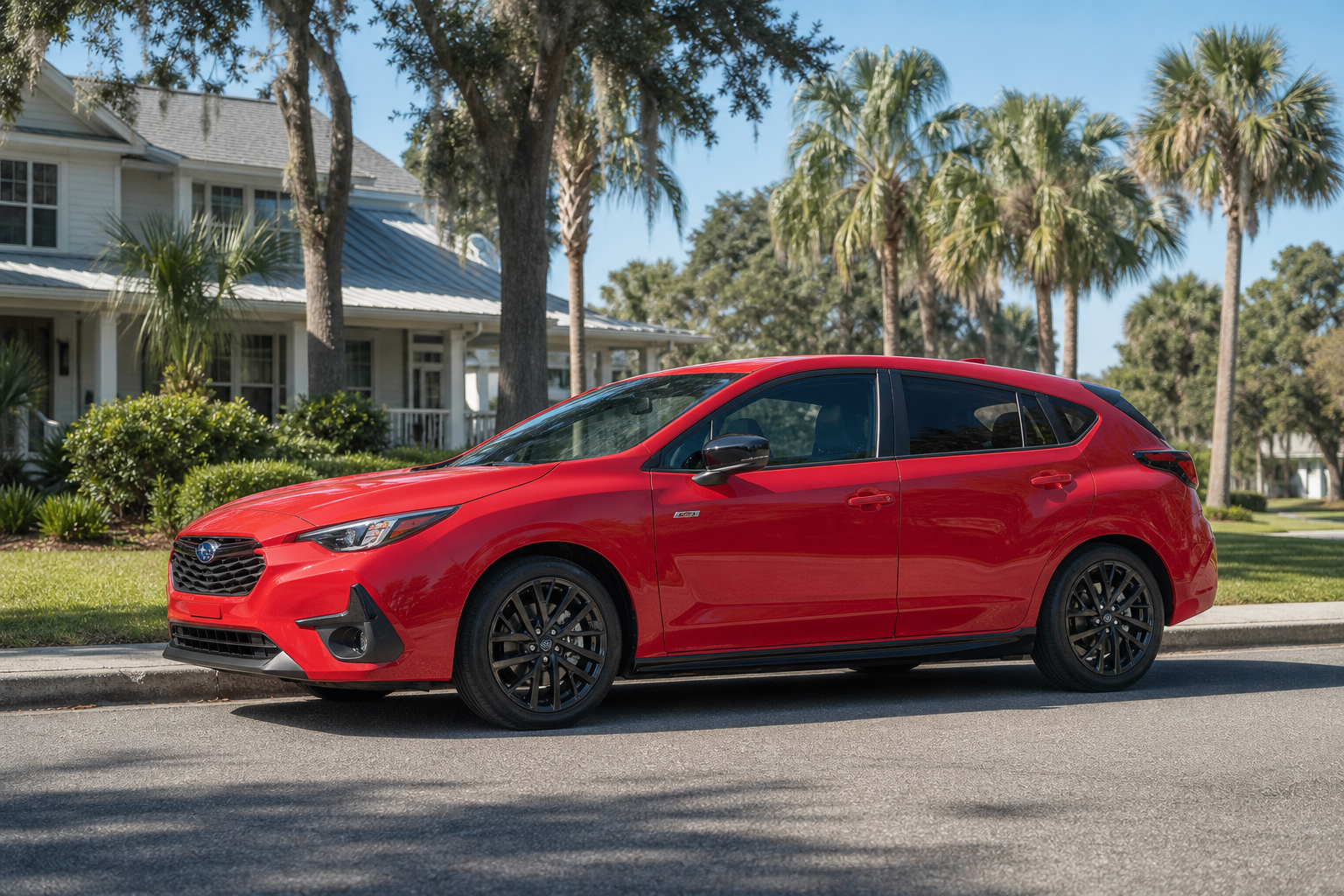
If you drive a recent Subaru around Jacksonville, there’s a good chance you’re already leaning on EyeSight without thinking much about it. It’s the pair of cameras near your rearview mirror that watch the road ahead and step in when things get dicey. Here’s what it actually does, how to keep it working, and when it needs our attention.
What is the Subaru EyeSight safety system?
EyeSight is Subaru’s driver-assist suite that uses two color cameras mounted at the top of the windshield to watch traffic, lane lines, and pedestrians ahead. It powers features like adaptive cruise control, automatic pre-collision braking, lane keep assist, and lane departure warning to help you avoid or soften a crash.
Unlike systems that rely on radar bumper sensors, Subaru built EyeSight around stereo cameras that judge distance the way your own two eyes do. That’s why a cracked or dirty windshield in the camera’s view can matter more than you’d expect.
Does EyeSight actually reduce crashes on roads like ours?
Yes, the data is strong. According to the Insurance Institute for Highway Safety, Subaru vehicles equipped with EyeSight showed a 85% reduction in rear-end crashes with injuries compared to Subarus without it. On stop-and-go stretches like I-295 and Blanding Boulevard, that automatic braking buys you margin when the car ahead slams its brakes.
Around town, the pedestrian detection and lane-keep features earn their keep too, especially during those blinding afternoon sun-glare drives home and sudden summer downpours where visibility drops fast.
- Adaptive Cruise Control — keeps a set gap from the car ahead and slows automatically.
- Pre-Collision Braking — brakes for you if a crash looks imminent.
- Lane Keep Assist — nudges the wheel to hold your lane.
- Lane Departure Warning — alerts you if you drift without signaling.
- Lead Vehicle Start Alert — pings you when traffic starts moving and you don’t.
When does EyeSight need service or recalibration?
EyeSight cameras need recalibration after certain repairs, not on a routine mileage schedule. The big triggers are a windshield replacement, front-end collision work, suspension or alignment changes that alter ride height, or a dashboard warning light for the system itself. When any of those happen, the cameras must be re-aimed precisely.
Here’s a quick reference for what usually calls for a calibration check:
| Situation | Calibration usually needed? |
|---|---|
| Windshield replaced | Yes |
| Front-end collision repair | Yes |
| Ride height / suspension changed | Yes |
| EyeSight warning light on dash | Yes — get it checked |
| Routine oil change | No |
One practical Jacksonville tip: if you replace your windshield, use a shop that can perform the Subaru camera calibration, or bring the car to us afterward. A generic glass swap without recalibration can leave EyeSight aimed wrong or disabled entirely. Keeping the camera area clean and unobstructed by dash-mounted gadgets also helps the system read the road clearly.
Can I turn EyeSight off, and should I?
Some features can be switched off from buttons near the steering wheel or the dash menu, and pre-collision braking temporarily disables if a camera is blocked. For everyday driving we suggest leaving it on. The alerts occasionally feel eager, but the automatic braking works in the split second you might not react in time.
If a warning message pops up saying EyeSight is temporarily unavailable, it’s often fog, heavy rain, or a fogged-over camera lens near the mirror. Once conditions clear, the system typically restores itself. If the message stays on in clear weather, that’s your cue to have us scan it.
Have questions about your specific Subaru or want a calibration check? Our service team at Hanania Subaru of Orange Park handles EyeSight diagnostics and recalibration in-house, so you’re not bouncing between shops.
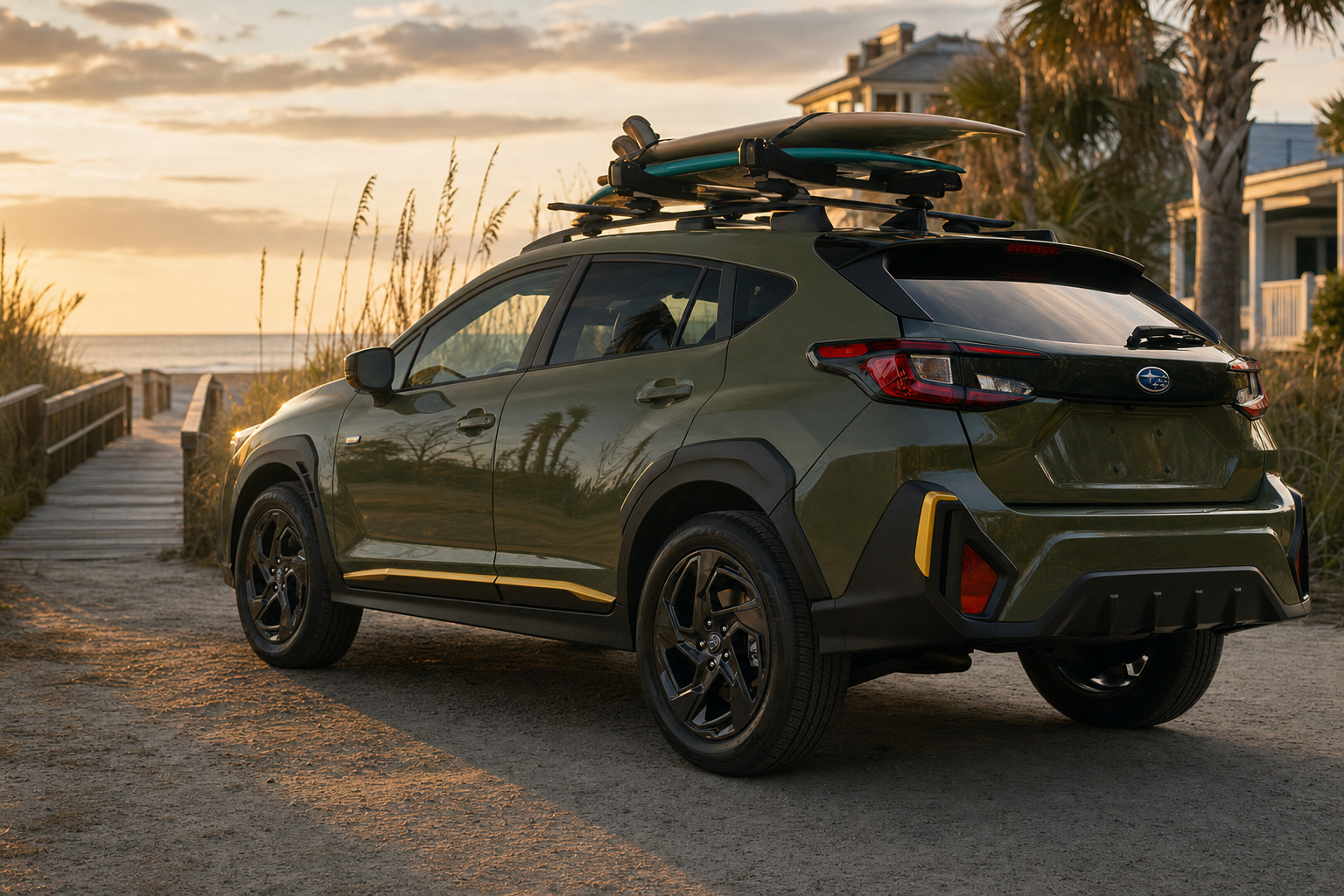
Both the Subaru Outback and the Subaru Crosstrek show up in a lot of Orange Park driveways, and for good reason: standard all-wheel drive, room for gear, and the kind of ground clearance that shrugs off a flooded intersection after a summer storm. But they solve different problems. Here’s a plain look at how the two compare so you can match the right one to how you actually drive around Jacksonville.
What’s the real size difference between the Outback and Crosstrek?
The Outback is the bigger vehicle in every direction. It rides on a longer wheelbase, offers more cargo room behind the rear seats, and gives taller passengers more legroom. The Crosstrek is a compact SUV built on a smaller platform, so it’s easier to park and squeeze into tight spots at the beach or downtown.
- Outback: midsize wagon-SUV, roughly 191 inches long, best for families and long highway hauls to Gainesville or Savannah.
- Crosstrek: subcompact SUV, roughly 176 inches long, best for solo commuters, couples, and city parking.
- Cargo: the Outback nearly doubles the Crosstrek’s space behind the second row.
- Ground clearance: both sit around 8.7 inches, so neither loses to the other on standing water.
Which Subaru is better for Jacksonville driving and fuel costs?
For a stop-and-go I-95 commute or errands around Orange Park, the Crosstrek’s smaller size and strong fuel economy make it the easier daily driver. If you regularly load up passengers, tow a small trailer, or drive long stretches to Atlanta, the Outback’s extra power options and roomier cabin earn their keep.
Fuel economy matters when you’re driving Jacksonville distances. Per EPA estimates, the 2026 Subaru Crosstrek with its base engine returns up to 34 mpg highway, while the four-cylinder Outback lands around 32 mpg highway. Step up to the Outback’s turbocharged engine and highway numbers drop into the high 20s in exchange for noticeably more towing muscle.
| Feature | 2026 Crosstrek | 2026 Outback |
|---|---|---|
| Body style | Subcompact SUV | Midsize SUV/wagon |
| Highway mpg (base) | Up to ~34 | Up to ~32 |
| Standard drivetrain | Symmetrical AWD | Symmetrical AWD |
| Best for | Commuters, couples | Families, road trips |
| Max towing (approx.) | Up to 1,500 lbs | Up to 3,500 lbs (turbo) |
How do I decide which one to buy?
Start with three questions: How many people and how much gear do you haul on a normal week? How long are your typical drives? And how tight is your budget? If you rarely fill the back seat and park in crowded lots, the Crosstrek fits. If weekends mean coolers, dogs, and highway miles, the Outback is worth the extra spend.
A quick way to sort it out:
- Choose the Crosstrek if: you commute solo or with one passenger, want a lower starting price, and value easy parking.
- Choose the Outback if: you need more cargo space, tow a small boat or camper, or want extra rear-seat comfort for road trips.
- Either works if: you want standard all-wheel drive and the clearance to handle Florida’s flash-flood downpours.
Pricing on both models varies by trim and model year, and we’ll walk you through the exact figures on the specific 2026 Subaru Crosstrek or 2026 Subaru Outback trim you’re looking at before anything gets signed. We’d rather show you the real numbers on the window sticker than talk in vague ranges. Come drive both back-to-back at Hanania Subaru of Orange Park and see which one feels like yours.
Reaching the quarter-million-mile mark is a point of pride for Subaru owners, but that kind of longevity is rarely an accident. We sat down with Brent Davis, a Service Advisor at Hanania Subaru with 6 years of experience, to discuss the specific maintenance blueprints required to keep these vehicles running reliably through decades of Florida driving. In this interview, Brent explains how consistent care and technical precision allow models like the Outback and Forester to outlast the industry average.
Q: Brent, we often hear about Subarus lasting for decades, but what is the actual baseline for an owner who wants to see 200,000 miles on their odometer?
A: The foundation for that kind of longevity starts with the 6,000-mile or six-month service interval. Most people think of this as just an oil change, but for a high-mileage candidate, it is actually a comprehensive health check. In our environment, where the hot Florida sun and high ambient temperatures place constant thermal stress on the engine, staying disciplined with these visits is non-negotiable. I tell owners that the vehicles we see reaching 200,000 miles are almost always the ones that never skipped a fluid inspection or a filter replacement. If you are driving in from Ponte Vedra Beach after a weekend at the coast, that salt air and humidity make it even more important to have our Subaru Service Center technicians look for early signs of corrosion or belt wear. You can reach our team at (904) 906-1235 to discuss a personalized plan, or stop by our location at 6400 Blanding Blvd, Jacksonville, FL 32244 to get a baseline inspection for your vehicle.
Q: Walk me through a scenario where an owner is approaching that first major 100,000-mile threshold—what are the most critical items they need to address?
A: When a customer brings in a vehicle like the 2026 Subaru Crosstrek with high miles, we focus heavily on the 30,000-mile, 60,000-mile, and 90,000-mile milestones. By the time you hit 100,000 miles, you should have already replaced your spark plugs at least once, especially on FA-series turbo engines where they are rated for 60,000 miles. We also look closely at the cooling system. If the coolant is neglected, it can lead to overheating, which is the quickest way to end an engine’s life. For those driving a Subaru Crosstrek or similar model, we also emphasize differential fluid changes. These are often overlooked, but the rear differential needs fresh fluid every 30,000 to 60,000 miles to prevent the internal gears from whining or wearing down prematurely. Catching these items at 90,000 miles sets the stage for the next 100,000 miles of trouble-free driving.
Q: Is there a significant difference in how you maintain the Boxer engine compared to a traditional inline-four to ensure it lasts “forever”?
A: The horizontally-opposed Boxer engine is a masterpiece of balance, but its layout means gravity affects lubrication and sealing surfaces differently than an upright engine. For maximum life in a 2.5L H4 engine, such as the one found in the Subaru Forester, using the required 0W-20 synthetic oil is critical. Synthetic oil handles the internal heat of our Florida summers much better than conventional blends, preventing the “sludging” that can clog oil passages. I also remind owners that the Boxer engine has more sealing surfaces, so we keep a close eye on valve cover gaskets and cam seals as the vehicle ages. If you notice a faint smell of oil after a long drive, it is time to schedule your service appointment immediately. Addressing a small seep early prevents it from becoming a major leak that could starve the engine of lubrication at high speeds.
“The vehicles we see reaching 200,000 miles are almost always the ones that never skipped a fluid inspection or a filter replacement.”
Q: Many drivers worry about the CVT transmission as they get into higher mileages; what should they be watching for?
A: There is a common misconception that CVT fluid is “lifetime,” but in my experience, that is only true if you don’t plan on keeping the car past 100,000 miles. For a Lineartronic CVT, like the one in the 2026 Subaru Outback, we recommend a fluid exchange every 60,000 miles, or even every 30,000 miles if you are doing heavy stop-and-go commuting. If you live in Yulee and commute daily into Jacksonville along US Highway 17, that constant shifting and heat build-up can degrade the fluid faster. Signs that you need service include a slight shudder when accelerating or a delayed engagement when shifting from Park to Drive. We always use genuine Subaru parts and high-torque CVT fluid because generic fluids can actually cause internal slipping. Maintaining the transmission is vital for the Symmetrical All-Wheel Drive system to function correctly in a Subaru Outback, ensuring power is distributed evenly to all four corners without mechanical strain.
Q: How strictly should owners follow the 2/32-inch rule for tire tread depth, and can it really destroy the AWD system?
A: It absolutely can. The Symmetrical AWD system is incredibly sensitive to the rolling circumference of the tires. If one tire is significantly more worn than the others, it has to spin faster to keep up, which creates a constant “traction event” in the center differential. This generates heat and mechanical stress that can lead to a repair bill in the thousands. Subaru specifies that tread depth should not vary by more than 2/32 of an inch between any two tires. This is why regular tire rotations every 6,000 miles are so important. If you have a larger vehicle like the 2026 Subaru Ascent, which carries more weight and places more load on the tires, this rule is even more critical. If you ever damage just one tire on your Subaru Ascent, we often have to recommend replacing all four to keep that drivetrain synchronized and protected for the long haul.
Q: Brent, why is it better for a long-term owner to choose a dealership like Hanania Subaru over a general repair shop for this 200,000-mile journey?
A: I recently observed a customer who had been using a general shop for years and was frustrated by a recurring EyeSight Driver Assist error. It turned out the non-OEM windshield they had installed wasn’t calibrated to the cameras. At Hanania Subaru, our technicians are factory-trained specifically on these systems. We also provide the Hanania Lifetime Warranty and two years of maintenance with every new vehicle purchase, which is a massive advantage for someone planning to keep their car for 15 years. Whether you are looking at our Subaru performance inventory for a weekend car or browsing our certified pre-owned Subaru models for a reliable daily driver, you get the peace of mind that comes with OEM parts and specialized diagnostics. You can find us at 6400 Blanding Blvd, Jacksonville, FL 32244, or give us a quick call to discuss how we can help your current Subaru reach that 200,000-mile goal. If you ever run into trouble on the road, remember that Subaru Roadside Assistance is available at 1-800-261-2155 to ensure you are never stranded.
Reaching high mileage in a Subaru is a partnership between the owner’s diligence and expert technical support. By adhering to the 6,000-mile service interval, using synthetic oil, and respecting the 2/32-inch tire wear rule, you can protect your investment for years to come. Brent Davis and the entire team at Hanania Subaru are dedicated to providing the transparent, expert care necessary to keep your vehicle on the road for its next 100,000 miles. Visit our service department today to ensure your Subaru is prepared for the long journey ahead.
© 2026 Hanania Subaru. All rights reserved.
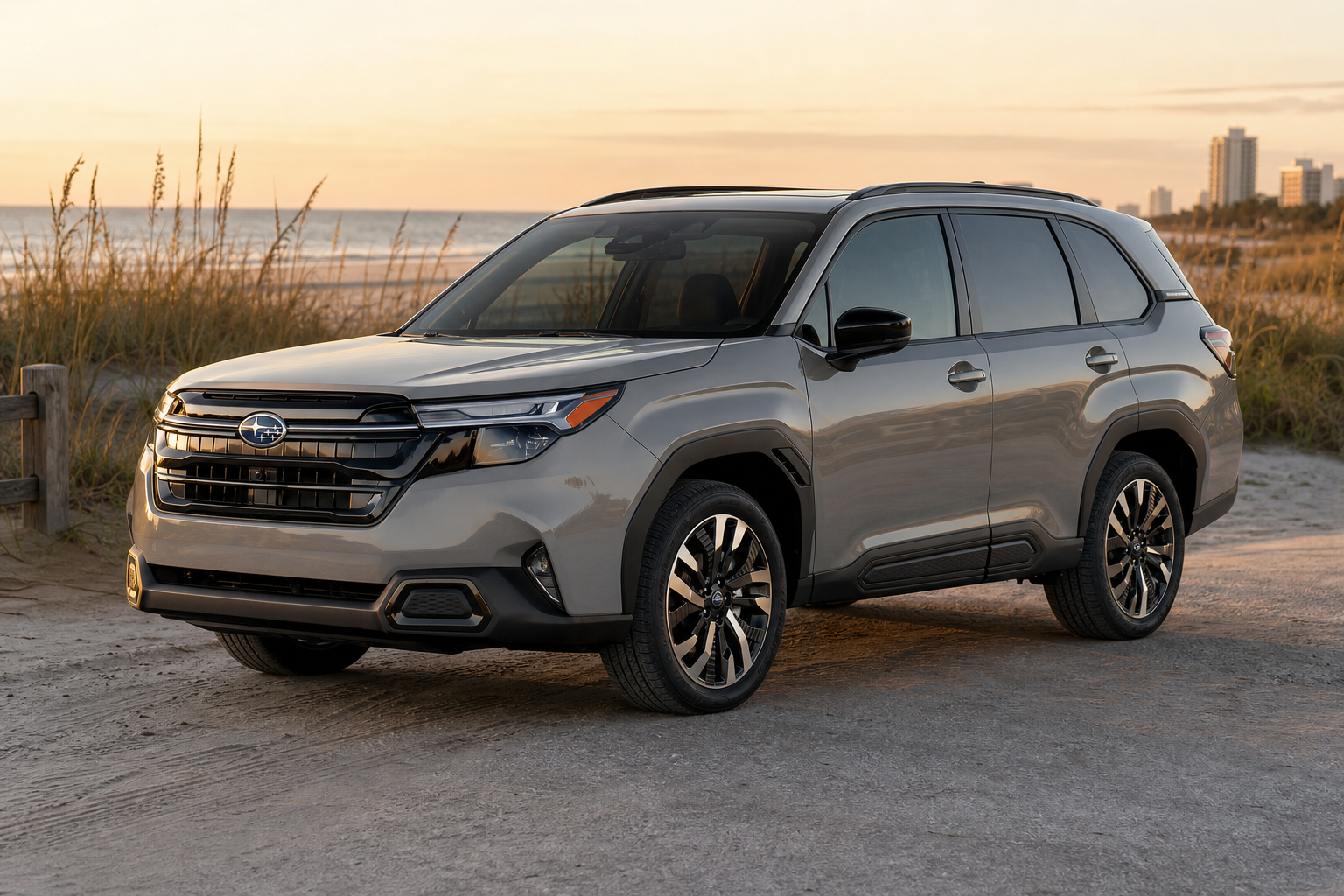
Between Atlantic Beach, Neptune Beach, Jax Beach, and the Talbot Islands, a lot of us plan whole weekends around getting sand between our toes. Here’s a plain-spoken guide to which Subaru fits that life best, and how to keep it happy after months of salt air.
What makes the 2026 Subaru Forester the best Subaru for Jacksonville beaches?
The 2026 Subaru Forester is the best Subaru for Jacksonville beaches because it pairs tall ground clearance and standard Symmetrical All-Wheel Drive with a boxy cargo hold that swallows coolers, chairs, and boards. Roof rails carry surfboards or kayaks, and X-MODE steadies you on soft, sandy approach roads.
Beach days aren’t just the beach. They’re the deep-rutted parking lot at Huguenot, the crushed-shell path near Little Talbot, and the packed cooler that has to fit alongside the beach wagon. The Forester is built like a tool for exactly that mix of jobs.
- Cargo room: a wide, tall hatch opening for wagons, umbrellas, and boogie boards
- Roof rails: standard on most trims for board and kayak carriers
- Symmetrical All-Wheel Drive: standard across the lineup
- Visibility: big windows that help in crowded lot traffic near the pier
How does the Forester’s ground clearance and X-MODE handle sand-adjacent roads?
According to Subaru’s published specifications, the 2026 Forester offers 8.7 inches of ground clearance, which helps clear rutted, washboard access roads without scraping. X-MODE optimizes throttle and All-Wheel Drive grip for slick or loose surfaces, so soft-but-firm sandy approaches and wet boat ramps feel more composed and controlled.
A quick reality check: the Forester is a capable crossover, not a dedicated dune buggy. Deep, dry, soft sand can trap any street vehicle. Stick to firm packed surfaces, air down only if you know what you’re doing, and never park below the tide line. X-MODE gives you confidence on the roads leading to the beach far more than it does on the beach itself.
Is the Subaru Crosstrek a good runner-up for beach days?
Yes. The 2026 Subaru Crosstrek is the compact runner-up: it shares Symmetrical All-Wheel Drive and X-MODE, offers strong ground clearance, and fits easily in tight beach lots. It carries less gear than the Forester, so it suits couples and small crews over big families hauling a full day’s worth of coolers and boards.
| Feature | 2026 Forester | 2026 Crosstrek |
|---|---|---|
| Best for | Families, big gear loads | Couples, solo surfers |
| Cargo space | More | Compact |
| Ground clearance | 8.7 in (per Subaru) | Generous for its class |
| All-Wheel Drive | Standard | Standard |
| Parking in tight lots | Easy | Easiest |
How do you protect a Subaru from Jacksonville salt air?
Rinse the underbody and wheel wells with fresh water after beach trips, wash regularly, and keep a coat of wax or sealant on the paint. Salt and humidity accelerate corrosion, so target the undercarriage, brake components, and any spot where sand collects. A quick rinse after each outing does most of the work.
Jacksonville’s coastal humidity stays high much of the year, which is why routine rinsing matters here more than it does inland. A few habits go a long way:
- Hose down the underbody and behind the wheels after sandy or salty drives
- Wash the whole vehicle every week or two during heavy beach season
- Reapply wax or paint sealant on a regular schedule
- Ask our service team to inspect brakes and underbody hardware at oil-change intervals
- Shake out floor mats and vacuum sand before it grinds into carpet and seat tracks
Can the Forester handle the boat ramp?
For light trailers and small boats, yes. The Forester’s All-Wheel Drive and X-MODE traction help on wet, algae-slick ramps, and its ground clearance keeps the approach angle friendly. Always check the tow rating for your specific 2026 Forester trim before hauling, and rinse the hitch and underbody afterward to fight salt corrosion.
Ramp days at places like the Mayport or Sisters Creek launches put traction to the test. Back down slowly, keep momentum smooth on the pull-out, and let X-MODE manage grip so you’re not spinning tires on the wet concrete. If you tow often, talk with us about the right trim and factory-approved towing setup before you buy.
Want to see how the 2026 Subaru Forester or 2026 Subaru Crosstrek fits your beach routine? Come drive one at Hanania Subaru of Orange Park and bring your questions about salt-air care and towing.
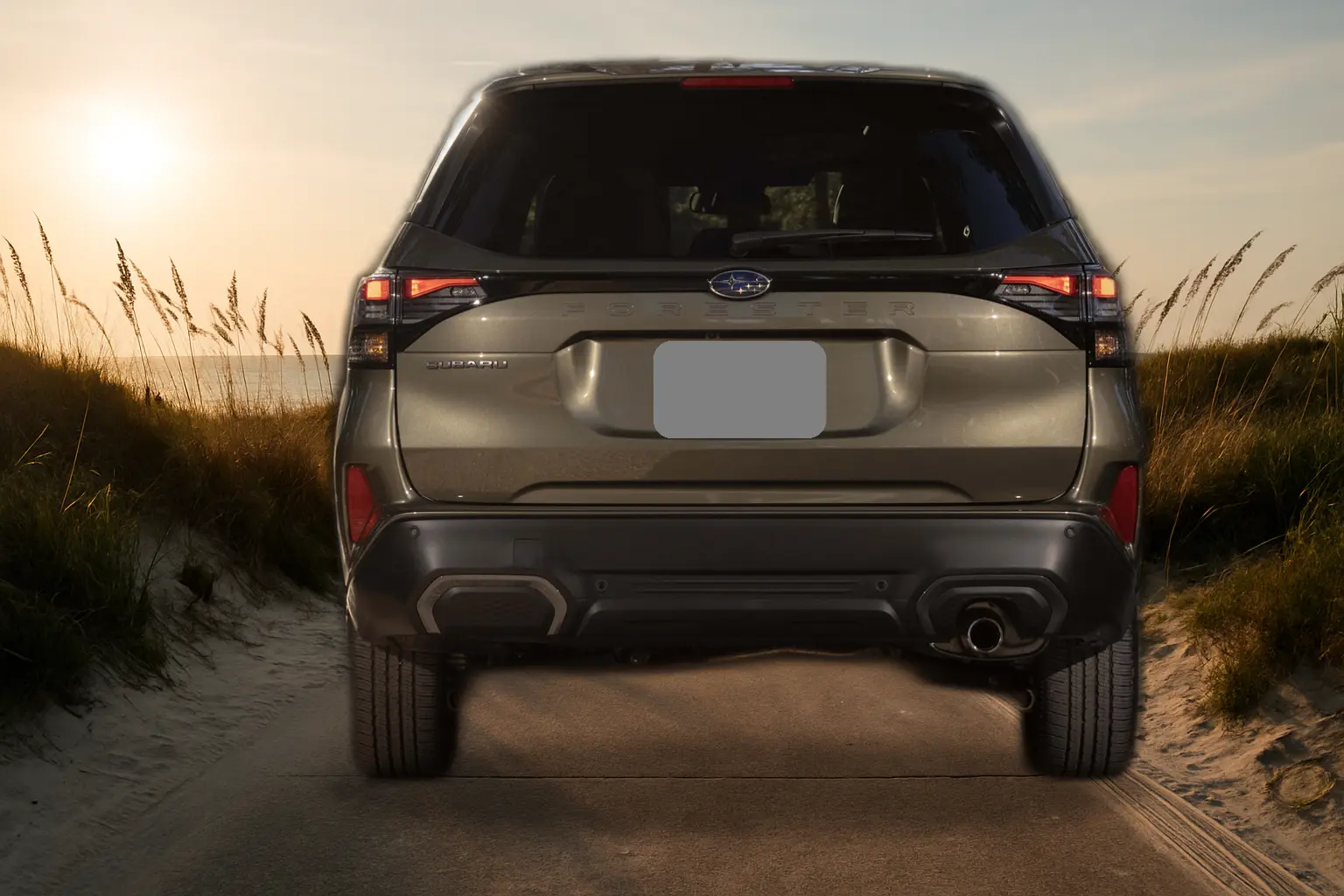
Weekends in Jacksonville rarely go according to plan. One Saturday it’s the ramp at Huguenot with soft sand and salt spray, the next it’s a downpour on the way to Ichetucknee. Families around Orange Park keep landing on the 2026 Subaru Forester for the same reasons, and we’d rather walk you through the honest ones than sell you a slogan.
What makes the 2026 Subaru Forester good for Jacksonville weekends?
Standard all-wheel drive, a high seating position, and roughly 8.7 inches of ground clearance make the 2026 Subaru Forester comfortable on sandy beach approaches, flooded intersections after summer storms, and the packed-dirt roads out to North Florida springs. It handles the everyday drive to work just as easily, which is what most families actually need.
The cabin is the other half of it. Wide door openings, a flat cargo floor, and roof rails that accept crossbars mean coolers, paddleboards, and beach chairs load without a fight. For a family bouncing between the St. Johns River and the Nassau County line, that flexibility matters more than any spec sheet number.
How does the Forester handle Florida heat, rain, and sandy roads?
Florida throws heat, humidity, and sudden downpours at a vehicle year-round, and the 2026 Subaru Forester is built to shrug them off. Symmetrical all-wheel drive sends power to all four wheels for grip on wet pavement and loose sand, while the raised ride height keeps the undercarriage clearer of standing water on flooded streets.
Jacksonville sees serious rain. The National Weather Service reports the Jacksonville area averages about 52 inches of rainfall per year, well above the U.S. average, so wet-weather traction isn’t a luxury here—it’s a weekly reality. The Forester’s driver-assist features and strong visibility also help on those low-light drives home from the coast.
- Beach access: Ground clearance and all-wheel drive help on soft, unpaved ramps like Huguenot Memorial Park.
- Storm season: Raised ride height gives more margin over flooded intersections.
- Springs and trails: Steady grip on packed dirt and gravel to Ichetucknee, Ginnie, and beyond.
- Daily commute: Same setup makes rainy I-295 mornings less stressful.
How much cargo and passenger room does the 2026 Forester offer?
The 2026 Subaru Forester seats five and offers a genuinely usable cargo area behind the rear seats, expanding significantly when you fold them flat. That’s enough for a family’s beach gear, a weekend of camping supplies, or a big-box run, and the low load floor means you’re not hoisting a cooler over your head.
Here’s how families in our showroom tend to use the space across a typical Jacksonville weekend:
| Weekend Plan | How the Forester Fits It |
|---|---|
| Beach day at Mickler’s Landing | Chairs, umbrella, cooler, and boards with seats up |
| Camping at Little Talbot Island | Rear seats folded for tent, bags, and gear |
| Springs trip to Ichetucknee | Coolers and tubes, roof rails for extra length |
| Costco or farmers market run | Full grocery haul plus stroller and kids |
Is the 2026 Subaru Forester a smart buy for a growing family?
For most Jacksonville families, yes. The 2026 Subaru Forester pairs the capability you want for coastal and springs trips with the safety features, easy car-seat access, and predictable ownership costs you want Monday through Friday. It’s a single vehicle that covers the whole week instead of forcing a compromise.
Pricing depends on trim, so we won’t throw a naked number at you—come see how a 2026 Subaru Forester Base or 2026 Subaru Forester Premium is equipped and we’ll break down current offers with the model year and trim spelled out. If you’re weighing new against a certified pre-owned option, our team at Hanania Subaru of Orange Park will lay out both side by side.
Where can Jacksonville families see the 2026 Forester in person?
You can see and test-drive the 2026 Subaru Forester at Hanania Subaru of Orange Park, right here in the Jacksonville area. We keep a range of trims on the lot so you can compare seating, cargo room, and features in person before deciding. Bring the car seats and the beach chairs—we encourage the real-world test.
A test drive tells you more than any brochure. Take it down a familiar stretch of road, load your usual gear, and see whether the space and ride actually fit your family’s weekends. Our team is happy to answer questions without rushing you toward a signature.
#How Windshield Damage Directly Impacts Your Subaru EyeSight System
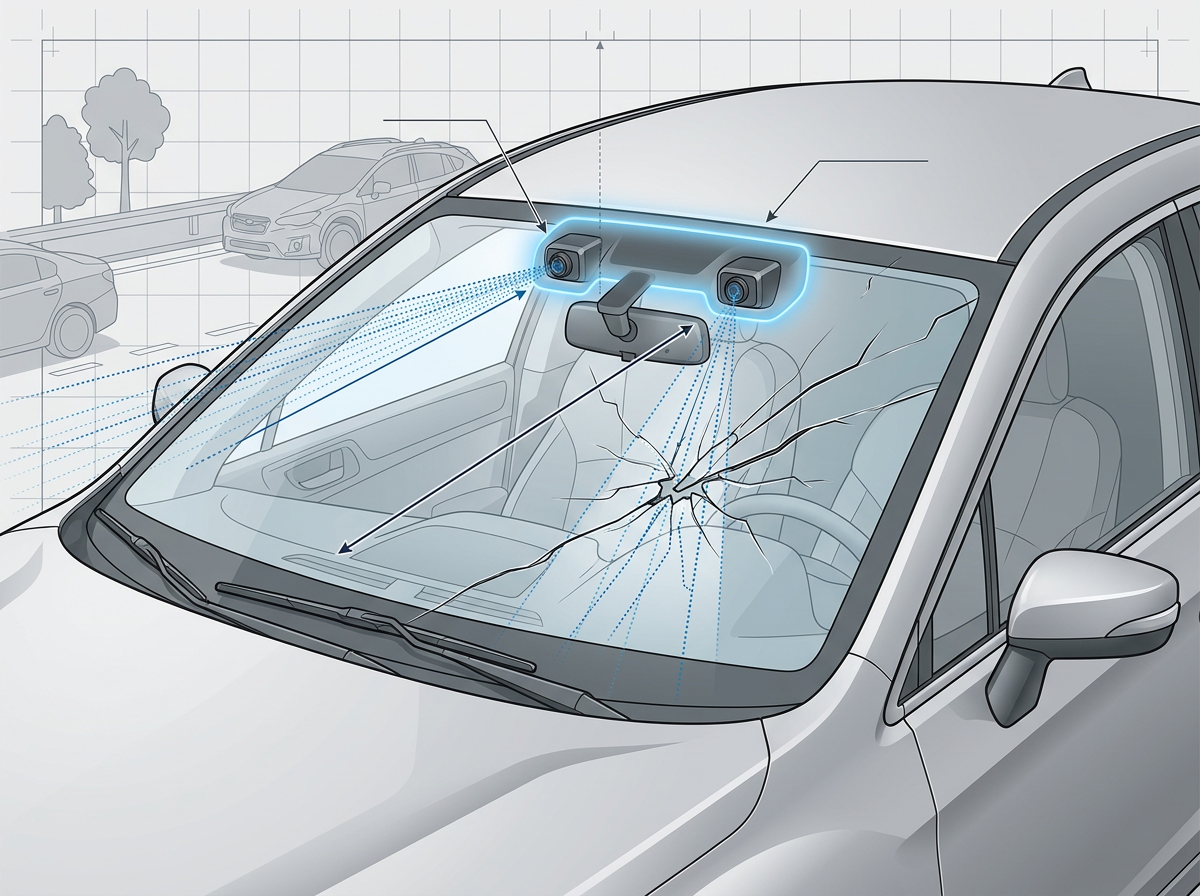
As a Service Advisor at Hanania Subaru with 6 years of experience, I spend my days helping drivers keep their vehicles in peak operating condition. One of the most frequent questions I receive in our service lane is whether a small crack or chip in the glass actually matters to the Subaru EyeSight driver-assist technology. The straightforward answer is yes; physical damage to your windshield directly compromises how this advanced safety system functions.
The Subaru EyeSight system relies on dual color cameras mounted inside the cabin, positioned right against the upper edge of your windshield. These cameras act as your vehicle’s eyes, constantly scanning the road ahead to manage features like Pre-Collision Braking, Adaptive Cruise Control, and Lane Keep Assist. When a stone chips or cracks the glass within the camera’s viewing window, it acts like a smudge on a pair of eyeglasses. The physical crack bends and distorts light, which prevents the cameras from accurately calculating distances or recognizing lane markings.
If you are currently driving with a damaged windshield, you might notice that the system behaves erratically or shuts down completely. When the cameras detect a physical obstruction or a distorted field of view, the system is designed to disable itself and display an error light on your dashboard. Trying to manually turn the system off to ignore the crack is not a safe long-term solution, as you lose crucial safety interventions. If you have noticed an error light on your dashboard, I highly recommend giving our service team a call at (904) 906-1235 so we can inspect the glass and ensure your safety systems are fully operational. For drivers who prioritize peak performance and precise handling on their daily drives, maintaining these safety systems is just as critical as maintaining the mechanical components of our new Subaru performance inventory. If you need to bring your vehicle in for a physical inspection, you can easily find our service center location and get expert help from our certified technicians.
Table of Contents
- When a Simple Chip Repair Demands a Full Calibration
- The True Cost of Advanced Driver Assist Glass Replacement
- Why OEM Glass is Crucial for Camera System Accuracy
- The Risks of Improper Calibration and How to Verify Success
- Florida Insurance Policies and Safe Driving
When a Simple Chip Repair Demands a Full Calibration
I often hear from drivers who hope a quick resin fill at a local repair stand will solve their windshield issues without needing a full system recalibration. While minor chip repairs are highly effective for standard glass, the rules change when you have a camera system mounted behind the rearview mirror. Whether you need a full recalibration after a glass repair depends entirely on where the damage is located.
Subaru defines a highly specific camera viewing area on the windshield where no repairs are permitted. This critical viewing area is the precise rectangular space directly in front of the dual lenses. If a stone chip or scratch falls inside this zone, a simple resin injection is not an option because the repair process leaves behind microscopic structural changes and slight optical distortions. Even if the repaired spot looks completely clear to your eyes, the camera lenses can still experience refraction errors, leading to delayed braking responses. For safety reasons, any damage within this viewing window requires a complete windshield replacement followed by a precise camera calibration.
For minor chips that occur well outside this designated viewing area, a professional resin repair can be completed without requiring a system recalibration. However, if the glass must be removed and replaced, a calibration is mandatory. Our factory-trained technicians use specialized diagnostic tools and physical targets to perform this alignment. If you need to address a chip or want to ensure your glass is repaired to factory standards, you can easily book an appointment online at our dedicated service center. We always stock genuine Subaru parts, including the exact glass specifications required for models like the 2026 Subaru Forester to keep your active family safe on every school run.
The True Cost of Advanced Driver Assist Glass Replacement
Many of our customers wonder why replacing a windshield on a modern vehicle is notably more expensive than it was on older cars. In the past, a windshield was simply a structural piece of safety glass designed to keep out wind and debris. Today, the windshield on your vehicle is a highly engineered optical component that serves as the primary lens for your driver-assist technology.
The total cost of a modern windshield replacement is divided into two primary parts: the specialized glass itself and the technical calibration process. Standard aftermarket glass often lacks the strict manufacturing tolerances required for camera integration. This specialized glass must feature perfect curvature, consistent thickness, and zero optical distortion in the camera’s line of sight. Additionally, the labor involved is highly technical. Our technicians must mount physical alignment targets at precise distances from the vehicle, connect specialized diagnostic computers, and perform both static and dynamic road calibrations to ensure the cameras read the road correctly.
This calibration requirement is not unique to our brand. For example, similar driver-assist systems like Toyota Safety Sense also require a complete camera calibration anytime the front windshield is replaced. Because these systems are so closely tied to your safety, cutting corners with lower-cost glass or skipped alignments is never worth the risk. If you are driving a highly capable vehicle like the 2026 Subaru Crosstrek or maintaining one of the reliable models from our certified pre-owned inventory, investing in proper, certified glass care is the best way to protect your vehicle’s long-term value and your family’s safety.
Why OEM Glass is Crucial for Camera System Accuracy
One of the first things I discuss with drivers facing a windshield replacement is the critical difference between original equipment manufacturer (OEM) glass and aftermarket alternatives. While independent glass shops may offer cheaper aftermarket options, using non-OEM glass on a vehicle equipped with Subaru EyeSight can lead to persistent system errors and safety hazards.
Subaru OEM glass is manufactured to incredibly strict specifications, ensuring that the glass in front of the camera lenses is completely free of distortions, waves, or variations in thickness. Aftermarket glass manufacturers often use different cooling processes or glass compositions, which can introduce minor, invisible distortions. While these imperfections are imperceptible to human eyes, they can bend light in ways that cause the cameras to miscalculate the distance to the vehicle ahead. This can lead to unexpected, abrupt braking or a complete system shutdown.
Furthermore, OEM glass features specialized acoustic and thermal properties that match the original design of your cabin. Using non-OEM glass can also interfere with how the windshield rain sensors and heating elements interact with the camera housing. To avoid these issues and ensure your driver-assist features work exactly as the engineers intended, it is always best to have your replacement handled by factory-certified professionals. You can easily schedule your service online with our team to have your glass replaced and calibrated using correct factory procedures.
The Risks of Improper Calibration and How to Verify Success
Let’s talk about what actually happens if a glass replacement is completed without a proper camera calibration. Skipping this step or relying on an uncertified shop can have serious consequences for how your vehicle behaves on the road. Without a successful calibration, the cameras may still “see” the road, but they will misinterpret the physical location of objects.
An uncalibrated system can calculate distances incorrectly, which might cause your Pre-Collision Braking to engage too late in an emergency, or trigger unnecessary emergency braking when no hazard is present. In other cases, the vehicle may drift out of its lane because the cameras cannot accurately locate the painted lines on the asphalt. When our certified technicians perform a calibration, they verify success by running a complete system diagnostic that generates a digital certificate of completion. This certificate confirms that the cameras have successfully recognized the physical targets and that all sensor angles are aligned within fractions of a millimeter.
We see the importance of this precision every day, especially for drivers navigating the busy coastal roads around Ponte Vedra Beach. Whether you are driving a spacious 2026 Subaru Outback or any other camera-equipped model, knowing that your safety features are aligned to factory specifications provides invaluable peace of mind. Our team always performs a thorough post-calibration road test to verify that the system tracks lanes and targets flawlessly before we hand the keys back to you.
Florida Insurance Policies and Safe Driving
From my experience working with local drivers, navigating the insurance side of a windshield replacement is often much easier than people expect, especially here in Florida. The state has specific regulations designed to encourage drivers to fix damaged glass immediately rather than putting it off due to cost concerns.
Under Florida law, if you carry comprehensive insurance coverage, your insurance provider is required by law to replace your damaged windshield with zero deductible. This means you can have your windshield replaced and fully calibrated without any out-of-pocket expenses. This zero-deductible law is incredibly beneficial because it ensures you do not have to choose between your budget and your safety. When you bring your vehicle to us, our service advisors can work directly with your insurance company to handle the paperwork, verify coverage for both the glass and the mandatory camera calibration, and get you back on the road quickly.
Whether you are commuting daily along the busy corridors of Yulee or taking a weekend trip with the family, keeping your windshield clean and structurally sound is vital. If you are driving a larger family vehicle like the 2026 Subaru Ascent, maintaining a clear view for both you and your onboard cameras is essential for highway safety. If you have questions about how your insurance policy handles these high-tech glass replacements, please feel free to reach out to our team or stop by our service center at 6400 Blanding Blvd, Jacksonville, FL 32244 so we can help you coordinate your repair.
© 2026 Hanania Subaru. All rights reserved.
Connect with us


- Automotive Partnerships & Collaborations
- Buying & Leasing
- Buying Guides
- Community & Outreach Initiatives
- Event Highlights & Celebrations
- Family Vehicles
- Hanania Subaru of Orange Park Service
- Jacksonville Subaru Dealer
- Jacksonville Subaru Service
- Local Dealership News & Activities
- Local Living
- Local Ownership Tips
- Maintenance & Service
- Model Comparisons
- Model Research
- New Vehicle Reviews
- Off-Road Adventures
- Outdoor Lifestyle
- Ownership
- Ownership & Service
- Pet-Friendly Vehicle Features
- Safety Features
- Safety Recall
- Service & Maintenance
- Subaru Care & Maintenance
- Subaru Models
- Subaru Ownership
- Subaru Technology
- Technology & Innovation
- Uncategorized
- Vehicle Comparisons
- Vehicle Guides
- Vehicle Research
- Vehicle Safety
Categories