
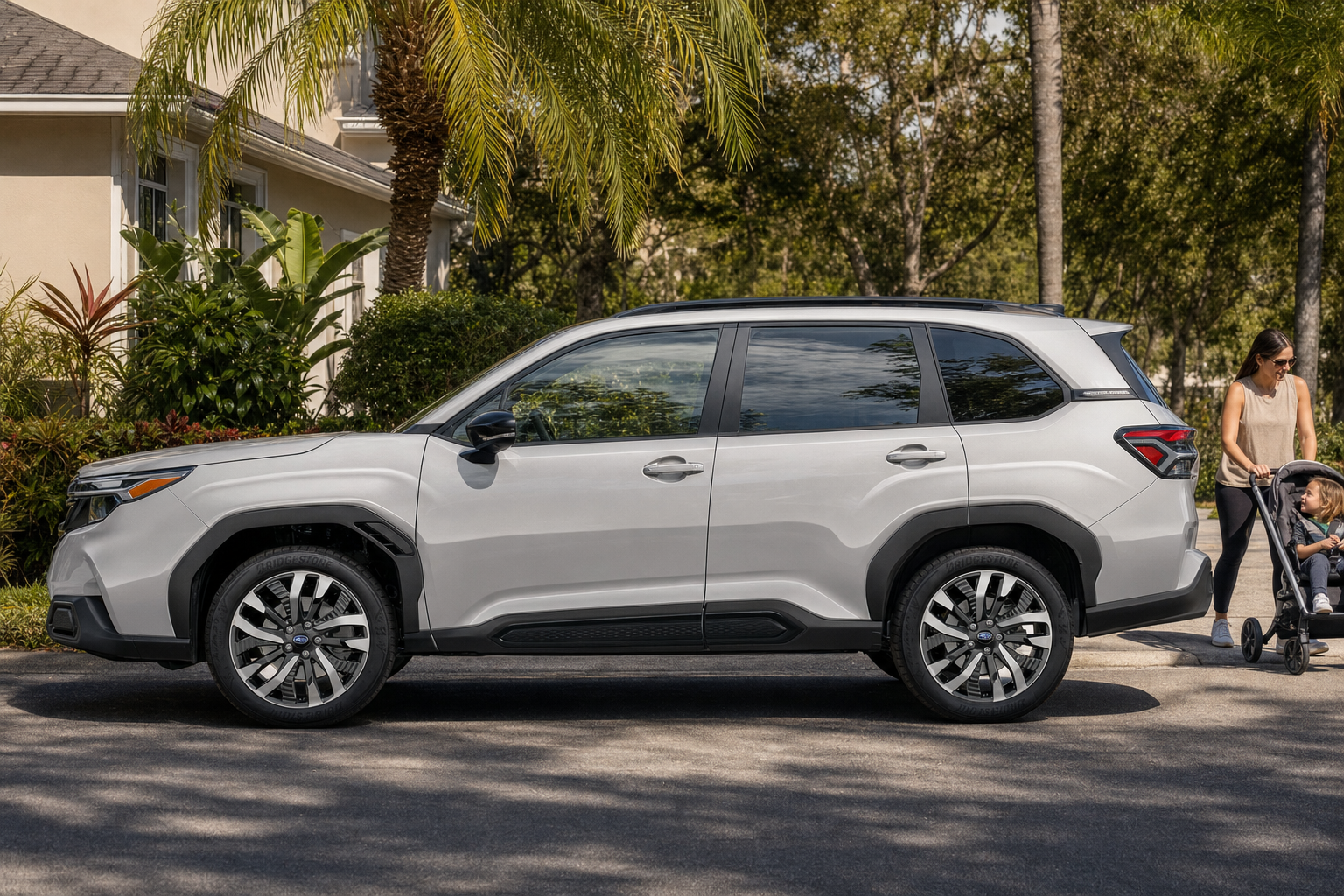
If you’re weighing the Subaru Forester vs Outback for families, you’re not choosing between a good car and a bad one. You’re choosing between two vehicles that do a lot of the same things well. The differences are real, though, and they matter more once you’re strapping in kids, loading a stroller, and driving I-295 every day. Here’s the plain-spoken breakdown from our lot in Orange Park.
What’s the real difference between the Forester and Outback for families?
Both ride on Subaru’s Global Platform with standard all-wheel drive, but the Forester is a taller, boxier compact SUV built for easy step-in access, while the Outback is a longer, wagon-style crossover with more cargo length and a lower load floor. For most Jacksonville families it comes down to seating height versus cargo stretch.
Neither has a third row, so if you need seven seats, both are off the table. For a household of four or five, either works. The Forester feels more upright and open; the Outback feels longer and more planted on the highway.
Which one has more room for car seats and cargo?
The Outback carries more cargo behind the rear seats, roughly 32.5 cubic feet versus about 26.9 in the Forester, per Subaru’s published specifications. But the Forester’s taller, more vertical door openings often make it easier to lean in and click a rear-facing car seat, which many parents value more than raw cargo numbers.
Here’s a quick side-by-side of the family-relevant numbers, based on 2026 Subaru specifications:
| Spec | 2026 Forester | 2026 Outback |
|---|---|---|
| Cargo behind rear seats | ~26.9 cu ft | ~32.5 cu ft |
| Max cargo (seats folded) | ~74.4 cu ft | ~75.7 cu ft |
| Ground clearance | 8.7 in (per Subaru) | 8.7 in (per Subaru) |
| Body style | Upright SUV | Wagon-style crossover |
Both models list 8.7 inches of ground clearance according to Subaru’s specifications, which is generous for a family vehicle and useful when a Florida afternoon storm floods the entrance to your neighborhood.
Which is better for Jacksonville driving and fuel economy?
They’re close. According to EPA estimates, the 2026 Forester with the 2.5-liter engine returns 26 mpg city and 33 mpg highway, while the 2026 Outback with the base 2.5-liter engine returns about 26 city and 32 highway. For daily St. Johns Town Center runs and Beaches commutes, you won’t notice a meaningful gap at the pump.
- Around town: The Forester’s shorter length makes tight Riverside and Avondale parking easier.
- Highway hauls: The Outback’s longer wheelbase feels calmer on a Gainesville or Savannah road trip.
- Turbo option: The Outback offers an available turbocharged engine for more passing power; the Forester’s 2026 lineup leans on its standard 2.5-liter.
Are the Forester and Outback safe enough for my family?
Both come standard with Subaru’s EyeSight driver-assist suite, including pre-collision braking and adaptive cruise, plus standard all-wheel drive. Subaru vehicles have a long history of strong crash-test results, but award status is model-year specific. Check the current ratings for your exact model and trim at iihs.org and nhtsa.gov before you decide, rather than trusting a secondhand claim.
According to IIHS data, models equipped with front crash prevention systems like EyeSight have shown large reductions in rear-end crashes, which is exactly the kind of tech that helps in Jacksonville’s stop-and-go I-95 traffic.
Which should a Jacksonville family buy?
Pick the Forester if you want the easiest car-seat access, a more upright view, and simpler parking. Pick the Outback if you regularly haul longer cargo, take highway road trips, or want the available turbo. Both handle Florida heat, rain, and the occasional dirt-road boat ramp without complaint.
The best move is to bring your actual car seats and gear to our Orange Park lot and try loading both. Any price you see should list the model year and trim, so ask us to spell out exactly what you’re looking at before you sign anything.
Connect with us


- Automotive Partnerships & Collaborations
- Buying & Leasing
- Buying & Trade-In
- Buying Guide
- Buying Guides
- Community & Outreach Initiatives
- Electric Vehicles
- Event Highlights & Celebrations
- Family Vehicles
- Hanania Subaru of Orange Park Service
- Hybrid & Electric
- Jacksonville Subaru Dealer
- Jacksonville Subaru Service
- Lifestyle
- Local Dealership News & Activities
- Local Living
- Local Ownership Tips
- Maintenance & Service
- Model Comparisons
- Model Research
- New Inventory
- New Vehicle Reviews
- New Vehicles
- Off-Road Adventures
- Outdoor Lifestyle
- Ownership
- Ownership & Service
- Pet-Friendly Vehicle Features
- Safety Features
- Safety Recall
- Service & Maintenance
- Subaru Care & Maintenance
- Subaru Lineup
- Subaru Models
- Subaru Ownership
- Subaru Technology
- Technology & Innovation
- Trade in
- Uncategorized
- Used Vehicles
- Vehicle Comparisons
- Vehicle Features
- Vehicle Guides
- Vehicle Research
- Vehicle Safety
Categories