
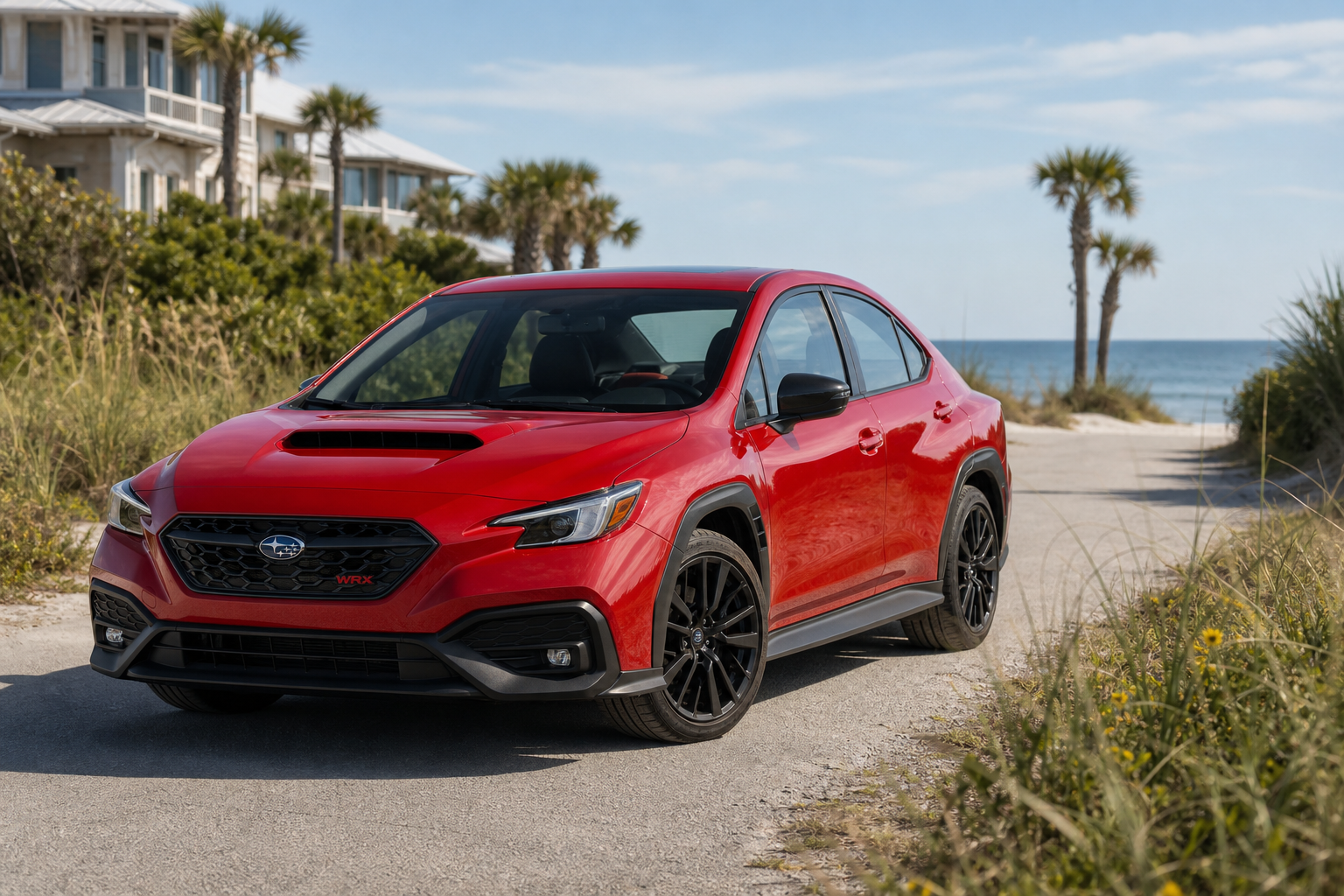
The Subaru WRX is built for grip and quick throttle response, not for topping fuel-economy charts. Still, plenty of Jacksonville drivers want honest numbers before they commit. Here’s what the WRX actually returns, why it sits where it does, and how your driving habits move the needle around town and on the highway to St. Augustine.
What is the Subaru WRX gas mileage rating?
Per EPA estimates, the 2025 Subaru WRX with the six-speed manual returns about 19 mpg city, 26 mpg highway, and 22 mpg combined. Fitted with the Subaru Performance Transmission (automatic), it lands near 18 city, 25 highway, and 21 combined. Real-world Jacksonville numbers usually track close to those figures.
| 2025 WRX Transmission | City | Highway | Combined |
|---|---|---|---|
| 6-speed manual | 19 mpg | 26 mpg | 22 mpg |
| Subaru Performance Transmission (auto) | 18 mpg | 25 mpg | 21 mpg |
These are EPA-rated estimates. Your own average depends on traffic, how hard you use the boost, and how much idling you do in summer heat with the air conditioning running.
Why isn’t the WRX gas mileage higher?
The WRX runs a turbocharged 2.4-liter boxer engine paired with standard all-wheel drive. That combination adds power and traction but also weight and drivetrain drag, which pulls fuel economy below a typical front-wheel-drive commuter car. You’re trading efficiency for performance and all-weather grip on purpose.
A few factors that keep the numbers where they are:
- Turbocharged engine: Rewards a heavy foot, and it’s tempting to use that power in a car this responsive.
- Standard all-wheel drive: Great for wet Florida roads, but it moves more hardware than a two-wheel-drive setup.
- Performance tuning: The WRX is geared and calibrated for acceleration, not for coasting economy.
- Premium fuel: Subaru recommends premium unleaded, which affects your cost per mile even when mpg stays steady.
How can I improve my WRX fuel economy in Jacksonville?
Smooth, steady driving does the most. Ease into the throttle instead of chasing boost, keep tires at the door-jamb pressure, and use cruise control on I-295 and I-95. Cutting hard acceleration and long idle time can meaningfully raise your combined average across a typical week of stop-and-go commuting.
Simple habits that pay off:
- Check tire pressure monthly; underinflated tires waste fuel and wear faster in summer heat.
- Stay on top of oil changes and air filters so the turbo engine breathes and runs clean.
- Combine errands to avoid repeated cold starts in short trips.
- Remove roof racks or extra cargo weight you’re not using.
- Use the recommended premium fuel to keep the engine mapping happy.
According to the U.S. Department of Energy, aggressive driving—rapid acceleration and hard braking—can lower gas mileage by roughly 15% to 30% at highway speeds, so a lighter foot is the cheapest upgrade you can make.
Does the WRX require premium gas?
Yes. Subaru recommends premium unleaded fuel (91 octane or higher) for the WRX’s turbocharged engine to deliver its rated power and protect long-term reliability. Running lower octane regularly can trigger the engine to pull timing, reducing performance and potentially efficiency. Budget for premium when you’re comparing running costs against a non-turbo model.
Is the WRX a good daily driver for a Jacksonville commute?
For many drivers, yes. The WRX handles I-95 traffic, summer downpours, and weekend trips to the beach with confidence thanks to standard all-wheel drive. The trade-off is fuel economy in the low-20s mpg range and a preference for premium gas. If a longer commute is your priority, weigh those costs honestly before you buy.
Want to see the current WRX in person and talk real ownership costs? Stop by Hanania Subaru of Orange Park in Jacksonville and our team will walk you through fuel expectations, trims, and a test drive on local roads.
Connect with us


- Automotive Partnerships & Collaborations
- Buying & Leasing
- Buying Guides
- Community & Outreach Initiatives
- Event Highlights & Celebrations
- Family Vehicles
- Hanania Subaru of Orange Park Service
- Jacksonville Subaru Dealer
- Jacksonville Subaru Service
- Local Dealership News & Activities
- Local Living
- Local Ownership Tips
- Maintenance & Service
- Model Comparisons
- Model Research
- New Vehicle Reviews
- Off-Road Adventures
- Outdoor Lifestyle
- Ownership
- Ownership & Service
- Pet-Friendly Vehicle Features
- Safety Features
- Safety Recall
- Service & Maintenance
- Subaru Care & Maintenance
- Subaru Models
- Subaru Ownership
- Subaru Technology
- Technology & Innovation
- Trade in
- Uncategorized
- Vehicle Comparisons
- Vehicle Guides
- Vehicle Research
- Vehicle Safety
Categories