Hanania Subaru of Orange Park

Blog / Subaru Ownership

Blog

All Subaru Ownership Buying Guides Hanania Subaru of Orange Park Service Jacksonville Subaru Dealer Subaru Models Vehicle Guides Safety Features Automotive Partnerships & Collaborations Jacksonville Subaru Service Maintenance & Service Model Comparisons Outdoor Lifestyle Model Research Service & Maintenance Vehicle Comparisons Off-Road Adventures Technology & Innovation Community & Outreach Initiatives Event Highlights & Celebrations New Vehicle Reviews Vehicle Safety Buying Guide Family Vehicles Vehicle Features Vehicle Research Local Dealership News & Activities Ownership Subaru Care & Maintenance Local Living New Vehicles Ownership & Service Pet-Friendly Vehicle Features Safety Recall Trade in Buying & Leasing Buying & Trade-In Electric Vehicles Hybrid & Electric Jacksonville Used Cars Lifestyle Local Ownership Tips New Inventory Subaru Lineup Subaru Technology Used Vehicles
Clean unbadged SUV parked in a sunny Jacksonville driveway ready for a trade-in appraisal appointment

The Subaru Trade-In Process in Jacksonville: What to Expect

Trading in a car should feel straightforward, not stressful. This guide walks through the Subaru trade-in process in Jacksonville step by step, so you know what to bring, how the number gets set, and where you can actually save money at the counter. How does the Subaru trade-in process in Jacksonville work? A Subaru trade-in in Jacksonville usually takes under an hour. You bring the vehicle and paperwork to Hanania Subaru of Orange Park, an appraiser inspects and test-drives it, checks current market data, and gives you a written offer. You can apply that value toward a new or used Subaru, or take it as a standalone offer. Step 1: Schedule or drop in for an appraisal. Step 2: A team member inspects tires, brakes, glass, body, and interior, then verifies mileage. Step 3: The vehicle gets a short test-drive to confirm how it runs. Step 4: You receive a written trade-in offer to review. Step 5: If you buy, the value is applied to your purchase and the paperwork is handled for you. What documents do you need to trade in your Subaru? Bring your title or current loan payoff details, your registration, a valid Florida driver's license, and all keys and fobs. If your name has changed or there is a co-owner, bring supporting documents and have the co-owner present. Having these ready keeps a Subaru trade-in in Jacksonville moving quickly. Document Why it matters Title or loan payoff info Confirms ownership or the amount still owed Registration Verifies the vehicle is current and matches you Driver's license Confirms identity for the transaction All keys and fobs Missing keys can lower the offer Service records Shows the vehicle was maintained How is your Subaru trade-in value determined in Jacksonville? Value comes from three things: the vehicle's condition, its mileage, and what similar vehicles are selling for right now in Northeast Florida. An appraiser at Hanania Subaru of Orange Park weighs recent maintenance, tires, and cosmetic wear against live wholesale and retail demand to reach a fair written figure for your Subaru trade-in in Jacksonville. You can help your number by cleaning the vehicle, gathering service records, and fixing small issues like a burned-out bulb. Well-kept Subaru models with documented maintenance tend to appraise stronger because they need less reconditioning before resale. Does a trade-in lower your sales tax in Florida? Yes. Florida charges 6% statewide sales tax on vehicle purchases, and per the Florida Department of Revenue, that tax applies only to the price after your trade-in credit is subtracted. So a trade-in reduces the taxable amount, which is real savings you would not get selling privately and buying separately. For example, when you trade a vehicle toward a purchase, you are taxed on the difference between the purchase price and the trade allowance rather than the full sticker. That built-in tax break is one reason many shoppers trade in at Hanania Subaru of Orange Park instead of handling two separate deals. Can you trade in a Subaru with a loan still on it? Yes, you can trade in a Subaru that still has a loan. Hanania Subaru of Orange Park gets your exact payoff from the lender and compares it to your trade value. If the value is higher, the difference goes toward your next vehicle. If you still owe more than it is worth, the gap can often be rolled into financing. Positive equity: Trade value exceeds payoff, and the surplus lowers your new balance. Negative equity: You owe more than the value, and the shortfall may be financed into the new loan. Even trade: Value and payoff match, so the loan simply closes out. Whatever your situation, the trade-in process is meant to be clear from the first number to the signed paperwork. Ask for the appraisal in writing, ask how each figure was reached, and you will leave knowing exactly where your money went.

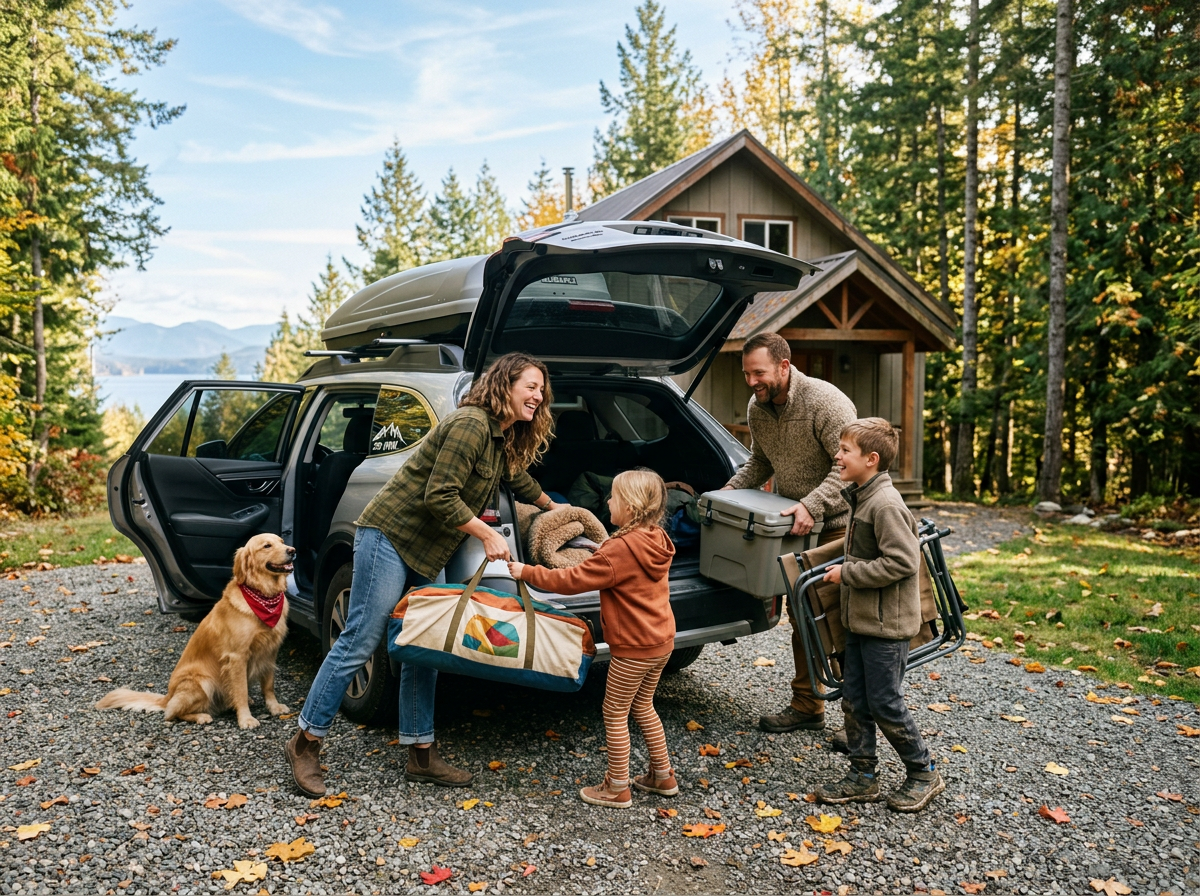
A family of four packs up their SUV with camping gear in front of a rustic cabin in the woods, accompanied by their golden retriever. (Representative image for illustration purposes only. Actual vehicle may vary based on trim and configuration.)

Why Families Trust Subaru for the Long Haul

The decision to purchase a new family vehicle often comes down to a single question: how will this investment hold up over years of daily school runs, unpredictable weather, and long highway commutes? For households seeking lasting value, the choice frequently leads to the engineering philosophy that defines the Subaru brand. Built on a foundation of durable construction and active safety, these vehicles are designed to perform reliably long after the odometer passes the six-figure mark. A primary reason for this enduring reliability is the brand's unique powertrain configuration. Unlike most conventional crossovers that rely on front-wheel-drive platforms and only engage the rear wheels when slippage occurs, Subaru vehicles feature standard Symmetrical All-Wheel Drive. This system continuously distributes power to all four wheels, optimizing traction and stability before traction is lost. Additionally, the horizontal layout of the Subaru BOXER engine places the pistons in a flat, side-to-side motion. This configuration lowers the vehicle's center of gravity, reducing body roll during cornering and minimizing cabin vibrations for a smoother ride. At Hanania Subaru, we see firsthand how these engineering choices translate into long-term owner satisfaction. For drivers who want to experience this balanced performance in a highly engaging package, we invite you to explore our new Subaru performance inventory. Every engineering detail, from the reinforced frame structures to the durable cabin materials, is selected to withstand the wear and tear of active family life. We are committed to helping you find a vehicle that serves your family for years to come. To speak with our sales or service experts, feel free to give us (904) 906-1235. If you prefer to browse our selection in person and discuss your driving needs with our team, you can easily get directions to Hanania Subaru and visit our showroom at 6400 Blanding Blvd, Jacksonville, FL 32244. Table of Contents Unpacking the Starting Price and Value of the 2026 Subaru Outback How the 2026 Subaru Outback Achieves Its 5-Star Safety Rating Evaluating Cargo Room: Subaru Outback vs Honda CR-V Navigating Coastal Sand: Can You Drive a Subaru Outback on the Beach? The High Mileage Club and Transferable Warranty Protections Common Questions About Subaru Longevity and Ownership Finding Your Perfect Family Match at Hanania Subaru Unpacking the Starting Price and Value of the 2026 Subaru Outback When shopping for a midsize crossover, understanding the entry point and the value packed into each trim tier helps clarify your overall budget. The redesigned 2026 Subaru Outback represents a substantial evolution for this iconic model, introducing a taller, more spacious body style that maximizes utility. For the 2026 model year, the 2026 Subaru Outback starts at an MSRP of $34,995 for the entry-level Premium trim, which comes equipped with a 2.5-liter four-cylinder engine producing 180 hp and 178 lb-ft of torque. As you move up the trim lineup, the vehicle adds premium amenities and performance upgrades designed to enhance comfort and capability. The Limited trim starts at an MSRP of $41,715, while the turbocharged Limited XT is priced at $44,365 and delivers a more robust 260 hp and 277 lb-ft of torque. For those seeking the pinnacle of comfort and standard features, the Touring trim carries an MSRP of $45,395, and the top-tier Touring XT reaches $47,995. Each of these models routes power through a refined Lineartronic CVT to ensure smooth, continuous acceleration. To help you find the exact configuration that matches your daily routine, you can browse our online new Outback inventory to compare available packages. If you are open to exploring other versatile models in the lineup, we also maintain a comprehensive new Subaru inventory featuring the latest crossovers and SUVs. To make your transition into a new vehicle even more seamless, our team can help you value your trade-in online to establish a clear picture of your buying power before you visit our showroom. Pricing Pricing by trim Feature Limited Limited Bronze Edition Onyx Edition-Touring Premium Touring Base MSRP $41,995 $43,495 $46,995 $34,995 $43,995 Destination charge $1,450 $1,450 $1,450 $1,450 $1,450 ​ How the 2026 Subaru Outback Achieves Its 5-Star Safety Rating Safety is rarely a secondary consideration for families, and the 2026 Subaru Outback addresses this priority through exhaustive crash-test performance and advanced driver-assist technologies. The National Highway Traffic Safety Administration (NHTSA) awards its 5-Star Overall Vehicle Score based on rigorous evaluations, including frontal, side barrier, and side pole crash tests. The 2026 Subaru Outback earns this top rating by combining a high-strength ring-shaped reinforcement frame with an array of smart safety sensors designed to protect occupants from every angle. The cornerstone of the vehicle's active safety suite is the standard EyeSight Driver Assist Technology. This system utilizes dual color cameras mounted near the rearview mirror to scan the road ahead for potential hazards. It acts as an extra set of eyes, providing features such as pre-collision braking, adaptive cruise control, and lane-keep assist to prevent accidents before they occur. In the event of an unavoidable impact, the vehicle's advanced airbag system and crumple zones are engineered to divert crash energy away from the passenger cabin. For families seeking this level of protection across different budget levels, we offer several excellent pathways. You can explore our used vehicle inventory to find reliable, safety-tested models from previous model years. Additionally, for those who prefer a slightly more compact footprint without sacrificing standard all-wheel-drive security, we encourage you to view our new Crosstrek inventory. Both models exemplify the brand's unwavering commitment to keeping your passengers secure on every journey. Engine & Performance Powertrain specs by trim Feature Limited Limited Bronze Edition Onyx Edition-Touring Premium Touring Engine 2.4L 2.4L 2.4L 2.4L 2.4L Horsepower 260 hp 260 hp 260 hp 260 hp 260 hp Torque 277 lb-ft 277 lb-ft 277 lb-ft 277 lb-ft 277 lb-ft Transmission Lineartronic CVT Lineartronic CVT Lineartronic CVT Lineartronic CVT Lineartronic CVT Drivetrain All-wheel drive All-wheel drive All-wheel drive All-wheel drive All-wheel drive ​ Evaluating Cargo Room: Subaru Outback vs Honda CR-V For active households, cargo capacity is a critical metric that dictates how easily a vehicle can transition from the weekday commute to a weekend getaway. When comparing the 2026 Subaru Outback to the Honda CR-V, the dimensions reveal distinct advantages depending on how you plan to load your gear. The Honda CR-V offers up to 39 cubic feet of cargo space behind its second row. While this is slightly higher on paper than the Outback's about 35 cubic feet of rear cargo volume, the Outback excels in real-world loading dynamics due to its longer, wagon-style cargo floor. The lower roofline and extended cargo length of the Outback make it significantly easier to slide in long, bulky items like strollers, bicycles, or camping bins. Furthermore, the Outback features a lower liftover height compared to many traditional compact SUVs, which reduces physical strain when lifting heavy coolers or suitcases into the back. When you need to maximize your carrying capacity, the rear seats of the Outback fold completely flat to unlock a massive cargo area, allowing you to transport larger items with ease. Maintaining this utility over the lifespan of your vehicle requires using components engineered specifically for your model's dimensions. If you want to protect your cargo area or expand your hauling capabilities with roof racks, you can order genuine Subaru parts directly through our department. To keep your vehicle running in peak condition for all your hauling needs, we make it simple to schedule a service appointment online with our factory-trained technicians. Dimensions & Capacity Capacity and dimensions by trim Feature Limited Limited Bronze Edition Onyx Edition-Touring Premium Touring Seating 8 7 7 8 7 Cargo 17.6 cu ft 17.6 cu ft 17.6 cu ft 17.8 cu ft 17.6 cu ft Curb weight 4,603 lbs 4,587 lbs 4,595 lbs 4,466 lbs 4,596 lbs Towing 5,000 lbs 5,000 lbs 5,000 lbs 5,000 lbs 5,000 lbs ​ Navigating Coastal Sand: Can You Drive a Subaru Outback on the Beach? The desire for outdoor adventure often leads Florida drivers to the state's iconic drivable coastlines, such as the hard-packed sands of Ponte Vedra Beach. Navigating these coastal environments requires a vehicle capable of handling shifting surfaces without getting bogged down. Thanks to its standard Symmetrical All-Wheel Drive and a generous ground clearance of 8.7 inches, the 2026 Subaru Outback is well-equipped to handle the transition from asphalt to coastal sand lanes. To optimize traction on loose surfaces, the Outback features X-MODE, an electronically controlled system that alters engine response, transmission gearing, and the all-wheel-drive power distribution. When activated, X-MODE minimizes wheel spin and maximizes grip on slippery or uneven terrain. This capability allows families to confidently access designated beach driving areas, provided they stay on the established, hard-packed paths and avoid the soft, protected dunes where even specialized off-road vehicles can struggle. For larger families who need maximum seating capacity alongside this rugged capability, the 3-row 2026 Subaru Ascent offers an excellent alternative. Equipped with a 2.4L turbocharged engine generating 260 hp and a towing capacity of 5,000 lbs, it provides the space and power required for larger excursions. You can browse our new Ascent inventory to find a model that fits your seating needs. To ensure your vehicle is fully prepared for coastal driving, our Subaru service center can inspect your tire pressures, fluid levels, and undercarriage to keep you exploring safely. ​ The High Mileage Club and Transferable Warranty Protections One of the most telling indicators of a vehicle's longevity is its representation in high-mileage communities. The Subaru High Mileage Club is an informal but highly celebrated group of owners whose vehicles have surpassed significant milestones, starting at 100,000 miles and often extending well past 300,000 miles. To honor this loyalty, the brand offers a Badge of Ownership program, allowing long-term drivers to display custom mileage and lifestyle badges on the rear of their vehicles. This long-term durability is backed by strong warranty protections that offer peace of mind to both first and subsequent owners. The standard factory warranty includes a 3-year or 36,000-mile bumper-to-bumper limited warranty and a 5-year or 60,000-mile powertrain warranty. Crucially, these warranties are fully transferable to a second owner at no additional cost, which helps preserve the vehicle's resale value and protects your investment if you choose to sell or trade the vehicle down the road. If you are looking for a vehicle that has already proven its reliability, we encourage you to browse our certified pre-owned inventory. These vehicles undergo a rigorous multi-point inspection and come with extended factory-backed powertrain coverage. When you find the right model for your household, you can easily apply for financing through our secure online portal to secure competitive rates and streamline your purchase process. Fuel Economy Fuel economy and range by trim Feature Limited Limited Bronze Edition Onyx Edition-Touring Premium Touring MPG 19 city / 25 hwy / 21 combined 19 city / 25 hwy / 21 combined 19 city / 25 hwy / 21 combined 19 city / 26 hwy / 22 combined 19 city / 25 hwy / 21 combined ​ Common Questions About Subaru Longevity and Ownership As families research their next vehicle purchase, several practical questions consistently arise regarding maintenance, mechanical specifications, and long-term care. Addressing these queries upfront helps buyers make informed decisions and maintain their vehicles properly over time. Q: Does the 2026 Subaru Outback use a timing belt or a timing chain? The 2026 Subaru Outback is equipped with a timing chain rather than a timing belt. Unlike rubber timing belts that require scheduled replacement intervals to prevent engine damage, modern timing chains are constructed from durable metal and are engineered to last the entire lifespan of the engine under normal operating conditions. Q: What are the routine maintenance intervals for a new Subaru? Subaru recommends scheduling routine maintenance every 6 months or 6,000 miles, whichever comes first. Regular service visits typically include an engine oil and filter change, tire rotation, and a comprehensive multi-point inspection to identify and address minor wear before it becomes a larger issue. Q: Is the CVT transmission fluid considered a lifetime fluid? Subaru designates its Lineartronic CVT fluid as a lifetime fluid under normal driving conditions, meaning it does not require regular replacement. However, if you frequently use your vehicle for towing or operate in severe driving conditions, our technicians recommend periodic inspections and fluid replacements to maintain optimal transmission performance. Q: How does the fuel economy of the Outback compare across its engine options? The standard 2.5-liter engine in the Outback delivers an EPA-estimated 25 city / 31 hwy MPG, making it highly efficient for daily commuting. Choosing the more powerful 2.4-liter turbocharged engine in the XT trims adjusts the efficiency slightly to an EPA-estimated 22 city / 29 hwy MPG, offering a balance of performance and utility. If you are ready to explore our lineup in person, you can view our new Forester inventory to compare another highly versatile family option. For personalized assistance, you can always call our team to speak with a product specialist. When you are ready to visit our showroom, simply get directions to our dealership on Blanding Blvd to experience our welcoming shopping environment firsthand. ​ Finding Your Perfect Family Match at Hanania Subaru Choosing a vehicle that will stand by your family through years of daily adventures is a significant decision. At Hanania Subaru, we are dedicated to providing a transparent, supportive, and personalized shopping experience that helps you navigate your options with absolute confidence. From comparing the cargo dimensions of our versatile crossovers to exploring the advanced safety features of our latest models, our team is here to guide you every step of the way. We invite you to take the next step in your automotive journey by visiting our showroom on Blanding Blvd. Whether you want to experience the confident handling of Symmetrical All-Wheel Drive on a personalized test drive, value your current vehicle, or discuss customized financing plans, we are ready to assist. Explore our online inventory today, and let us help you find the reliable, long-lasting Subaru that your family deserves. © 2026 Hanania Subaru. All rights reserved.

Subaru's Safety-Minded Vehicles are Getting a P200k Discount This Month | CarGuide.PH | Philippine Car News, Car Reviews, Car Prices

Evaluating Subaru Safety Ratings and Real-World Crash Performance

Structural integrity serves as the primary defense in any vehicle collision. The engineering behind the lineup focuses heavily on passive safety, utilizing a ring-shaped reinforcement frame constructed of high-tensile steel. This structural cage is designed to absorb and redirect impact energy away from the passenger cabin during a collision. Complementing this frame is a comprehensive airbag suite, including front, side, side-curtain, and driver's knee airbags as standard equipment on every model. This dedication to structural engineering is consistently recognized by independent safety organizations. As of March 2026, the brand has received 78 IIHS TOP SAFETY PICK+ awards since 2013 . For the 2025 model year, the Outback, Forester, Solterra, and Ascent all earned the IIHS TOP SAFETY PICK+ designation under updated crashworthiness and crash avoidance criteria . Furthermore, the 2025 Forester and Ascent achieved a 5-Star Overall Safety Rating from the NHTSA, earning five stars in frontal and side crash tests, and four stars in rollover evaluations . For families driving near the coastal plains and sandy dunes of Ponte Vedra Beach, standard all-wheel-drive traction is a necessity for navigating beachside roads and outdoor weekend excursions. Symmetrical All-Wheel Drive works in tandem with the vehicle's structural frame to maintain stability and control before an impact can even occur. For drivers seeking safety combined with sports-tuned handling, our new Subaru performance inventory showcases how safety engineering translates to active road control. Table of Contents How Subaru EyeSight Driver Assist Technology Works to Prevent Collisions Comparing Subaru Safety and Engineering Against Luxury and Mainstream Rivals Balancing Long-Term Durability, Safety Awards, and Ownership Costs Common Questions About Subaru Safety Technology and Value Finding Your Safe and Reliable Subaru How Subaru EyeSight Driver Assist Technology Works to Prevent Collisions Camera-based monitoring represents a distinct engineering approach to crash avoidance. The core of this active safety system is EyeSight® Driver Assist Technology, which is standard on every 2025 Outback, Forester, Crosstrek, Legacy, and Ascent model sold in the United States . This system utilizes dual color cameras mounted unobtrusively near the rearview mirror to scan the road ahead for potential hazards . Select models also feature a third wide-angle camera to enhance pedestrian and cyclist detection . The camera system operates several integrated safety features designed to intervene in critical situations. Pre-Collision Braking can automatically apply full braking force to help avoid or mitigate frontal collisions, while Pre-Collision Throttle Management reduces engine power if an obstacle is detected ahead in low-speed situations . For highway driving, Adaptive Cruise Control with lane centering helps maintain a safe distance from the vehicle ahead, and Lane Keep Assist along with Lane Departure and Sway Warning provides gentle steering interventions to keep the vehicle in its lane . Beyond the forward-facing cameras, the active safety suite offers comprehensive surrounding awareness. Rear Cross-Traffic Alert and Blind-Spot Detection use radar sensors to warn of vehicles in adjacent lanes or approaching from the side when in reverse . Additionally, Reverse Automatic Braking can stop the vehicle if an object is detected behind it, while the DriverFocus® Distraction Mitigation System monitors driver attentiveness and alerts those showing signs of drowsiness . This active driver-assist suite is standard across our new Subaru inventory. You can find this technology featured prominently in our new Forester inventory, which offers advanced compact SUV safety. For budget-conscious buyers, our certified pre-owned inventory includes late-model vehicles equipped with previous generations of this protective camera system. Engine & Performance Powertrain specs by trim Feature Limited Limited XT Premium Touring Touring XT Wilderness Engine 2.5L 2.4L 2.5L 2.5L 2.4L 2.4L Horsepower 180 hp 260 hp 180 hp 180 hp 260 hp 260 hp Torque 178 lb-ft 277 lb-ft 178 lb-ft 178 lb-ft 277 lb-ft 277 lb-ft Transmission Lineartronic CVT Lineartronic CVT Lineartronic CVT Lineartronic CVT High-torque Lineartronic CVT Lineartronic CVT Drivetrain All-wheel drive All-wheel drive All-wheel drive All-wheel drive All-wheel drive All-wheel drive Comparing Subaru Safety and Engineering Against Luxury and Mainstream Rivals Divergent engineering philosophies define how different automotive manufacturers approach occupant protection. When comparing active driver-assist systems, the dual-camera optical stereoscopic system differs significantly from radar-based setups like Toyota Safety Sense. While Toyota's radar-and-camera system provides excellent lane tracing on structured highways, the dual-camera setup of EyeSight excels in wide-angle pedestrian and cyclist detection in complex urban environments. Many drivers also find that the camera-based lane centering offers a more natural, intuitive steering assist compared to radar-based lane tracing. Comparing these models to luxury brands like Volvo highlights a difference in market accessibility. Volvo has historically been the industry benchmark for safety, focusing on ultra-high-strength steel passenger cages and cutting-edge occupant protection innovations. However, the engineering behind the Symmetrical All-Wheel Drive platform delivers comparable IIHS crash-test safety ratings and advanced active safety features at a mainstream price point. This makes top-tier occupant protection highly accessible to everyday drivers without the premium luxury cost. For those comparing different brands, our pre-owned vehicle inventory features a variety of makes and models to cross-shop. Families looking for the ultimate in spacious safety can explore our new Ascent inventory, which provides three rows of seating and standard driver-assist features. Alternatively, those seeking a versatile subcompact option can browse our new Crosstrek inventory to see how compact dimensions can still deliver top-tier crash protection. Balancing Long-Term Durability, Safety Awards, and Ownership Costs Long-term value in a vehicle depends on a combination of mechanical durability and predictable operational expenses. The horizontally opposed four-cylinder boxer engine and the turbocharged four-cylinder engine are engineered with a low center of gravity. This mechanical layout allows the engine to slide beneath the passenger cabin in a severe frontal impact, serving as a key passive safety feature. This unique boxer design also contributes to long-term durability when coupled with regular maintenance. While vehicles with high safety ratings can help moderate insurance costs, actual premiums are determined by individual driver profiles and the cost of replacement parts. To keep your vehicle performing reliably, our service department only uses genuine Subaru parts. You can easily schedule a service appointment online to keep your vehicle's safety systems calibrated and running smoothly. For the 2026 Subaru Outback lineup, pricing and efficiency vary by trim level. The Premium trim starts at a base MSRP of $34,995, while the Limited trim is priced at $41,715, and the Touring trim comes in at $45,395. Upgrading to turbocharged performance, the Limited XT starts at $44,365, the Touring XT at $47,995, and the off-road-oriented Wilderness trim starts at $44,995. Each of these models requires a destination charge of $1,450. In terms of fuel efficiency, the Premium, Limited, and Touring trims achieve an EPA-estimated 25 city / 31 hwy / 27 combined MPG. The more powerful Limited XT and Touring XT trims are rated at 21 city / 29 hwy / 24 combined MPG, while the rugged Wilderness trim delivers 21 city / 27 hwy / 23 combined MPG. At our dealership, every new vehicle purchase comes with a complimentary lifetime powertrain warranty and two years of scheduled maintenance. Buyers do not have to choose between long-term coverage and initial upkeep because we provide both benefits as standard. Our team at the showroom on Blanding Blvd often meets commuters from Orange Park who need a reliable, fuel-efficient crossover to handle the daily highway drive into the city. Pricing Pricing by trim Feature Limited Limited XT Premium Touring Touring XT Wilderness Base MSRP $41,715 $44,365 $34,995 $45,395 $47,995 $44,995 Destination charge $1,450 $1,450 $1,450 $1,450 $1,450 $1,450 Common Questions About Subaru Safety Technology and Value Answering critical questions about active driver assistance helps buyers make informed decisions. Before you check our new Outback inventory, let's address some common questions we receive. If you are looking to trade in your current vehicle, you can value your trade-in online to see how it fits your budget. For existing owners, our certified Subaru service center is always available to assist with safety-system maintenance. Q: Does the active driver assistance system require periodic calibration? Yes, if the windshield is replaced or if the camera housing is disturbed, the dual cameras must be precisely calibrated. Our certified technicians use specialized targeting equipment to ensure the system scans the road accurately and functions as intended. Q: How does the boxer engine design contribute to passive safety? The horizontal layout of the engine allows it to sit lower in the chassis. In a severe frontal collision, the engine is designed to slide under the passenger cabin rather than invading the footwell, protecting the occupants' legs. Q: What is the benefit of the standard Symmetrical All-Wheel Drive system in dry conditions? Symmetrical All-Wheel Drive continuously routes power to all four wheels, optimizing traction and stability even on dry pavement. This active safety feature helps prevent loss of control during sudden evasive maneuvers or sharp cornering. Q: Are there any active recalls for recent Subaru safety systems? On select 2025 Outback and Legacy models, there was a safety recall regarding a potential issue with the brake light switch that could cause intermittent illumination . Our team can quickly verify your vehicle's status and perform the necessary corrective repair. Q: How does the vehicle's structural frame protect passengers during a rollover? Every modern model uses a ring-shaped reinforcement frame made of high-tensile steel. This design encircles the passenger cabin from the roof to the floor, dispersing crash energy away from the occupants and maintaining cabin integrity. Finding Your Safe and Reliable Subaru Selecting a vehicle that prioritizes occupant protection provides lasting peace of mind. Every new model comes with manufacturer-backed roadside assistance, providing brand-specific expertise and towing to an authorized facility. If you ever experience an emergency on the road, you can contact Subaru Roadside Assistance at 1-800-261-2155 for immediate, trusted support. To begin your purchase journey, you can prequalify for financing online using our secure application. When you are ready to experience these advanced safety systems firsthand, you can find our showroom at 6400 Blanding Blvd or give us a quick call to schedule a personalized test drive. © 2026 Hanania Subaru. All rights reserved.
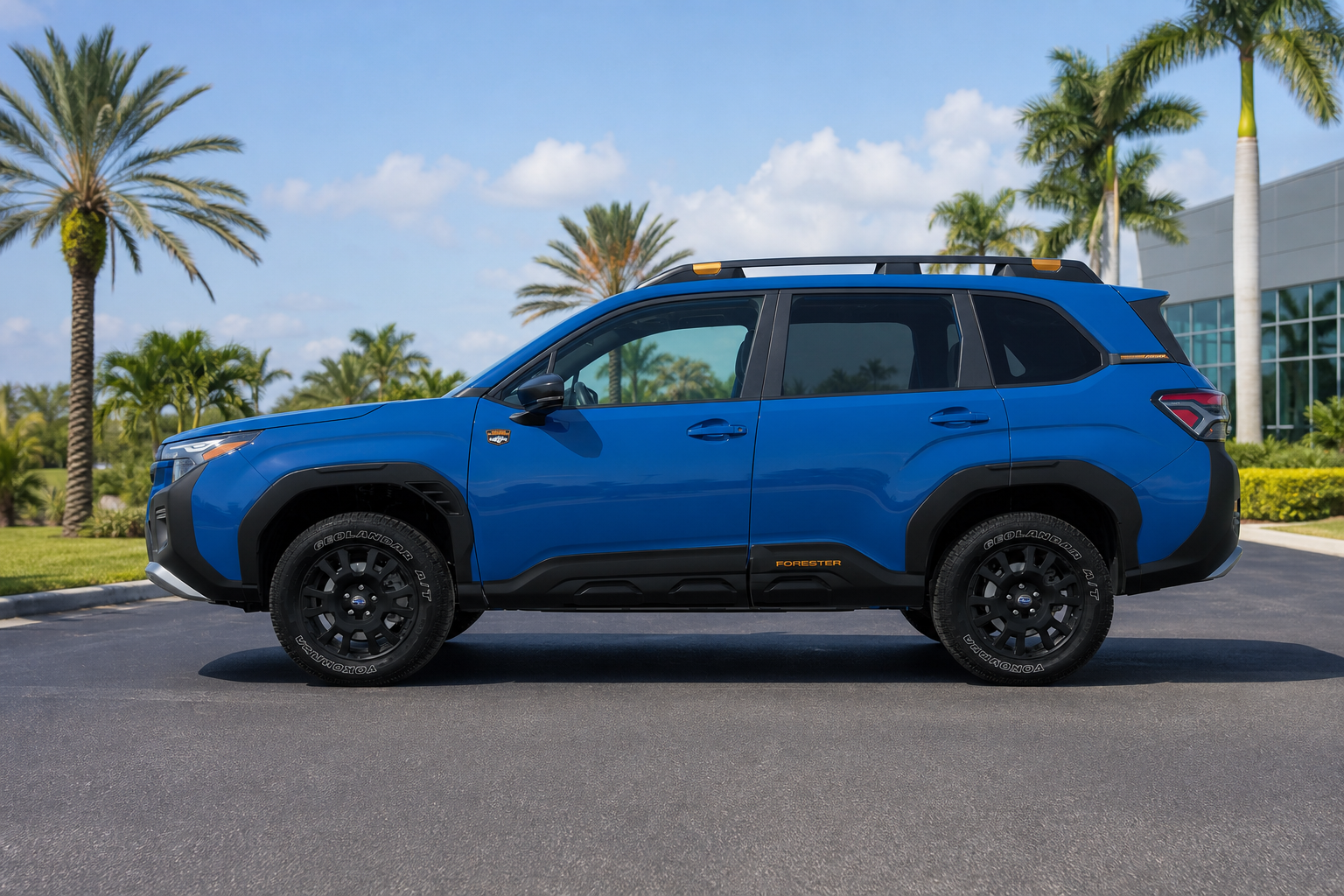
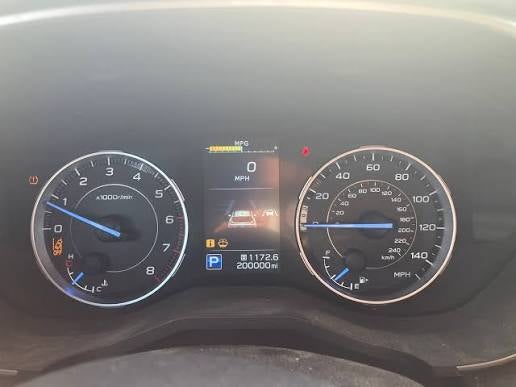
Subaru Ascent reaches 200,000 miles with minimal maintenance

How Regular Service Helps Subaru Models Reach 200,000+ Miles

Reaching the quarter-million-mile mark is a point of pride for Subaru owners, but that kind of longevity is rarely an accident. We sat down with Brent Davis, a Service Advisor at Hanania Subaru with 6 years of experience, to discuss the specific maintenance blueprints required to keep these vehicles running reliably through decades of Florida driving. In this interview, Brent explains how consistent care and technical precision allow models like the Outback and Forester to outlast the industry average. Q: Brent, we often hear about Subarus lasting for decades, but what is the actual baseline for an owner who wants to see 200,000 miles on their odometer? A: The foundation for that kind of longevity starts with the 6,000-mile or six-month service interval. Most people think of this as just an oil change, but for a high-mileage candidate, it is actually a comprehensive health check. In our environment, where the hot Florida sun and high ambient temperatures place constant thermal stress on the engine, staying disciplined with these visits is non-negotiable. I tell owners that the vehicles we see reaching 200,000 miles are almost always the ones that never skipped a fluid inspection or a filter replacement. If you are driving in from Ponte Vedra Beach after a weekend at the coast, that salt air and humidity make it even more important to have our Subaru Service Center technicians look for early signs of corrosion or belt wear. You can reach our team at (904) 906-1235 to discuss a personalized plan, or stop by our location at 6400 Blanding Blvd, Jacksonville, FL 32244 to get a baseline inspection for your vehicle. Q: Walk me through a scenario where an owner is approaching that first major 100,000-mile threshold—what are the most critical items they need to address? A: When a customer brings in a vehicle like the 2026 Subaru Crosstrek with high miles, we focus heavily on the 30,000-mile, 60,000-mile, and 90,000-mile milestones. By the time you hit 100,000 miles, you should have already replaced your spark plugs at least once, especially on FA-series turbo engines where they are rated for 60,000 miles. We also look closely at the cooling system. If the coolant is neglected, it can lead to overheating, which is the quickest way to end an engine's life. For those driving a Subaru Crosstrek or similar model, we also emphasize differential fluid changes. These are often overlooked, but the rear differential needs fresh fluid every 30,000 to 60,000 miles to prevent the internal gears from whining or wearing down prematurely. Catching these items at 90,000 miles sets the stage for the next 100,000 miles of trouble-free driving. Q: Is there a significant difference in how you maintain the Boxer engine compared to a traditional inline-four to ensure it lasts "forever"? A: The horizontally-opposed Boxer engine is a masterpiece of balance, but its layout means gravity affects lubrication and sealing surfaces differently than an upright engine. For maximum life in a 2.5L H4 engine, such as the one found in the Subaru Forester, using the required 0W-20 synthetic oil is critical. Synthetic oil handles the internal heat of our Florida summers much better than conventional blends, preventing the "sludging" that can clog oil passages. I also remind owners that the Boxer engine has more sealing surfaces, so we keep a close eye on valve cover gaskets and cam seals as the vehicle ages. If you notice a faint smell of oil after a long drive, it is time to schedule your service appointment immediately. Addressing a small seep early prevents it from becoming a major leak that could starve the engine of lubrication at high speeds. "The vehicles we see reaching 200,000 miles are almost always the ones that never skipped a fluid inspection or a filter replacement." Q: Many drivers worry about the CVT transmission as they get into higher mileages; what should they be watching for? A: There is a common misconception that CVT fluid is "lifetime," but in my experience, that is only true if you don't plan on keeping the car past 100,000 miles. For a Lineartronic CVT, like the one in the 2026 Subaru Outback, we recommend a fluid exchange every 60,000 miles, or even every 30,000 miles if you are doing heavy stop-and-go commuting. If you live in Yulee and commute daily into Jacksonville along US Highway 17, that constant shifting and heat build-up can degrade the fluid faster. Signs that you need service include a slight shudder when accelerating or a delayed engagement when shifting from Park to Drive. We always use genuine Subaru parts and high-torque CVT fluid because generic fluids can actually cause internal slipping. Maintaining the transmission is vital for the Symmetrical All-Wheel Drive system to function correctly in a Subaru Outback, ensuring power is distributed evenly to all four corners without mechanical strain. Q: How strictly should owners follow the 2/32-inch rule for tire tread depth, and can it really destroy the AWD system? A: It absolutely can. The Symmetrical AWD system is incredibly sensitive to the rolling circumference of the tires. If one tire is significantly more worn than the others, it has to spin faster to keep up, which creates a constant "traction event" in the center differential. This generates heat and mechanical stress that can lead to a repair bill in the thousands. Subaru specifies that tread depth should not vary by more than 2/32 of an inch between any two tires. This is why regular tire rotations every 6,000 miles are so important. If you have a larger vehicle like the 2026 Subaru Ascent, which carries more weight and places more load on the tires, this rule is even more critical. If you ever damage just one tire on your Subaru Ascent, we often have to recommend replacing all four to keep that drivetrain synchronized and protected for the long haul. Q: Brent, why is it better for a long-term owner to choose a dealership like Hanania Subaru over a general repair shop for this 200,000-mile journey? A: I recently observed a customer who had been using a general shop for years and was frustrated by a recurring EyeSight Driver Assist error. It turned out the non-OEM windshield they had installed wasn't calibrated to the cameras. At Hanania Subaru, our technicians are factory-trained specifically on these systems. We also provide the Hanania Lifetime Warranty and two years of maintenance with every new vehicle purchase, which is a massive advantage for someone planning to keep their car for 15 years. Whether you are looking at our Subaru performance inventory for a weekend car or browsing our certified pre-owned Subaru models for a reliable daily driver, you get the peace of mind that comes with OEM parts and specialized diagnostics. You can find us at 6400 Blanding Blvd, Jacksonville, FL 32244, or give us a quick call to discuss how we can help your current Subaru reach that 200,000-mile goal. If you ever run into trouble on the road, remember that Subaru Roadside Assistance is available at 1-800-261-2155 to ensure you are never stranded. Reaching high mileage in a Subaru is a partnership between the owner's diligence and expert technical support. By adhering to the 6,000-mile service interval, using synthetic oil, and respecting the 2/32-inch tire wear rule, you can protect your investment for years to come. Brent Davis and the entire team at Hanania Subaru are dedicated to providing the transparent, expert care necessary to keep your vehicle on the road for its next 100,000 miles. Visit our service department today to ensure your Subaru is prepared for the long journey ahead. © 2026 Hanania Subaru. All rights reserved.
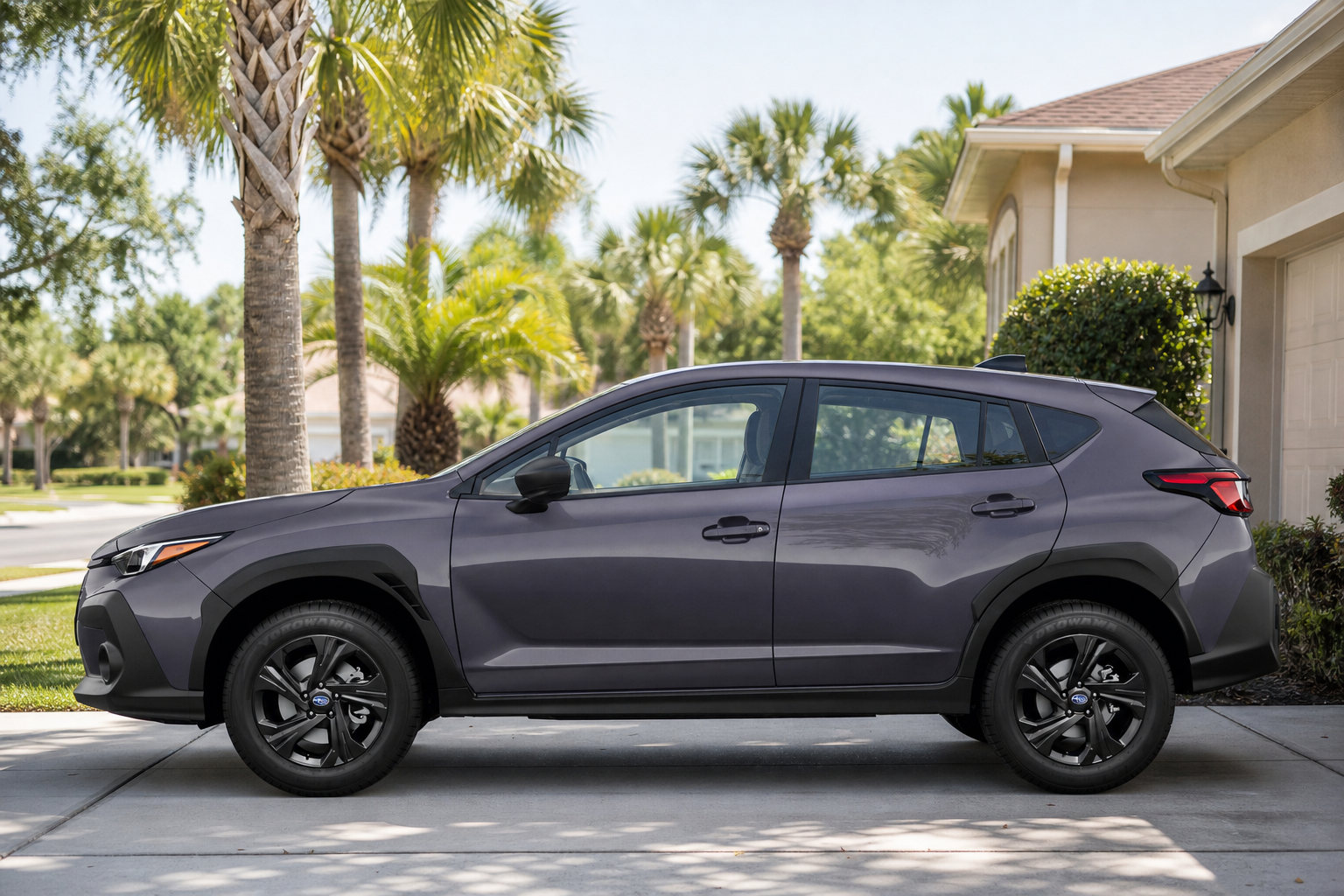
Technician rinsing salt from a Subaru undercarriage to prevent coastal corrosion in Jacksonville

Protecting Your Subaru from Salt Air and Coastal Corrosion in Jacksonville

If you live in Jacksonville Beach, Ponte Vedra, near the Mayport ferry, or you just commute along A1A, salt is part of your daily drive whether you notice it or not. You don't have to park on the sand to deal with rust. Managing salt air corrosion Subaru Jacksonville owners face is really about a simple routine, and this guide from the service team at Hanania Subaru of Orange Park walks you through it, step by step, with no pricing and no upsell. Does salt air really rust cars in Florida even if I never drive on the beach? Yes. Salt air rusts cars across the First Coast even if your tires never touch sand. Airborne salt settles on your undercarriage, brake lines, and paint edges, then pulls moisture from our humid climate. That constant salt-plus-moisture cycle speeds oxidation, so both parked and beach-bound Subarus face real corrosion risk over time. Salt spray can drift up to 50 miles inland, according to NOAA coastal air-quality research, which means neighborhoods well west of the beaches still collect a fine salty film on cars. Corrosion isn't cheap to reverse, either —related repairs cost U.S. drivers roughly three billion dollars over a recent multi-year span, per AAA's reporting on vehicle maintenance costs. The good news: prevention is straightforward. These are the components that tend to corrode first on coastal Subarus: Undercarriage and subframe: where salt spray collects and lingers out of sight. Brake and fuel lines: exposed steel lines are prime rust targets and a safety concern. Exhaust system: heat plus salt accelerates pitting and thinning. Battery terminals: salty, humid air encourages white or greenish corrosion buildup. Paint edges and rock chips: door bottoms, wheel arches, and hood edges where bare metal is exposed. How often should I wash my car if I live near the beach? If you live near or commute past the beaches, rinse your Subaru every one to two weeks, and after any windy coastal day. Always include a thorough undercarriage rinse, since that's where salt hides. Drivers farther inland can stretch to every two to three weeks, but shouldn't skip the underbody flush. A plain-water rinse is better than nothing, but a proper wash with car soap lifts salt more effectively. Here's a practical cadence for coastal Jacksonville drivers: Task How often Why it matters Full wash + undercarriage rinse Every 1–2 weeks (beach-close) Removes salt before it sets and draws moisture Quick water rinse After windy or salty-air days Keeps salt film from baking onto paint Wax or paint sealant Every 3–4 months Adds a barrier over paint and edges Battery terminal check Monthly Catches corrosion buildup early A few extra habits go a long way: park in a garage when you can, use a breathable car cover rather than a plastic tarp that traps moisture, and don't let mud or road grime sit in the wheel wells. If you can reach it with a hose, spray the underbody, inner fenders, and behind the wheels. What are the warning signs of salt air corrosion Subaru Jacksonville drivers should watch for? Watch for bubbling or flaking paint, orange or brown staining near seams and door bottoms, white crust on battery terminals, squeaky or grinding brakes, and any flaking metal under the car. A rough or louder exhaust note can also signal rust thinning the system. Any of these deserves a professional inspection soon. Some corrosion is cosmetic, but some is a safety issue — especially rusted brake lines, which can fail without much warning. Use this quick self-check between service visits: Peek under the car for flaking rust, especially along brake and fuel lines. Run a hand along door bottoms and wheel arches for rough, bubbling paint. Pop the hood and look for powdery buildup on battery terminals. Listen for new squeaks, grinding, or a raspier exhaust. Note any brake pedal that feels soft or spongy — get that checked right away. How can Hanania Subaru of Orange Park help protect my Subaru from corrosion? The service team at Hanania Subaru of Orange Park can perform a corrosion-focused inspection of your undercarriage, brake and fuel lines, exhaust, and battery terminals, then recommend protective treatments and undercoating options suited to coastal driving. Hanania Subaru of Orange Park uses Subaru-specified parts and procedures, so any repairs match how your vehicle was built. If you commute along A1A or live near the water, ask Hanania Subaru of Orange Park to add a corrosion check to your regular maintenance visit. Catching surface rust or a corroding brake line early is far simpler than replacing a component after it fails. Bring any warning signs you've noticed to the appointment so the technician knows where to look first.

Contact Us

Fill out this form below and we'll contact you shortly
*Required Fields