Hanania Subaru of Orange Park

Blog

All Buying Guides Jacksonville Subaru Dealer Hanania Subaru of Orange Park Service Subaru Models Vehicle Guides Safety Features Automotive Partnerships & Collaborations Maintenance & Service Jacksonville Subaru Service Model Comparisons Outdoor Lifestyle Model Research Service & Maintenance Vehicle Comparisons Off-Road Adventures Subaru Ownership Technology & Innovation Buying Guide Community & Outreach Initiatives Event Highlights & Celebrations New Vehicle Reviews Vehicle Safety Family Vehicles Ownership Vehicle Features Vehicle Research Buying & Leasing Local Dealership News & Activities Ownership & Service Pet-Friendly Vehicle Features Subaru Care & Maintenance Buying & Trade-In Local Living New Vehicles Safety Recall Trade in Dealership Electric Vehicles Hybrid & Electric Jacksonville Used Cars Lifestyle Local Ownership Tips New Inventory Subaru Lineup Subaru Technology Used Vehicles
Unbadged SUV parked on a wet Jacksonville street after a summer rain, illustrating brake care in Florida

Subaru Brake Maintenance Schedule: What Jacksonville Drivers Need to Know

Brakes wear a little every time you drive, and Jacksonville traffic on I-295 and stop-and-go stretches of Blanding Boulevard is harder on them than most people think. Here is a straight answer on when to check your brakes, what wears out first, and what the work actually costs at our shop. How often should you follow a Subaru brake maintenance schedule? Follow a Subaru brake maintenance schedule that inspects the pads, rotors, and fluid at least every 6 months or 6,000 miles, whichever comes first. Front pads typically last 30,000 to 70,000 miles depending on driving style, while brake fluid should be replaced roughly every 30,000 miles or 3 years to stay effective. The 2025 Subaru Outback Owner's Manual lists brake inspections on the 6-month/6,000-mile interval and calls for brake fluid replacement at 30,000 miles. Intervals are similar across the 2025 Subaru Forester, Crosstrek, and Ascent, but the exact numbers live in your specific model-year manual, so it is worth confirming against yours. Component Inspect Typical replacement Front brake pads Every 6,000 miles 30,000–70,000 miles Rear brake pads Every 6,000 miles 40,000–80,000 miles Rotors Every 6,000 miles As needed (often with second pad set) Brake fluid Every 6 months Every 30,000 miles or 3 years What are the signs your Subaru brakes need service? Watch and listen for a high-pitched squeal when stopping, a grinding sound, a soft or spongy pedal, vibration through the pedal, or the vehicle pulling to one side. A dashboard brake warning light or noticeably longer stopping distances also means it is time to have the system inspected right away. Squealing: the wear indicator is telling you pads are getting thin. Grinding: metal-on-metal contact that can damage rotors quickly. Spongy pedal: possible air or moisture in the brake fluid. Vibration: often warped or unevenly worn rotors. Pulling: a sticking caliper or uneven pad wear. According to NHTSA's National Motor Vehicle Crash Causation Survey (report DOT HS 811 059, 2008), brake-related problems were the critical reason in roughly 22 percent of crashes traced to a vehicle failure. That is a strong argument for not ignoring a squeal or a soft pedal. How much does Subaru brake service cost in Jacksonville? At Hanania Subaru of Orange Park in Jacksonville, a brake inspection is straightforward and often included with routine maintenance visits. A front or rear pad replacement using genuine Subaru parts commonly runs a few hundred dollars per axle, and rotor replacement adds to that. We give you the exact figure in writing before any work begins. Florida heat and humidity also play a role. Frequent short trips and stop-and-go driving in the summer keep brakes hot, and coastal moisture can accelerate corrosion on rotors and hardware. A twice-a-year inspection catches surface rust and thinning pads before they turn into a bigger repair. Can you make your Subaru brakes last longer in Florida? Yes. Leave more following distance so you coast to stops instead of braking hard, take weight out of the vehicle when you can, and avoid riding the brake pedal on long downgrades. Keeping up with the 6-month fluid and pad inspections at a Subaru shop is the single most effective habit for extending brake life. Two more Jacksonville-specific tips: after driving through standing water during summer storms, gently apply the brakes a few times to dry them, and rinse road salt or beach-area grit off the underside of the vehicle so it does not sit on the calipers and rotors. If your brakes are due for a look or something feels off, the service team at Hanania Subaru of Orange Park can inspect the full system, show you the measurements, and tell you plainly what needs attention now versus what can wait.

Compared: 2024 Honda Civic vs. 2024 Subaru Impreza | Capital One Auto Navigator

Why Compact Car Shoppers are Rethinking the Civic

I've spent over 5 years helping people find the right vehicle, and lately, I've noticed a shift in what drivers are looking for in a small car. While the Honda Civic has been a go-to for decades, the 2026 Subaru Impreza is changing the conversation by offering a level of standard utility that the Civic simply doesn't match. Many shoppers who visit us are surprised to find that the Impreza is now available exclusively as a hatchback, a body style that provides significantly more flexibility for an active lifestyle than a traditional sedan. When I walk customers through our new-vehicle inventory, the first thing we usually talk about is the sheer value of the Impreza lineup. For 2026, the base model has been discontinued, leaving the Sport and RS as the primary choices. The 2026 Subaru Impreza Sport starts at $30,126, while the more powerful 2026 Subaru Impreza RS is priced at $33,256. These figures aren't just competitive; they include standard features that often cost thousands more on a Civic. If you're currently weighing these two options, I invite you to give our team (904) 906-1235 a quick call to discuss what we have on the lot. Seeing these cars in person makes a world of difference, and you can easily find our showroom address to stop by for a walk-around. The Impreza isn't just about getting from point A to point B; it's about having a car that's ready for whatever the day throws at you. Standard Symmetrical All-Wheel Drive Versus Front-Wheel Drive Commutes One of the most frequent questions I get is why all-wheel drive matters in a place like Florida. It's a fair point until you're caught in a sudden afternoon downpour on I-295. Every 2026 Subaru Impreza comes standard with Symmetrical All-Wheel Drive, a system that provides constant power to all four wheels for maximum traction. In contrast, the Honda Civic remains a front-wheel-drive vehicle across its entire lineup, which can leave you feeling less planted when the roads get slick. Our team often sees buyers who are trading in older sedans because they want that extra layer of confidence. If you're looking for that same capability in a larger package, we also have a great selection of new Subaru Outback models that utilize the same legendary drivetrain. For those looking to keep their monthly payments lower, browsing our current used-vehicle inventory is a smart way to find AWD technology at an even more accessible price point. Even with the added weight and grip of a 4WD system, the Impreza remains highly efficient for daily commuting. The Sport trim delivers 27 mpg city / 36 mpg highway, resulting in a 32 mpg combined rating. If you opt for the larger engine in the RS, you'll still see a solid 26 mpg city / 33 mpg highway, or 30 mpg combined. It’s impressive to see a car offer this much grip without forcing you to spend significantly more at the pump than you would with a front-wheel-drive rival. Table of Contents Comparing the Boxer Engine Performance and Trim Lineups Cabin Comfort and Cargo Utility on the Jacksonville Highway Standard Safety Technology and Crash Test Excellence Smart Financing and Getting the Best Value at Hanania Subaru Comparing the Boxer Engine Performance and Trim Lineups What engine options do the 2026 Subaru Impreza and Honda Civic offer? This is where the engineering really sets these cars apart. The Impreza uses a BOXER engine, which sits lower in the chassis for a better center of gravity. The Sport trim features a 2.0L H4 engine, while the RS steps up to a 2.5L H4 that has been revised for 2026 to be even more responsive. Both are paired with a Lineartronic CVT that manages power smoothly during acceleration. Fuel Economy EPA-estimated fuel economy ratings Feature Sport RS City MPG 27 mpg 26 mpg Highway MPG 36 mpg 33 mpg Combined MPG 32 mpg 30 mpg Standard across all trims: Fuel Type Unleaded Best combined fuel economy: Sport at 32 mpg I often tell shoppers that if they want a bit more "zip" in their daily drive, the RS is the way to go. It’s a performance-oriented trim that feels sharper on the road thanks to a sport-tuned suspension. For those who need even more capability or perhaps a different form factor, you might want to look at our new Crosstrek inventory or even the three-row Subaru Ascent if your family is growing. If you are a true driving enthusiast, I always recommend checking out our Subaru performance models like the WRX, which takes that same AWD DNA and turns it up to eleven. However, for most people, the 182 hp found in the Impreza RS provides the perfect balance of power and practicality. It gives you the confidence to merge into fast-moving traffic without the hesitation sometimes felt in smaller-displacement engines. Cabin Comfort and Cargo Utility on the Jacksonville Highway How much space do you actually get? In my experience, the hatchback design of the Impreza is its "secret weapon" against the Civic. While the Civic is a great car, the Impreza offers a roomy interior that feels much larger than its compact footprint suggests. You get about 20 cubic feet of cargo space with the rear seats up, but that expands to a massive 56 cubic feet when you fold the 40/60-split rear seats down. This is perfect for hauling everything from surfboards for a trip to Ponte Vedra Beach to a full load of groceries. Pricing MSRP and destination charges (source: MarketCheck VIN Decode (consensus)) Feature Sport RS Starting MSRP $30,126 $33,256 Lowest starting MSRP: Sport at $30,126 Engine & Performance Powertrain specifications across trim levels Feature Sport RS Engine 2.0L H4 2.5L H4 Standard across all trims: Feature Included Transmission CVT Drivetrain 4WD The cabin is designed for durability, featuring high-quality materials that can stand up to the sand and sun we deal with every day. If you're looking for a vehicle with even more ground clearance for off-road weekend trips, you can compare the Impreza to our new Forester inventory right here on the lot. We also maintain a high-quality selection of certified pre-owned Subaru models for those who want that "new car" feel and warranty protection with a smaller price tag. Inside the 2026 Subaru Impreza, tech is front and center with a standard 11.6-inch touchscreen that includes wireless Apple CarPlay and Android Auto. I find that most of our customers in Orange Park appreciate how easy the system is to use; the icons are large, and the response time is quick. It makes managing your navigation and music during a long commute much less stressful, allowing you to keep your focus on the road ahead. Standard Safety Technology and Crash Test Excellence Subaru has always been synonymous with safety, and the 2026 Subaru Impreza continues that legacy. It has earned the IIHS TOP SAFETY PICK award, which is one of the highest honors in the industry. For 2026, Subaru even added new standard rear-seat side airbags to further protect your passengers. This commitment to safety is a huge reason why so many families choose us when they are looking for a reliable vehicle. Dimensions & Capacity Feature Standard across all trims Seating Capacity 5 Length 176.2 Width 70.1 Height 59.5 Every Impreza comes standard with EyeSight Driver Assist Technology. This suite includes features like Pre-collision Braking, Lane Departure Warning, and Adaptive Cruise Control. These systems act like a second set of eyes, helping to prevent accidents before they happen. While the Honda Civic has its own safety suite, Subaru’s integration of EyeSight with Symmetrical All-Wheel Drive creates a safety net that is hard to beat. We want to make sure your vehicle stays as safe as the day you bought it, which is why we make it easy to schedule a service appointment with our factory-trained technicians. Remember, every new Subaru purchased from us comes with a complimentary Lifetime Warranty and 2 years of Maintenance. It’s our way of ensuring you can drive with total peace of mind through every season. Smart Financing and Getting the Best Value at Hanania Subaru The question I get most often is about the bottom line: is the Impreza a better value than the Civic? When you factor in the standard AWD, the advanced safety tech, and our exclusive dealer benefits, the answer is a resounding yes. We often see the Impreza transacting at prices that offer more "car" for the money than a similarly equipped Civic. Plus, the Subaru Limited Warranty provides 3 years / 36,000 miles of basic coverage and 5 years / 60,000 miles for the powertrain, along with standard Roadside Assistance. Safety & Driver Assistance Safety ratings and driver assistance systems Feature Sport RS IIHS Rating TOP SAFETY PICK TOP SAFETY PICK Standard across all trims: Feature Included Small overlap front (driver-side): Good (G) ✓ Small overlap front (passenger-side): Good (G) ✓ Moderate overlap front (updated test): Overall evaluation Marginal (M) ✓ Side (updated test): Good (G) ✓ Side: Driver torso: Acceptable (A) ✓ Side: Driver head protection G (Good) ✓ Side: Rear passenger torso: Acceptable (A) ✓ Side: Rear passenger head protection G (Good) ✓ Headlights (all trims): Overall rating Good (G) ✓ Front crash prevention (vehicle-to-vehicle 2.0): Overall evaluation Good (G) ✓ Front crash prevention (pedestrian): Overall evaluation Good (G) ✓ Seat belt reminders: Overall evaluation Good (G) ✓ Child seat anchors: Overall evaluation Good (G) (+ extra LATCH positions) ✓ To get started, I recommend that you value your trade-in online so you have a clear idea of your buying power. Our finance team is excellent at working with all types of credit, and you can prequalify for financing through our secure website to save time when you visit. We’re here to make the process transparent and straightforward, whether you're a first-time buyer or a long-time Subaru enthusiast. If you’re ready to see the difference for yourself, come visit us at 6400 Blanding Blvd. You can also reach out to me directly by giving us a quick call to set up a personalized test drive. Whether you're commuting from Yulee or just driving around town, the 2026 Subaru Impreza is built to handle it all with style and safety. Keep Your Vehicle Running Strong Keep your vehicle performing at its best with our service team: Subaru Service Center Genuine Subaru Parts © 2026 Hanania Subaru. All rights reserved.

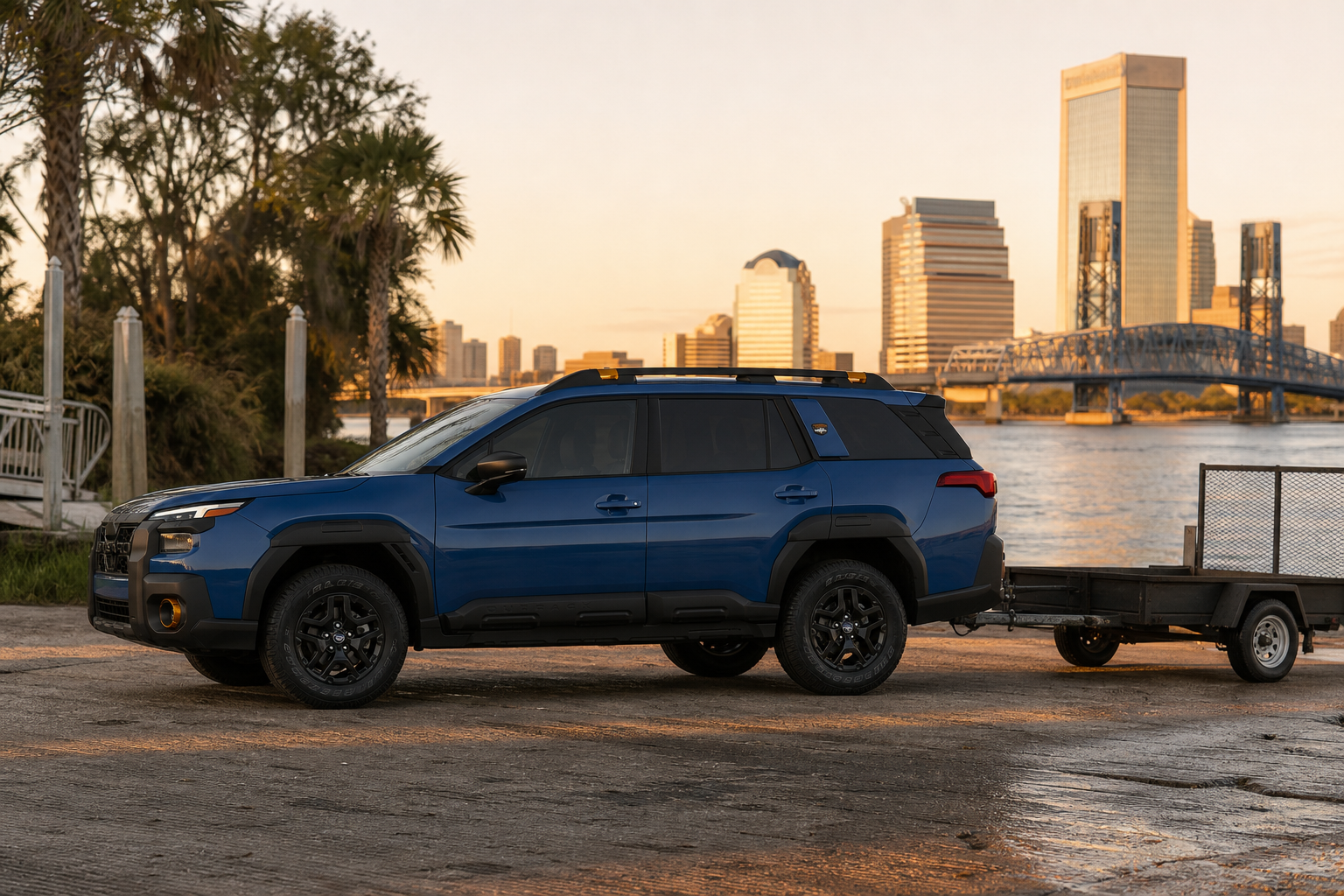
Wagon-style SUV parked at a riverside boat ramp near a small utility trailer at sunset

How Much Can a Subaru Outback Tow?

If you're eyeing a Subaru Outback for weekend trips to the boat ramp, a small camper, or hauling gear to the coast, the towing number matters. The short version: it depends on the engine under the hood. Here's the honest, trim-by-trim breakdown, plus what those pounds actually let you pull around Jacksonville. How much can a Subaru Outback tow? A Subaru Outback tows between 2,700 and 3,500 pounds depending on the trim and engine. Standard 2.5-liter models are rated at 2,700 pounds. Trims with the turbocharged 2.4-liter engine, including the XT versions and the Wilderness, step up to 3,500 pounds. Always match the number to the specific trim you're buying. Which Outback trims tow the most? The turbocharged Outback trims tow the most. Any XT-badged model and the Wilderness use the 2.4-liter turbo and carry a 3,500-pound rating, while the naturally aspirated 2.5-liter trims are rated at 2,700 pounds. If towing is your priority, the extra torque of the turbo is what buys you that higher number. The Outback's turbocharged trims are rated to tow 3,500 pounds, per Subaru of America's published specifications, compared with 2,700 pounds on the standard-engine trims. Engine / Trim group Towing rating 2.5L (Base, Premium, Limited, Touring) 2,700 lbs 2.4L Turbo XT trims (Onyx Edition XT, Limited XT, Touring XT) 3,500 lbs Wilderness (2.4L Turbo) 3,500 lbs Note on the newest model year: Subaru refreshed the Outback lineup for the 2026 model year, and we recommend confirming the exact rating for any 2026 trim against that vehicle's window sticker and Subaru of America's current specifications before you hitch up. If you're shopping our lot, just ask a Hanania Subaru of Orange Park team member to pull the figure for the specific VIN. What can you actually tow with 2,700 or 3,500 pounds? Plenty of common loads fit under those ratings. A 2,700-pound Outback comfortably handles a small utility trailer, two personal watercraft, or a lightweight pop-up camper. A 3,500-pound turbo Outback opens up single small boats on a trailer, teardrop and compact travel trailers, and heavier hauls to the beach or campground. Small utility trailer with yard gear: typically 1,000–1,800 lbs loaded — fine for any Outback. Two personal watercraft on a trailer: often 1,800–2,400 lbs — within the 2,700 lb trims. Teardrop or compact travel trailer: commonly 1,500–3,000 lbs — best matched to a 3,500 lb turbo trim. Small aluminum fishing boat and trailer: often 1,500–2,500 lbs — comfortable for turbo trims, doable on standard trims if you stay under the rating. One rule that trips people up: the towing rating includes the weight of the loaded trailer, not just the empty trailer. Add your cargo, fuel, water, and gear before you compare against the number. How do you tow safely with an Outback in Jacksonville? Tow safely by staying under your trim's rating, distributing weight so about 10–15% sits on the tongue, and using the factory-style hitch and proper wiring for your load. In Florida heat, watch your transmission and engine temperatures on longer pulls, and give yourself extra stopping distance on I-295 and the Buckman Bridge. A few practical Jacksonville notes: Boat ramps along the St. Johns River and Intracoastal get busy on weekends — a backup camera and the Outback's ground clearance help on wet, sloped ramps. Summer afternoon storms mean slick roads; a lighter, balanced trailer is much easier to control. For anything near your maximum rating, have the hitch, wiring, brakes, and cooling checked before a long trip. Our service team can inspect the setup and confirm your specific trim's rating. Florida law also requires trailer brakes on heavier trailers, so confirm your trailer's requirements before you load up. When in doubt, the lighter turbo trims give you the most margin for the kinds of loads most local drivers actually pull. Is the turbo Outback worth it just for towing? For many buyers, yes. The 2.4-liter turbo adds roughly 800 pounds of towing capacity and noticeably more low-end pull, which makes hills, on-ramps, and loaded trailers feel easier. If you tow only a light utility trailer a few times a year, the standard 2.5-liter trim and its 2,700-pound rating may be all you need. Come by Hanania Subaru of Orange Park and we'll walk you through the trims, show you the exact ratings, and help you match an Outback to what you actually plan to tow.

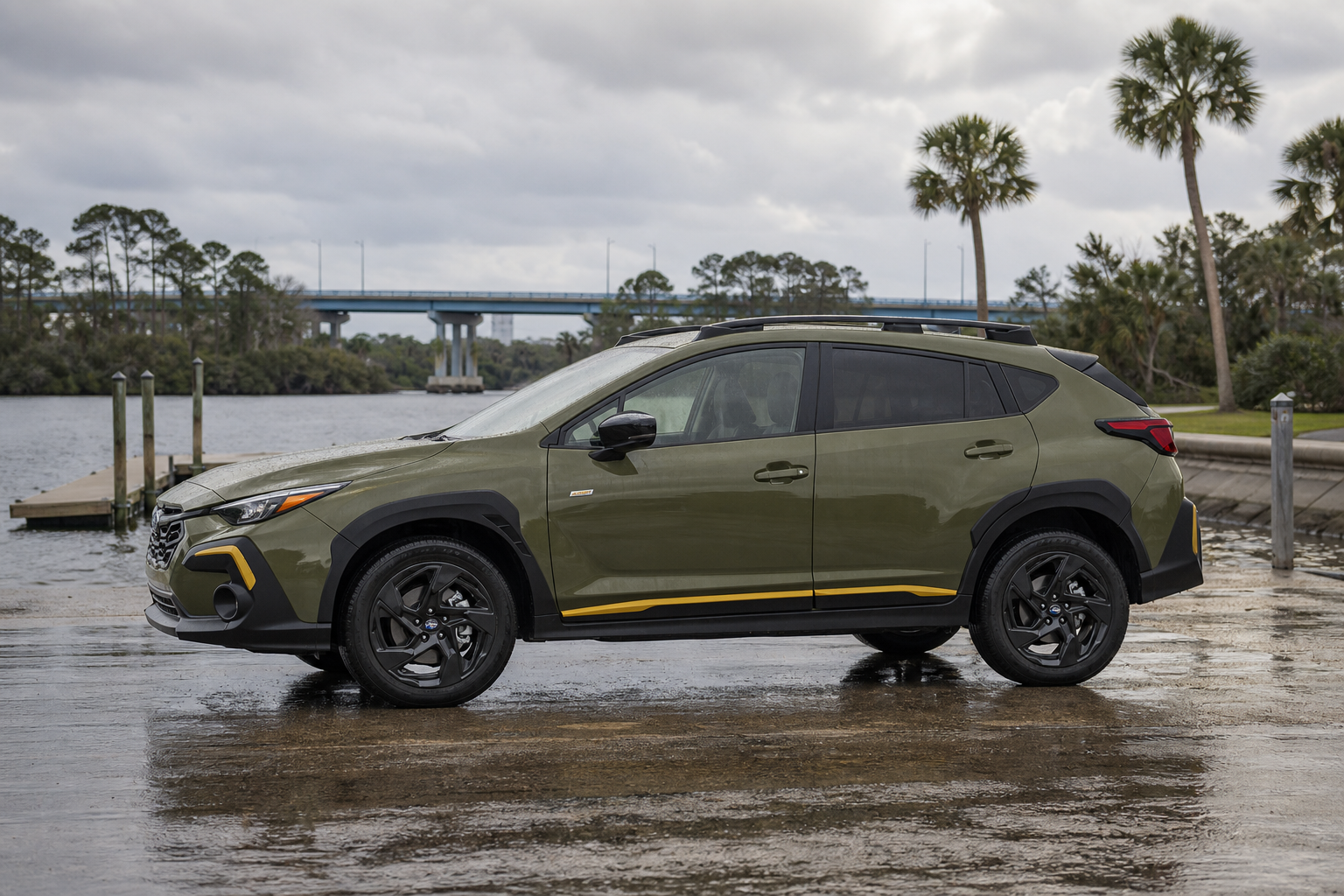
Compact crossover parked at a wet Jacksonville boat launch under a cloudy sky after summer rain

Subaru Crosstrek vs Impreza: Which Fits Your Jacksonville Drive?

The Crosstrek and the Impreza share a lot of DNA, which is exactly why so many Jacksonville shoppers get stuck deciding between them. They ride on the same platform, use similar engines, and look like cousins in the parking lot. But the differences that matter show up when you load the dog, hit a flooded intersection off Blanding, or check the monthly payment. Here's a plain look at how they compare. What's the real difference between the Crosstrek and the Impreza? The 2026 Subaru Crosstrek is a raised, rugged crossover built for clearance and cargo, while the 2026 Subaru Impreza is a lower, lighter hatchback tuned for easy city driving and fuel efficiency. The Crosstrek sits higher, adds standard cladding, and gives you more room behind the seats. Ground clearance: Crosstrek offers about 8.7 inches; Impreza sits closer to 5.1 inches. Drivetrain: Crosstrek comes standard with Symmetrical All-Wheel Drive across the lineup; the current Impreza also includes standard all-wheel drive. Body style: Crosstrek is a taller crossover; Impreza is a compact five-door hatchback. Cargo: Crosstrek gives you more usable space behind the rear seats for gear. Which one handles Jacksonville roads and weather better? For our area, the Crosstrek's extra clearance is the standout. Jacksonville sees heavy summer downpours, and standing water pools fast on roads near the St. Johns and low-lying neighborhoods. That added height gives more confidence in flooded intersections. The Impreza, meanwhile, is easier to park downtown and lighter on gas for daily commuters. According to the National Weather Service, Jacksonville averages roughly 52 inches of rain per year, well above the U.S. average of about 38 inches. That means water management matters here. Both models carry standard all-wheel drive for traction, but the Crosstrek's ground clearance is the difference-maker when a street floods during an afternoon storm. How do the Crosstrek and Impreza compare on price and value? The Impreza is the more affordable of the two, typically carrying a lower starting MSRP than the Crosstrek, which makes it a strong pick for budget-focused buyers. The Crosstrek costs more but adds clearance, cargo room, and available trims aimed at outdoor use. Your best value depends on how you actually drive. Feature 2026 Crosstrek Base 2026 Impreza Base Body style Crossover Hatchback Ground clearance ~8.7 in ~5.1 in Standard AWD Yes Yes Best for Cargo, clearance, gear Commuting, parking, MPG We'd rather you pick the model that fits your week than the one with the flashier badge. If you haul kayaks to the coast or drive gravel out to a launch, the Crosstrek earns its price. If you're mostly commuting the Buckman or running errands around Orange Park, the Impreza can save you money up front and at the pump. Stop by and drive both back to back. Which Subaru is better for families in Jacksonville? For growing families, the Crosstrek usually wins on practicality thanks to its taller roofline, easier child-seat access, and larger cargo area for strollers and beach gear. The Impreza still seats five and works well for smaller households or couples who prioritize efficiency and a lower price over maximum cargo space. Do both models come with standard all-wheel drive? Yes. Both the 2026 Subaru Crosstrek and the 2026 Subaru Impreza come with Subaru's Symmetrical All-Wheel Drive as standard equipment. That's a genuine advantage in wet Jacksonville weather, since many competing compact cars charge extra for all-wheel drive or don't offer it at all. Traction is built in on both. Whichever way you lean, our team at Hanania Subaru of Orange Park can line both up side by side so you can feel the seating height, load your own gear, and compare the ride before you decide.

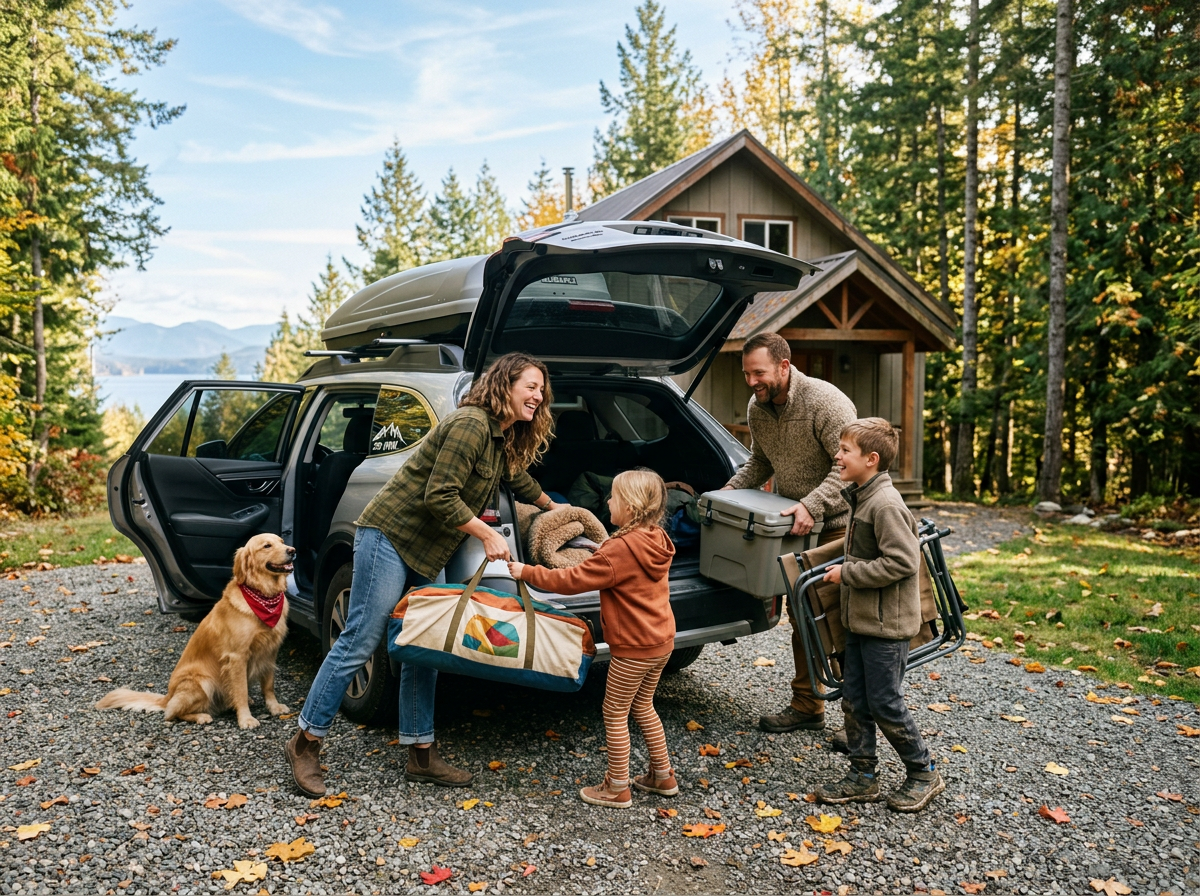
A family of four packs up their SUV with camping gear in front of a rustic cabin in the woods, accompanied by their golden retriever. (Representative image for illustration purposes only. Actual vehicle may vary based on trim and configuration.)

Why Families Trust Subaru for the Long Haul

The decision to purchase a new family vehicle often comes down to a single question: how will this investment hold up over years of daily school runs, unpredictable weather, and long highway commutes? For households seeking lasting value, the choice frequently leads to the engineering philosophy that defines the Subaru brand. Built on a foundation of durable construction and active safety, these vehicles are designed to perform reliably long after the odometer passes the six-figure mark. A primary reason for this enduring reliability is the brand's unique powertrain configuration. Unlike most conventional crossovers that rely on front-wheel-drive platforms and only engage the rear wheels when slippage occurs, Subaru vehicles feature standard Symmetrical All-Wheel Drive. This system continuously distributes power to all four wheels, optimizing traction and stability before traction is lost. Additionally, the horizontal layout of the Subaru BOXER engine places the pistons in a flat, side-to-side motion. This configuration lowers the vehicle's center of gravity, reducing body roll during cornering and minimizing cabin vibrations for a smoother ride. At Hanania Subaru, we see firsthand how these engineering choices translate into long-term owner satisfaction. For drivers who want to experience this balanced performance in a highly engaging package, we invite you to explore our new Subaru performance inventory. Every engineering detail, from the reinforced frame structures to the durable cabin materials, is selected to withstand the wear and tear of active family life. We are committed to helping you find a vehicle that serves your family for years to come. To speak with our sales or service experts, feel free to give us (904) 906-1235. If you prefer to browse our selection in person and discuss your driving needs with our team, you can easily get directions to Hanania Subaru and visit our showroom at 6400 Blanding Blvd, Jacksonville, FL 32244. Table of Contents Unpacking the Starting Price and Value of the 2026 Subaru Outback How the 2026 Subaru Outback Achieves Its 5-Star Safety Rating Evaluating Cargo Room: Subaru Outback vs Honda CR-V Navigating Coastal Sand: Can You Drive a Subaru Outback on the Beach? The High Mileage Club and Transferable Warranty Protections Common Questions About Subaru Longevity and Ownership Finding Your Perfect Family Match at Hanania Subaru Unpacking the Starting Price and Value of the 2026 Subaru Outback When shopping for a midsize crossover, understanding the entry point and the value packed into each trim tier helps clarify your overall budget. The redesigned 2026 Subaru Outback represents a substantial evolution for this iconic model, introducing a taller, more spacious body style that maximizes utility. For the 2026 model year, the 2026 Subaru Outback starts at an MSRP of $34,995 for the entry-level Premium trim, which comes equipped with a 2.5-liter four-cylinder engine producing 180 hp and 178 lb-ft of torque. As you move up the trim lineup, the vehicle adds premium amenities and performance upgrades designed to enhance comfort and capability. The Limited trim starts at an MSRP of $41,715, while the turbocharged Limited XT is priced at $44,365 and delivers a more robust 260 hp and 277 lb-ft of torque. For those seeking the pinnacle of comfort and standard features, the Touring trim carries an MSRP of $45,395, and the top-tier Touring XT reaches $47,995. Each of these models routes power through a refined Lineartronic CVT to ensure smooth, continuous acceleration. To help you find the exact configuration that matches your daily routine, you can browse our online new Outback inventory to compare available packages. If you are open to exploring other versatile models in the lineup, we also maintain a comprehensive new Subaru inventory featuring the latest crossovers and SUVs. To make your transition into a new vehicle even more seamless, our team can help you value your trade-in online to establish a clear picture of your buying power before you visit our showroom. Pricing Pricing by trim Feature Limited Limited Bronze Edition Onyx Edition-Touring Premium Touring Base MSRP $41,995 $43,495 $46,995 $34,995 $43,995 Destination charge $1,450 $1,450 $1,450 $1,450 $1,450 ​ How the 2026 Subaru Outback Achieves Its 5-Star Safety Rating Safety is rarely a secondary consideration for families, and the 2026 Subaru Outback addresses this priority through exhaustive crash-test performance and advanced driver-assist technologies. The National Highway Traffic Safety Administration (NHTSA) awards its 5-Star Overall Vehicle Score based on rigorous evaluations, including frontal, side barrier, and side pole crash tests. The 2026 Subaru Outback earns this top rating by combining a high-strength ring-shaped reinforcement frame with an array of smart safety sensors designed to protect occupants from every angle. The cornerstone of the vehicle's active safety suite is the standard EyeSight Driver Assist Technology. This system utilizes dual color cameras mounted near the rearview mirror to scan the road ahead for potential hazards. It acts as an extra set of eyes, providing features such as pre-collision braking, adaptive cruise control, and lane-keep assist to prevent accidents before they occur. In the event of an unavoidable impact, the vehicle's advanced airbag system and crumple zones are engineered to divert crash energy away from the passenger cabin. For families seeking this level of protection across different budget levels, we offer several excellent pathways. You can explore our used vehicle inventory to find reliable, safety-tested models from previous model years. Additionally, for those who prefer a slightly more compact footprint without sacrificing standard all-wheel-drive security, we encourage you to view our new Crosstrek inventory. Both models exemplify the brand's unwavering commitment to keeping your passengers secure on every journey. Engine & Performance Powertrain specs by trim Feature Limited Limited Bronze Edition Onyx Edition-Touring Premium Touring Engine 2.4L 2.4L 2.4L 2.4L 2.4L Horsepower 260 hp 260 hp 260 hp 260 hp 260 hp Torque 277 lb-ft 277 lb-ft 277 lb-ft 277 lb-ft 277 lb-ft Transmission Lineartronic CVT Lineartronic CVT Lineartronic CVT Lineartronic CVT Lineartronic CVT Drivetrain All-wheel drive All-wheel drive All-wheel drive All-wheel drive All-wheel drive ​ Evaluating Cargo Room: Subaru Outback vs Honda CR-V For active households, cargo capacity is a critical metric that dictates how easily a vehicle can transition from the weekday commute to a weekend getaway. When comparing the 2026 Subaru Outback to the Honda CR-V, the dimensions reveal distinct advantages depending on how you plan to load your gear. The Honda CR-V offers up to 39 cubic feet of cargo space behind its second row. While this is slightly higher on paper than the Outback's about 35 cubic feet of rear cargo volume, the Outback excels in real-world loading dynamics due to its longer, wagon-style cargo floor. The lower roofline and extended cargo length of the Outback make it significantly easier to slide in long, bulky items like strollers, bicycles, or camping bins. Furthermore, the Outback features a lower liftover height compared to many traditional compact SUVs, which reduces physical strain when lifting heavy coolers or suitcases into the back. When you need to maximize your carrying capacity, the rear seats of the Outback fold completely flat to unlock a massive cargo area, allowing you to transport larger items with ease. Maintaining this utility over the lifespan of your vehicle requires using components engineered specifically for your model's dimensions. If you want to protect your cargo area or expand your hauling capabilities with roof racks, you can order genuine Subaru parts directly through our department. To keep your vehicle running in peak condition for all your hauling needs, we make it simple to schedule a service appointment online with our factory-trained technicians. Dimensions & Capacity Capacity and dimensions by trim Feature Limited Limited Bronze Edition Onyx Edition-Touring Premium Touring Seating 8 7 7 8 7 Cargo 17.6 cu ft 17.6 cu ft 17.6 cu ft 17.8 cu ft 17.6 cu ft Curb weight 4,603 lbs 4,587 lbs 4,595 lbs 4,466 lbs 4,596 lbs Towing 5,000 lbs 5,000 lbs 5,000 lbs 5,000 lbs 5,000 lbs ​ Navigating Coastal Sand: Can You Drive a Subaru Outback on the Beach? The desire for outdoor adventure often leads Florida drivers to the state's iconic drivable coastlines, such as the hard-packed sands of Ponte Vedra Beach. Navigating these coastal environments requires a vehicle capable of handling shifting surfaces without getting bogged down. Thanks to its standard Symmetrical All-Wheel Drive and a generous ground clearance of 8.7 inches, the 2026 Subaru Outback is well-equipped to handle the transition from asphalt to coastal sand lanes. To optimize traction on loose surfaces, the Outback features X-MODE, an electronically controlled system that alters engine response, transmission gearing, and the all-wheel-drive power distribution. When activated, X-MODE minimizes wheel spin and maximizes grip on slippery or uneven terrain. This capability allows families to confidently access designated beach driving areas, provided they stay on the established, hard-packed paths and avoid the soft, protected dunes where even specialized off-road vehicles can struggle. For larger families who need maximum seating capacity alongside this rugged capability, the 3-row 2026 Subaru Ascent offers an excellent alternative. Equipped with a 2.4L turbocharged engine generating 260 hp and a towing capacity of 5,000 lbs, it provides the space and power required for larger excursions. You can browse our new Ascent inventory to find a model that fits your seating needs. To ensure your vehicle is fully prepared for coastal driving, our Subaru service center can inspect your tire pressures, fluid levels, and undercarriage to keep you exploring safely. ​ The High Mileage Club and Transferable Warranty Protections One of the most telling indicators of a vehicle's longevity is its representation in high-mileage communities. The Subaru High Mileage Club is an informal but highly celebrated group of owners whose vehicles have surpassed significant milestones, starting at 100,000 miles and often extending well past 300,000 miles. To honor this loyalty, the brand offers a Badge of Ownership program, allowing long-term drivers to display custom mileage and lifestyle badges on the rear of their vehicles. This long-term durability is backed by strong warranty protections that offer peace of mind to both first and subsequent owners. The standard factory warranty includes a 3-year or 36,000-mile bumper-to-bumper limited warranty and a 5-year or 60,000-mile powertrain warranty. Crucially, these warranties are fully transferable to a second owner at no additional cost, which helps preserve the vehicle's resale value and protects your investment if you choose to sell or trade the vehicle down the road. If you are looking for a vehicle that has already proven its reliability, we encourage you to browse our certified pre-owned inventory. These vehicles undergo a rigorous multi-point inspection and come with extended factory-backed powertrain coverage. When you find the right model for your household, you can easily apply for financing through our secure online portal to secure competitive rates and streamline your purchase process. Fuel Economy Fuel economy and range by trim Feature Limited Limited Bronze Edition Onyx Edition-Touring Premium Touring MPG 19 city / 25 hwy / 21 combined 19 city / 25 hwy / 21 combined 19 city / 25 hwy / 21 combined 19 city / 26 hwy / 22 combined 19 city / 25 hwy / 21 combined ​ Common Questions About Subaru Longevity and Ownership As families research their next vehicle purchase, several practical questions consistently arise regarding maintenance, mechanical specifications, and long-term care. Addressing these queries upfront helps buyers make informed decisions and maintain their vehicles properly over time. Q: Does the 2026 Subaru Outback use a timing belt or a timing chain? The 2026 Subaru Outback is equipped with a timing chain rather than a timing belt. Unlike rubber timing belts that require scheduled replacement intervals to prevent engine damage, modern timing chains are constructed from durable metal and are engineered to last the entire lifespan of the engine under normal operating conditions. Q: What are the routine maintenance intervals for a new Subaru? Subaru recommends scheduling routine maintenance every 6 months or 6,000 miles, whichever comes first. Regular service visits typically include an engine oil and filter change, tire rotation, and a comprehensive multi-point inspection to identify and address minor wear before it becomes a larger issue. Q: Is the CVT transmission fluid considered a lifetime fluid? Subaru designates its Lineartronic CVT fluid as a lifetime fluid under normal driving conditions, meaning it does not require regular replacement. However, if you frequently use your vehicle for towing or operate in severe driving conditions, our technicians recommend periodic inspections and fluid replacements to maintain optimal transmission performance. Q: How does the fuel economy of the Outback compare across its engine options? The standard 2.5-liter engine in the Outback delivers an EPA-estimated 25 city / 31 hwy MPG, making it highly efficient for daily commuting. Choosing the more powerful 2.4-liter turbocharged engine in the XT trims adjusts the efficiency slightly to an EPA-estimated 22 city / 29 hwy MPG, offering a balance of performance and utility. If you are ready to explore our lineup in person, you can view our new Forester inventory to compare another highly versatile family option. For personalized assistance, you can always call our team to speak with a product specialist. When you are ready to visit our showroom, simply get directions to our dealership on Blanding Blvd to experience our welcoming shopping environment firsthand. ​ Finding Your Perfect Family Match at Hanania Subaru Choosing a vehicle that will stand by your family through years of daily adventures is a significant decision. At Hanania Subaru, we are dedicated to providing a transparent, supportive, and personalized shopping experience that helps you navigate your options with absolute confidence. From comparing the cargo dimensions of our versatile crossovers to exploring the advanced safety features of our latest models, our team is here to guide you every step of the way. We invite you to take the next step in your automotive journey by visiting our showroom on Blanding Blvd. Whether you want to experience the confident handling of Symmetrical All-Wheel Drive on a personalized test drive, value your current vehicle, or discuss customized financing plans, we are ready to assist. Explore our online inventory today, and let us help you find the reliable, long-lasting Subaru that your family deserves. © 2026 Hanania Subaru. All rights reserved.

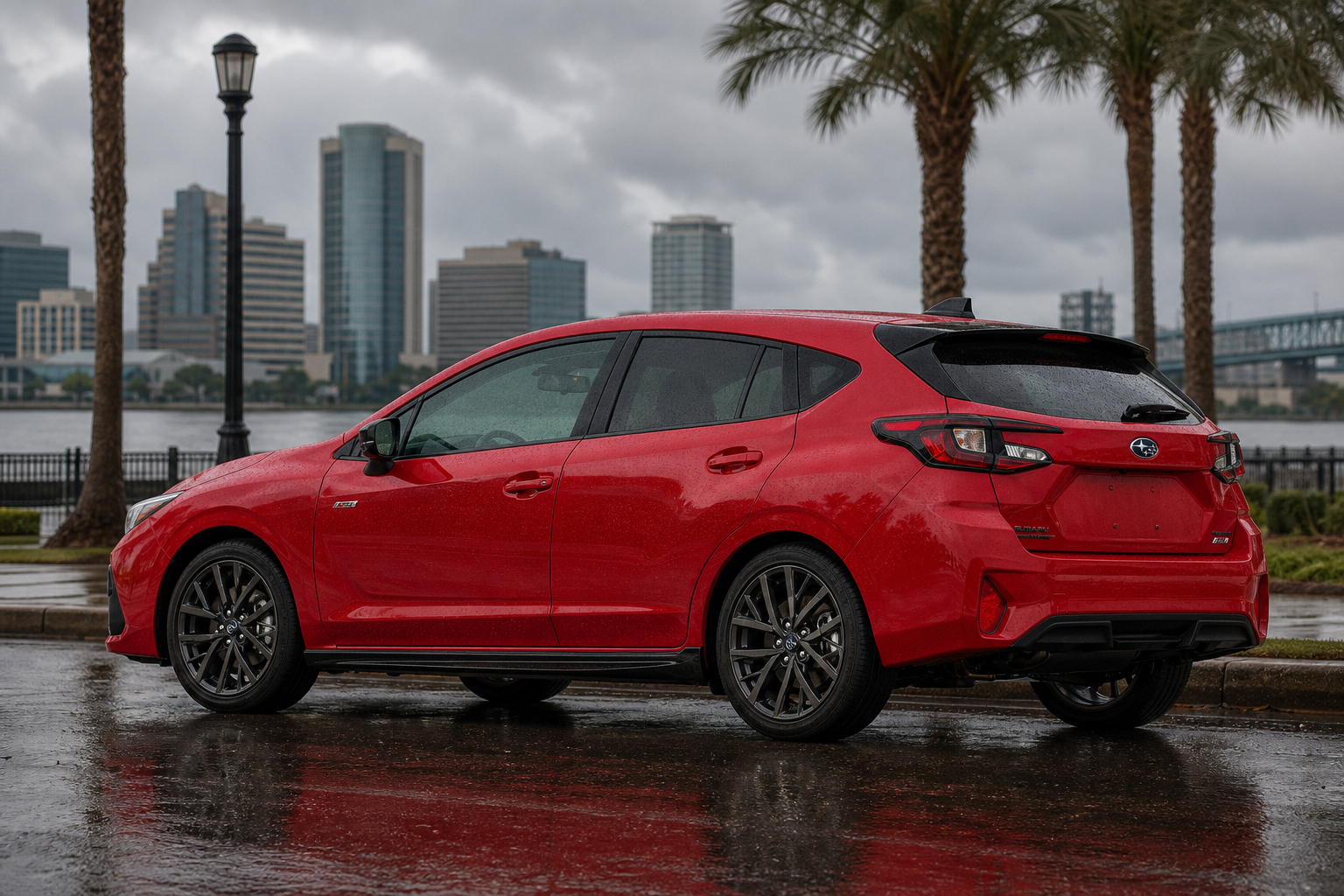
Compact SUV on a wet Jacksonville street after an afternoon rainstorm with palm trees nearby

Best Subaru for Jacksonville Commuters: How to Choose

Between I-295 traffic, afternoon thunderstorms, and the slow crawl over the Buckman Bridge, a good commuter car in Jacksonville needs to do a few things well: sip fuel, stay planted in the rain, and stay comfortable when the heat index hits triple digits. Here's an honest look at which Subaru fits that daily grind, what the numbers say, and how to narrow it down without guesswork. What's the best Subaru for Jacksonville commuters? For most Jacksonville commuters, the Subaru Impreza and Crosstrek hit the sweet spot: strong EPA fuel economy, standard all-wheel drive for wet roads, and an easy footprint for parking downtown or at the beach. If you want more cargo room or a taller ride, step up to the Forester or Outback. The right pick depends on your route and how much you haul. A short in-town commute favors the compact Impreza. A mixed highway-and-surface-street drive from Nocatee or Fleming Island favors the Crosstrek or Forester. Regular Costco runs and road trips to the Panhandle lean toward the Outback. How much will a Subaru save me on gas around Jacksonville? Fuel economy varies by model, but the compact Subaru lineup posts strong highway numbers that pay off on longer commutes. The table below shows EPA estimates so you can compare apples to apples. Actual mileage depends on your route, AC use, and traffic, but these give a fair baseline for budgeting. 2026 Model (base engine) EPA City EPA Highway Impreza (2.0L) 27 mpg 34 mpg Crosstrek (2.0L) 27 mpg 34 mpg Forester (2.5L) 26 mpg 33 mpg Outback (2.5L) 26 mpg 32 mpg EPA estimates as of July 2026, per fueleconomy.gov; confirm the exact figure for the trim you're considering, since larger-engine and Wilderness variants differ. The average one-way commute in Duval County is about 26 minutes, according to the U.S. Census Bureau's 2023 American Community Survey — enough daily driving that even a few mpg adds up over a year. Which Subaru handles Jacksonville rain and summer heat best? All of them handle it well, because every current Subaru sedan and SUV comes with standard Symmetrical All-Wheel Drive, which helps traction on flooded intersections and slick on-ramps after a summer storm. For heat and humidity, look for available ventilated front seats and a larger sunroof-shading setup on higher trims. Standard all-wheel drive — grip when Jacksonville's afternoon downpours pool water on the road. Available ventilated seats — a real comfort upgrade when the cabin bakes in a beach parking lot. EyeSight Driver Assist — adaptive cruise and lane centering ease stop-and-go on I-95. Ground clearance — the Crosstrek, Forester, and Outback sit higher, which helps on flood-prone side streets. Should commuters choose the Impreza, Crosstrek, or Outback? Choose the Impreza if you want the lowest price and easiest parking, the Crosstrek if you want SUV clearance in a compact size, and the Outback if you regularly carry gear or road-trip. All three share the same all-wheel-drive and safety DNA, so the decision comes down to size, cargo, and budget rather than capability. Here's a quick way to decide based on your day-to-day. Trim and pricing vary, so ask us to build out an exact quote before you compare payments. Impreza (2026, Base or Sport trim): best for short urban commutes and tight parking. Crosstrek (2026, Premium trim): best all-arounder for mixed highway and surface streets. Outback (2026, Premium trim): best for cargo, families, and frequent trips out of town. Stop by Hanania Subaru of Orange Park and drive a couple back to back on your own commute route — that's the fastest way to feel the difference in ride height, visibility, and cabin comfort before you decide.

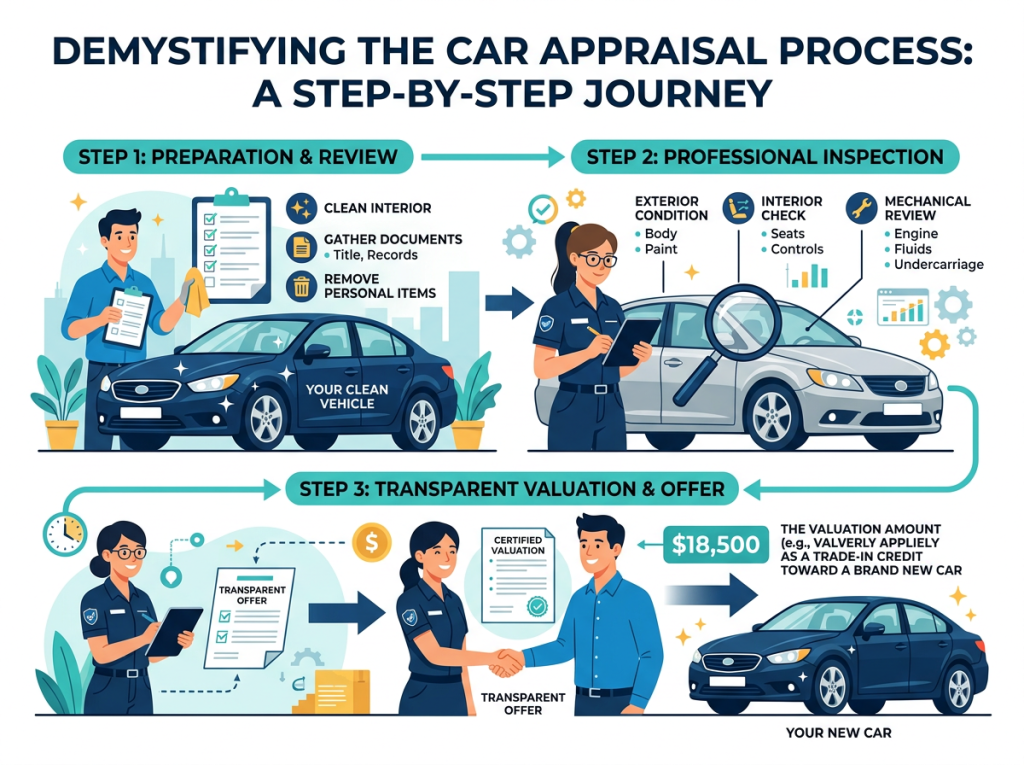
Demystifying the Auto Appraisal: How to Secure the Best Value When Trading Your Vehicle

Trading in a vehicle is a major financial step that often comes with unnecessary anxiety, but entering the dealership with the right information completely changes the dynamic. To help you navigate this process with absolute certainty, we sat down with Kyle Nelson, Sales Consultant at Hanania Subaru, who has spent 3 years helping buyers maximize their trade-in power. In this exclusive interview, Kyle breaks down the exact mechanics of dealership appraisals, local market factors, and the financial advantages that can help you secure a highly competitive offer for your current vehicle. Q: Kyle, what are the primary steps a vehicle owner should expect when they decide to trade in their current car for a new Subaru? A: When you decide to transition into a new vehicle, the trade-in path is designed to operate as a seamless, single-day transaction. The process begins when you arrive at our showroom to explore the new Subaru inventory and select the vehicle that matches your lifestyle. While you are test-driving a potential new vehicle, our professional appraisal team will perform a physical evaluation of your trade-in to establish its current market value. Once the appraisal is complete, we present you with a written valuation that can be applied directly as a down payment toward your purchase. If you accept the offer, we deduct that exact amount from the purchase price of your new vehicle, which immediately lowers your total loan balance or cash outlay. This entire process allows you to drop off your old keys and drive home in a new model in just a single visit, avoiding the weeks of detailing, listing, and meeting strangers that come with selling a vehicle on your own. For drivers who want to get a head start before visiting us, we highly recommend using our online tool to value your trade-in from the comfort of home. Knowing your estimated value beforehand helps you plan your budget more effectively, whether you are eyeing the versatile new Forester inventory or looking at the family-sized new Ascent inventory. If you want to discuss your trade-in options directly with our team, you can easily reach out by giving us a quick call or dropping by our showroom. Q: Why is it so important for local car owners to use their specific regional ZIP code when they are gathering trade-in estimates online? A: Many vehicle owners do not realize that vehicle valuations are highly regionalized, meaning a national average estimate rarely reflects what your car is actually worth in Northeast Florida. When you enter your local ZIP code into an online valuation tool, the software automatically adjusts the pricing algorithm to account for regional supply, demand, and localized inventory shortages. For example, in our coastal environment, vehicles equipped with standard Symmetrical All-Wheel Drive are highly sought after by outdoor enthusiasts who frequent the sandy coastal plains and maritime forests of Ponte Vedra Beach. This localized demand directly inflates the trade-in value of pre-owned all-wheel-drive models in our area compared to flat, dry regions of the country where all-wheel drive is considered a luxury rather than a necessity. The same principle applies to our used-vehicle inventory, where highly reliable crossovers maintain exceptionally strong resale values due to our active local lifestyle. To illustrate how well these vehicles hold their value, third-party automotive analytics from CarEdge show that brand-new Subaru vehicles depreciate only about 39% after five years, retaining roughly 61% of their original value. This impressive value retention places the brand among the slowest-depreciating mainstream manufacturers in the industry, meaning your trade-in is likely worth more in our local market than national estimators might suggest. Q: Walk us through the physical appraisal. What specific components and vehicle conditions do your appraisers inspect at the dealership? A: The physical appraisal is a highly systematic process where our team looks at both the cosmetic and mechanical health of your vehicle to determine its true wholesale value. We begin with a comprehensive exterior walk-around, looking for paint inconsistencies, body panel alignment issues, dents, and any signs of previous structural repairs. We also inspect the tires for even tread wear, as uneven patterns can point to underlying alignment or suspension issues that would need to be addressed before we can resell the vehicle. Inside the cabin, our appraisers evaluate the condition of the upholstery, dashboard, and electronic controls, ensuring that safety systems, climate control, and infotainment features function exactly as intended. We also conduct a short test drive to assess engine performance, transmission smoothness, and braking responsiveness. If your vehicle has minor cosmetic blemishes, we generally advise against spending money on major repairs before trading it in, as our service department can perform reconditioning work far more cost-effectively than a retail consumer can. However, bringing your vehicle in clean and presenting a complete folder of its maintenance history can significantly boost an appraiser's confidence in the vehicle's long-term durability. If your current vehicle is due for a pre-trade check or minor maintenance, you can easily schedule a service appointment online to ensure everything is in top shape before your appraisal. Q: How do you calculate the sales tax savings of a trade-in, and how does that impact the overall deal? A: One of the most significant financial advantages of trading in your vehicle at a dealership is the state sales tax credit, which is a benefit you completely lose when selling a car privately. In Florida, you are only required to pay sales tax on the net difference between the purchase price of your new vehicle and the value of your trade-in. To put this into perspective, if you are purchasing a new vehicle for $40,000 and our team values your trade-in at $15,000, your taxable balance is reduced to just $25,000. Assuming a standard local sales tax rate of 6%, you would only pay $1,500 in sales tax instead of the $2,400 you would owe without a trade-in, instantly saving you $900 on the transaction. "The sales tax credit is essentially free money from the state that immediately boosts the real-world value of your trade-in by hundreds, sometimes thousands, of dollars." This tax advantage makes trading in an incredibly lucrative option, especially for busy professionals and families who want to maximize their purchasing power. These tax savings can also be applied when transitioning into our high-quality certified pre-owned inventory, allowing you to secure a highly reliable, thoroughly inspected vehicle while keeping your upfront acquisition costs as low as possible. Q: What happens to your monthly payments when rolling negative equity into a new auto loan? A: Rolling negative equity into a new loan is a common solution for drivers who need to exit their current vehicle but owe more on their auto loan than the vehicle is currently worth. When you have negative equity, the dealership pays off your existing loan in full, and the outstanding balance—the difference between your loan payoff and the trade-in value—is added to the principal of your new auto loan. While this is a highly convenient way to consolidate your debt into a single monthly payment, it is important to understand that it will increase your new monthly payments and immediately put you in an underwater position on your new vehicle. Because you are financing a larger sum than the retail value of the new car, we always encourage buyers to carefully evaluate how this affects their long-term financial health. To offset this added principal, we recommend choosing a highly reliable vehicle with slow depreciation, such as the models found in our new Outback inventory or our new Crosstrek inventory, which help protect your equity over time. Before making any decisions, you can easily apply for financing online to see what loan terms, interest rates, and structures you qualify for, allowing you to make a highly informed decision. Q: In what situations is trading in your vehicle a better option than trying to sell it yourself? A: While selling a vehicle privately can sometimes yield a slightly higher nominal offer, the sheer amount of time, effort, and financial risk involved makes trading in the superior choice for the vast majority of drivers. Selling a car privately requires you to detail the vehicle, take high-quality photos, list it on multiple online platforms, and field dozens of inquiries from unserious buyers. You also have to coordinate test drives with strangers, navigate the legal complexities of transferring a title, and handle the payoff of any existing lien on the vehicle yourself. For commuters who rely on their vehicles daily to travel from growing suburban areas like Yulee into the city, being without a car during a private sale transition is simply not an option. Trading in your vehicle at a dealership eliminates all of these logistical headaches in a single afternoon. We handle all of the DMV paperwork, coordinate directly with your lienholder to pay off your existing loan, and ensure that you seamlessly transition from your old vehicle directly into your new one without a single day of downtime. The convenience of a guaranteed transaction, combined with the substantial sales tax savings, often completely bridges the gap between a private-party valuation and a dealer trade-in offer. Q: What key details should be clearly itemized in a written trade-in offer from a dealership? A: When you receive a written trade-in offer, transparency is paramount, and you should always ensure that every financial element of the transaction is clearly and separately itemized on the buyer's order. A professional, trustworthy written offer should explicitly state the exact wholesale valuation of your trade-in vehicle, completely separate from any dealer discounts, manufacturer incentives, or the purchase price of the new vehicle. You should also look for a clear line item showing the calculated sales tax savings, which confirms that the tax credit has been properly applied to reduce your taxable balance. Ensure that there are no hidden reconditioning fees or administrative charges deducted from your vehicle's valuation unless they were clearly discussed and justified during the physical appraisal. At Hanania Subaru, we pride ourselves on providing completely transparent, line-by-line breakdowns of every deal so you can see exactly where your money is going. If you are ready to experience a stress-free, transparent trade-in process, we invite you to stop by our showroom at 6400 Blanding Blvd to meet our team. Whether you want to explore our new Subaru performance inventory or simply want a professional, no-obligation appraisal of your current car, we are here to help you drive home with absolute confidence. ​ Pricing Pricing by trim Feature Limited Limited XT Premium Touring Touring XT Wilderness Base MSRP $41,715 $44,365 $34,995 $45,395 $47,995 $44,995 Destination charge $1,450 $1,450 $1,450 $1,450 $1,450 $1,450 ​ Engine & Performance Powertrain specs by trim Feature Limited Limited XT Premium Touring Touring XT Wilderness Engine 2.5L 2.4L 2.5L 2.5L 2.4L 2.4L Horsepower 180 hp 260 hp 180 hp 180 hp 260 hp 260 hp Torque 178 lb-ft 277 lb-ft 178 lb-ft 178 lb-ft 277 lb-ft 277 lb-ft Transmission Lineartronic CVT Lineartronic CVT Lineartronic CVT Lineartronic CVT High-torque Lineartronic CVT Lineartronic CVT Drivetrain All-wheel drive All-wheel drive All-wheel drive All-wheel drive All-wheel drive All-wheel drive Keep Your Vehicle Running Strong Keep your vehicle performing at its best with our service team: Genuine Subaru Parts Subaru Service Center © 2026 Hanania Subaru. All rights reserved.
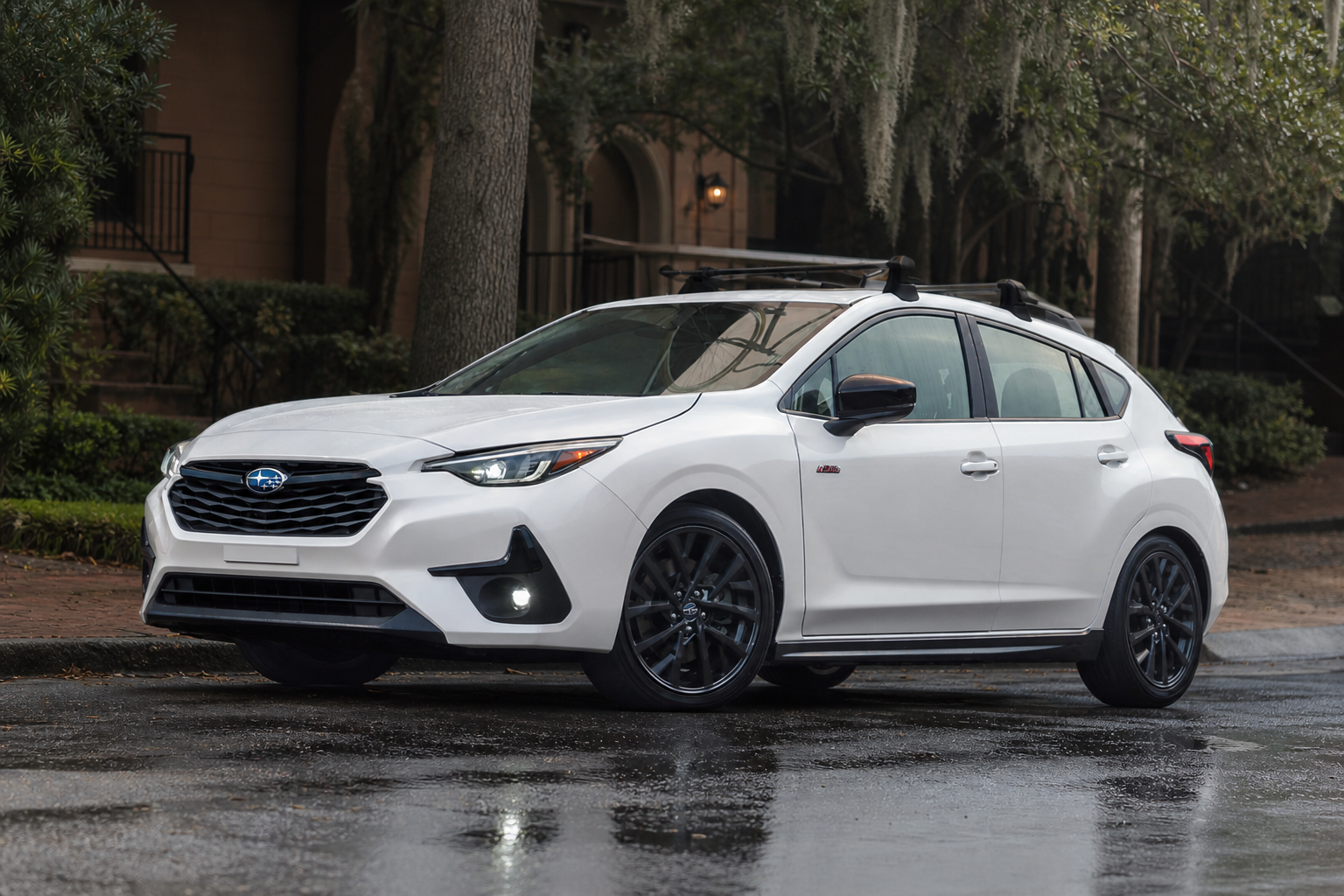
Late Summer Road Trips in the Mid-Atlantic

Finding the Best Subaru for Road Trips: Expert Q&A Guide

Planning a long-distance drive requires a vehicle that balances occupant comfort, reliable traction, and expansive cargo utility. To help you find the perfect match for your next journey, we sat down with Kyle Nelson, Sales Consultant at Hanania Subaru, to discuss which Subaru models excel on the open road. Q: Kyle, why is the redesigned 2026 Subaru Outback considered one of the best vehicles for road trips? A: When folks come in to look at the Outback, they usually ask why it's considered such a legendary road-trip vehicle compared to standard midsize SUVs. The redesign of this model really emphasizes passenger comfort and modern convenience. It features a taller roofline that creates a spacious interior with up to about 112 cubic feet of passenger volume, meaning even taller adults have plenty of room to stretch out. Subaru also brought back physical buttons and knobs for the climate control system, which sits right beneath the crisp 12.1-inch central touchscreen. This makes it incredibly easy to adjust the temperature on the highway without taking your eyes off the road. Many active families in Ponte Vedra Beach choose the Outback because they need a vehicle that can transition from hauling golf clubs at TPC Sawgrass to driving right up to sandy coastal access points. The standard Symmetrical All-Wheel Drive provides exceptional stability when the weather changes suddenly, ensuring you stay glued to the road during heavy downpours. If you want to see these upgrades in person, you can get directions to our showroom on Blanding Boulevard or simply give our sales team a call to talk through the available options. We have an excellent selection in our new Subaru Outback inventory, which is perfect for drivers who want a comfortable, versatile cruiser. While we also carry exciting options in our new Subaru performance inventory, the Outback remains a strong choice for long-distance family travel. Q: How do you help customers decide whether the Subaru Outback or the Subaru Forester is better for their road trips? A: The decision usually comes down to how you prefer to sit and the type of driving you plan to do. The Forester features a more upright, traditional SUV silhouette with massive windows that offer outstanding outward visibility. This design is highly appealing for drivers who like a commanding view of the road. On the other hand, the Outback has a longer, more wagon-like wheelbase that naturally delivers a smoother, more composed highway ride. This longer footprint helps isolate the cabin from expansion joints and road imperfections, making it the preferred choice for covering hundreds of miles in a single day. You can browse new Subaru Forester inventory to see that vertical design, or check out our new Subaru inventory to compare both side-by-side. For younger buyers or solo adventurers, we also suggest looking at new Subaru Crosstrek inventory, which offers a more compact footprint. When looking at the specs, the Outback Premium, Limited, and Touring trims utilize a 2.5L four-cylinder engine producing 180 hp and 178 lb-ft of torque, mated to a Lineartronic CVT and standard All-wheel drive, delivering an efficient 25 city / 31 hwy / 27 combined MPG. If you want more power for passing on the highway, the Limited XT and Touring XT step up to a 2.4L turbocharged engine with 260 hp and 277 lb-ft of torque, though the Wilderness trim's unique gearing adjusts its fuel economy to 21 city / 27 hwy / 23 combined MPG. Q: When it comes to packing for a long trip, how much cargo space and rear-seat legroom does the redesigned Outback actually provide? A: The interior packaging of the Outback is exceptionally clever. You get about 35 cubic feet of cargo space directly behind the second row, which easily swallows four large suitcases or extensive camping gear. If you fold the 60/40-split rear seatbacks down, that utility expands to roughly 81 cubic feet of maximum cargo volume. Subaru also added thoughtful touches like extra-wide door pockets carpeted to prevent water bottles from rattling, and a heavy-duty roof rack rated to support up to 800 pounds when parked, which is ideal for rooftop tents. For families living in Orange Park, having that extra legroom makes a massive difference during the daily commute or weekend boating trips near the St. Johns River. The Outback offers 39.5 inches of rear legroom, which slightly edges out the Forester's 39.4 inches, ensuring rear passengers remain comfortable for hours. If you are shopping for value, we often have excellent options in our pre-owned vehicle inventory that offer these exact same spatial benefits. Before you head out on a long trip, it is always a smart idea to schedule a service appointment online to make sure your vehicle is fully prepared for the road. "The best road trip vehicle isn't just about how much gear you can pack; it's about how fresh you feel when you finally arrive at your destination." Q: Kyle, what extra off-road features does the Outback Wilderness bring to the table for more adventurous road trips? A: The Wilderness trim is engineered specifically for those who want to take their road trips deep into the backcountry. It increases the standard ground clearance from 8.7 inches to 9.5 inches, allowing you to clear larger obstacles without scraping the underbody. It also adds a front skid plate, unique front and rear bumpers designed to improve approach and departure angles, and aggressive all-terrain tires that claw through mud, gravel, and sand. The hood features a matte-black decal to reduce sun glare, and the interior is wrapped in water-resistant StarTex upholstery that wipes clean easily after a muddy hike. If you are ready to upgrade, you can value your trade-in to see how much equity you can put toward a new adventure vehicle. We also stock genuine Subaru parts like heavy-duty floor liners and cargo organizers to protect your cabin from mud and sand. For larger families who need even more room and up to 5,000 pounds of towing capacity, we highly recommend checking out new Subaru Ascent inventory, which provides three rows of comfortable seating. Q: How does the Outback Wilderness compare to competitors like the Toyota RAV4 TRD Off-Road when driving on rough, unpaved forest roads? A: The differences become very clear once you leave the pavement. The Outback Wilderness features 9.5 inches of ground clearance, which easily beats the RAV4 TRD Off-Road's 8.6 inches. Furthermore, Subaru's continuous, active all-wheel-drive system provides always-on traction, while the Toyota RAV4 TRD Off-Road uses a different four-wheel-drive system. This continuous power delivery gives you immediate traction and confidence on loose gravel or muddy trails. Our certified Subaru service center is always here to keep your suspension and alignment in perfect shape after your trail adventures. If you want like-new reliability with warranty protection, we also have excellent choices in our certified pre-owned Subaru inventory. The Outback's longer wheelbase and softer suspension isolate cabin passengers from harsh bumps much better than the stiffer, shorter wheelbase of the RAV4, meaning you won't feel beat up after driving down a rutted forest service road. Q: What safety features on the 2026 Subaru Outback are most helpful for reducing driver fatigue on long highway stretches? A: The standard EyeSight Driver Assist Technology acts as an extra set of eyes on the road, which is incredibly reassuring during long hours behind the wheel. The system includes adaptive cruise control with lane-keep assist and lane-centering assist, which automatically helps keep the vehicle centered in its lane and maintains a safe following distance from the car ahead. On the Touring trim, available driver-assistance features can help reduce fatigue during cross-country journeys. Every new Subaru comes with the peace of mind of a dedicated manufacturer-backed safety net. If you ever run into trouble on the road, you can easily reach out to visit Hanania Subaru or contact us at 904-906-1235 to set up a personalized test drive. You can also submit a credit application online before your visit to streamline the buying process. Additionally, the standard roadside assistance program is included for 3 years or 36,000 miles, meaning that if you ever experience a flat tire or need a tow, you can connect directly with Subaru Roadside Assistance: 800-261-2155. This program ensures your vehicle is cared for by certified technicians using factory-approved parts, protecting your long-term investment. ​ Pricing Pricing by trim Feature Limited Limited XT Premium Touring Touring XT Wilderness Base MSRP MSRP subject to change MSRP subject to change MSRP subject to change MSRP subject to change MSRP subject to change MSRP subject to change Destination charge $1,450 $1,450 $1,450 $1,450 $1,450 $1,450 ​ Engine & Performance Powertrain specs by trim Feature Limited Limited XT Premium Touring Touring XT Wilderness Engine 2.5L 2.4L 2.5L 2.5L 2.4L 2.4L Horsepower 180 hp 260 hp 180 hp 180 hp 260 hp 260 hp Torque 178 lb-ft 277 lb-ft 178 lb-ft 178 lb-ft 277 lb-ft 277 lb-ft Transmission Lineartronic CVT Lineartronic CVT Lineartronic CVT Lineartronic CVT High-torque Lineartronic CVT Lineartronic CVT Drivetrain All-wheel drive All-wheel drive All-wheel drive All-wheel drive All-wheel drive All-wheel drive © 2026 Hanania Subaru. All rights reserved.

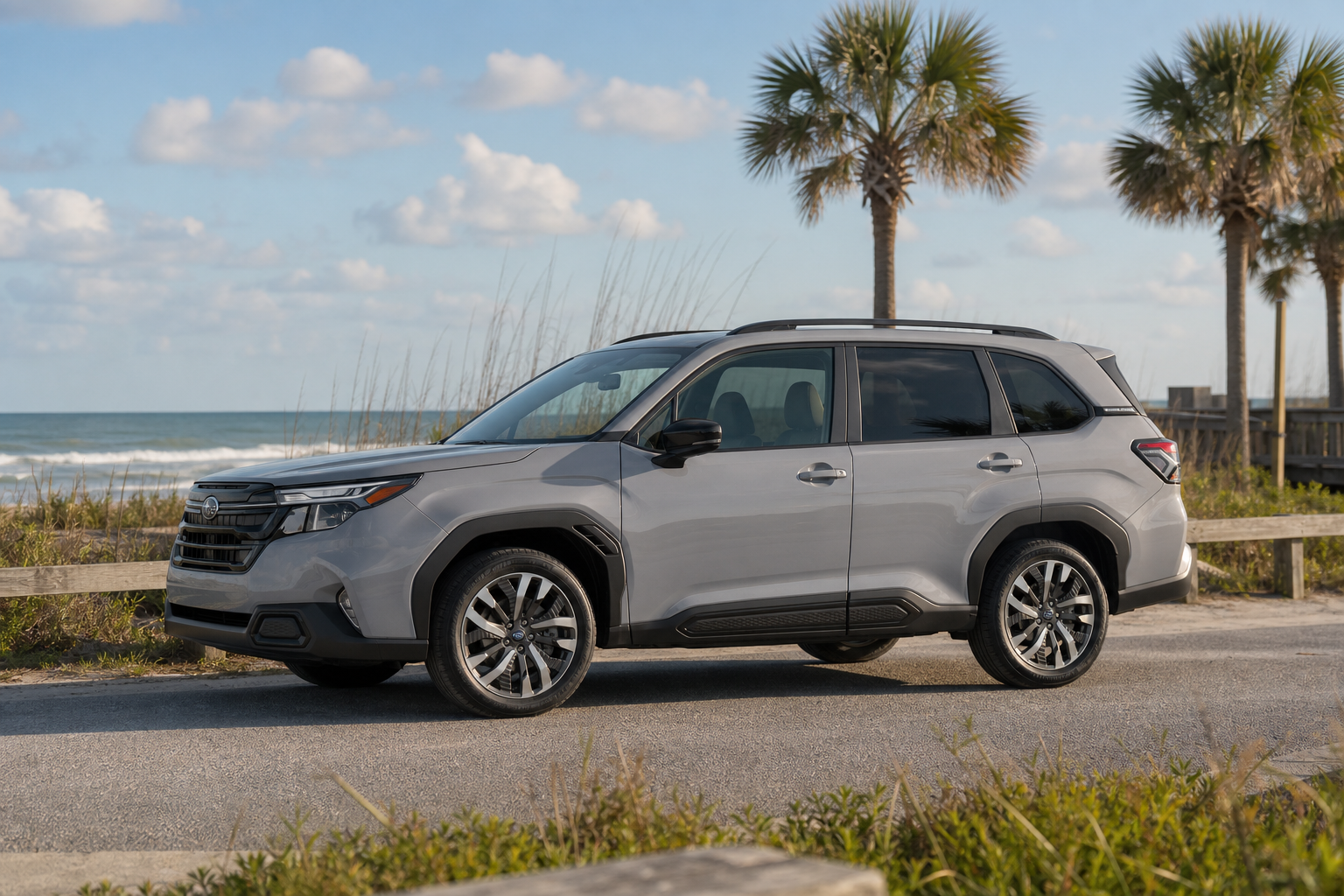
Compact SUV parked at a Florida beach access road with palms and dunes under a clear sky

2026 Subaru Forester Safety Features: A Plain-Spoken Guide for Jacksonville Drivers

The 2026 Subaru Forester leans hard on driver-assist technology, and if you commute on I-295 or run kids around Orange Park, that matters. Below is a straight explanation of what each system actually does, when it kicks in, and where it helps most on our roads. No jargon dumps, just what you'd want to know before a test drive. What safety features come standard on the 2026 Subaru Forester? Every 2026 Subaru Forester trim includes the EyeSight Driver Assist suite, which bundles adaptive cruise control, pre-collision braking, lane departure and sway warning, lane keep assist, and lead vehicle start alert. Standard symmetrical all-wheel drive and a full airbag array round out the baseline package on all trims. EyeSight adaptive cruise control with lane centering Pre-collision braking and throttle management Lane departure and sway warning Automatic emergency steering assist Symmetrical all-wheel drive as standard equipment Rear seat reminder and multiple airbags How does EyeSight actually help on Jacksonville roads? EyeSight uses stereo cameras to watch the road ahead and can slow or stop the vehicle if it senses a collision risk. In stop-and-go traffic on I-95 or the Buckman Bridge, adaptive cruise maintains a set gap automatically, and lane centering nudges you back if you drift. It reduces fatigue on longer runs to St. Augustine. According to the Insurance Institute for Highway Safety, vehicles equipped with front crash prevention systems like automatic emergency braking see rear-end crashes cut by roughly 50 percent, per IIHS research on the technology. That is a meaningful difference during our heavy summer rain, when stopping distances stretch out and visibility drops fast. Which 2026 Forester trims add extra safety technology? Higher trims layer on more equipment. Blind-Spot Detection with Lane Change Assist and Rear Cross-Traffic Alert becomes standard as you move up the lineup, and top trims add a wider-view monitor and DriverFocus, a system that watches for signs of distraction or drowsiness and issues alerts. Feature Availability EyeSight Driver Assist All trims, standard Blind-Spot Detection / Rear Cross-Traffic Alert Mid and upper trims DriverFocus distraction monitoring Upper trims Front-view and wide-angle monitor Upper trims Automatic reverse braking Mid and upper trims Do these safety systems work in Florida heat and rain? Yes, though conditions affect them. EyeSight cameras can be limited by heavy downpours, direct low sun, or a fogged windshield, so keep the glass clean and the area around the cameras clear. In normal Jacksonville weather the systems perform reliably, but they assist the driver rather than replace attention behind the wheel. If a warning light for a driver-assist system comes on, it is usually a sensor or camera calibration issue, not a reason to panic. Our service team can recalibrate EyeSight after windshield work or an alignment, which is a common step many owners overlook. Want to see how these systems feel on the road? Stop by Hanania Subaru of Orange Park in Jacksonville and take a 2026 Forester out on the highway, where adaptive cruise and lane centering are easiest to appreciate.

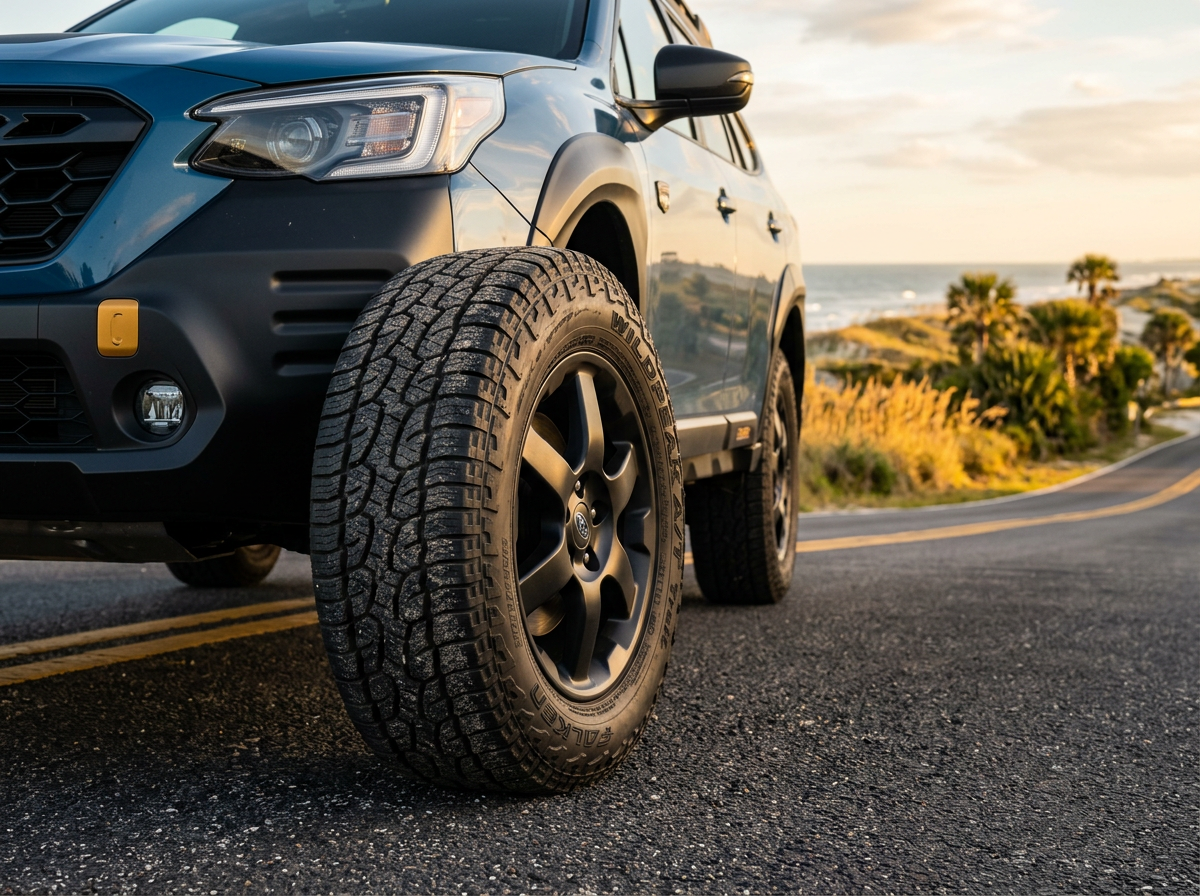
Close-up of an all-terrain Falken Wildpeak tire on a blue Subaru SUV parked on a coastal road at sunset.

What I Tell Our Customers About Choosing the Right Tires for a Subaru

## Understanding Subaru Factory Tire Standards and Recommended Brands My name is Carter Holloway, and as the Parts Manager here at Hanania Subaru with six years of experience helping owners maintain their vehicles, I spend a lot of time talking about rubber. Many drivers do not realize that Subaru vehicles require a higher tier of tire engineering than your average front-wheel-drive sedan because of how our Symmetrical All-Wheel Drive system functions. When your vehicle leaves the factory, it is equipped with high-quality all-season tires from top-tier brands like Yokohama Geolandar, Michelin, or Bridgestone Dueler to ensure optimal fuel economy and grip. For drivers commuting daily around the coastal dunes and humid sea air of Ponte Vedra Beach, choosing a tire that resists rubber degradation from heat and salt is essential. I always advise local owners to look at the Uniform Tire Quality Grading (UTQG) ratings on the sidewall, targeting a traction grade of A or AA and a temperature grade of A or B to handle our hot Florida summers. If you have questions about which brand matches your specific driving habits, you can reach my team directly at (904) 906-1235 or stop by our service and parts department on Blanding Blvd. Maintaining the correct speed rating and load index is crucial for the safety systems in your vehicle, including the EyeSight driver-assist suite. This is particularly true for high-performance setups like the ones we service from our performance-tuned vehicles, where cornering forces place immense stress on the tire sidewalls. At our certified service center, we stock and install only the exact tire specifications recommended by the manufacturer to keep your vehicle performing safely. Table of Contents Why Symmetrical AWD Demands Matching Tread Depth and Precise Fitment Subaru Tire Rotation Patterns and Maintenance Protocols Selecting Tires for Your Crosstrek or Rugged Outback Wilderness Replacement Costs, Budget Alternatives, and Online Ordering Realities Maximizing Protection with Road Hazard Plans and Dealer Packages Why Symmetrical AWD Demands Matching Tread Depth and Precise Fitment One of the most common questions I get in the parts department is whether an owner can replace just one damaged tire instead of all four. Because of the engineering behind Symmetrical All-Wheel Drive, the rolling circumference of all four tires must remain within 1/4 inch of one another, which translates to roughly 2/32 inch of tread depth. If you run mismatched tires, the speed difference forces the center differential to work continuously to compensate, which quickly leads to overheating and expensive drivetrain damage. This strict tolerance applies to every vehicle we service, whether it is a factory-fresh SUV or a model selected from our certified pre-owned inventory. This technical requirement is also why we warn against changing your vehicle's factory tire size or load rating. For commuters making the long drive from Yulee down to the city, running incorrect tire dimensions throws off your speedometer accuracy and disrupts the shift logic of the Lineartronic CVT. If you drive a popular family model like those found in our Forester inventory, keeping the factory-specified load index ensures your suspension can safely support your passengers and cargo. Our technicians always check these specifications against the tire placard on your driver-side door pillar during every multi-point inspection. ​ Subaru Tire Rotation Patterns and Maintenance Protocols To prevent uneven wear and protect your drivetrain, following a strict tire rotation schedule is absolutely vital. For most models, the recommended rotation interval is every 5,000 to 7,000 miles, which aligns perfectly with your standard oil change interval. We utilize a modified cross rotation pattern for non-directional tires, where the front tires move straight back to the rear, and the rear tires cross over to the opposite front positions. This specific pattern counteracts the unique wear forces experienced by the front steering wheels and keeps your tread depths perfectly balanced. Another critical standard that surprises many owners is our recommendation for replacement tread depth. While the legal minimum tread depth in most places is 2/32 inch, the factory recommendation is to replace your tires once they wear down to 4/32 inch. This extra margin of safety is designed to prevent hydroplaning and maintain the excellent wet-weather stopping power that our vehicles are known for. You can easily schedule a service visit online to have our factory-trained technicians measure your tread depths and execute a precise four-wheel alignment to maximize the lifespan of your rubber. ​ Selecting Tires for Your Crosstrek or Rugged Outback Wilderness Choosing the right replacement tire depends heavily on your vehicle model and how you use it. For owners of compact crossovers like those in our Crosstrek models, a premium touring all-season tire is often the best fit, offering a quiet ride, long tread life, and reliable wet traction for daily driving. If you drive one of our larger three-row family haulers from our Ascent models, you will need a tire with a reinforced sidewall and a higher load rating to handle the increased vehicle weight and passenger capacity safely. The tire selection process changes dramatically when we look at our trail-ready vehicles, such as the redesigned 2026 Outback Wilderness. While standard Outback models come equipped with highway all-season tires designed for a smooth ride and 25 city / 31 hwy MPG, the Wilderness trim is factory-fitted with rugged Yokohama Geolandar A/T all-terrain tires. These specialized tires feature aggressive tread blocks and reinforced sidewalls that match the model's elevated ground clearance of nearly 10 inches and 3,500 lbs towing capacity. Additionally, the Wilderness and Onyx Edition XT trims include a matching full-size spare tire under the cargo floor, which is essential for protecting your AWD system if you experience a flat on a remote trail. ​ Replacement Costs, Budget Alternatives, and Online Ordering Realities When it comes to replacing a full set of tires, pricing varies by vehicle and tire selection; please contact us for current pricing, depending on your vehicle's wheel size and whether you need highway touring or rugged all-terrain rubber. While some owners look to save money by choosing budget-friendly tire brands, I always caution that any alternative must strictly match the factory load index and speed rating. Saving a few dollars on a cheaper tire is not worth compromising your stopping distances or risking damage to your Symmetrical AWD system. Many drivers also wonder if they should order tires online and ship them to a local shop for installation. While online retailers make comparison shopping easy, buying directly through our parts department ensures you receive the exact tire model engineered for your specific vehicle chassis. When you purchase genuine parts and tires through our dealership, our factory-trained technicians handle the precise mounting, balancing, and four-wheel alignment required to maintain your ride quality. Plus, our direct relationships with tire manufacturers allow us to offer competitive pricing and exclusive rebates that online warehouses cannot match. ​ Maximizing Protection with Road Hazard Plans and Dealer Packages To give our customers complete peace of mind on the road, many tire purchases may qualify for the Subaru 24-Month Tire Protection Plan. This complimentary coverage covers the cost of tire repairs or complete replacements if you run over a nail, hit a pothole, or suffer other road hazard damage. It also features complimentary tire-focused roadside assistance, giving you a direct line to help when you need a flat tire changed or a tow to the nearest authorized retailer. If you ever find yourself stranded with a flat, you can call Subaru Roadside Assistance at 1-800-261-2155 for rapid, manufacturer-backed support. Protecting your investment with proper tire maintenance is the best way to ensure your vehicle remains safe and reliable for years to come. Whether you need a quick pressure check, a tire rotation, or a new set of factory-recommended tires, our team is here to provide transparent, expert care. You can reach our parts and service specialists by calling (904) 906-1235, or you can get directions to stop by our Jacksonville dealership location today. © 2026 Hanania Subaru. All rights reserved.
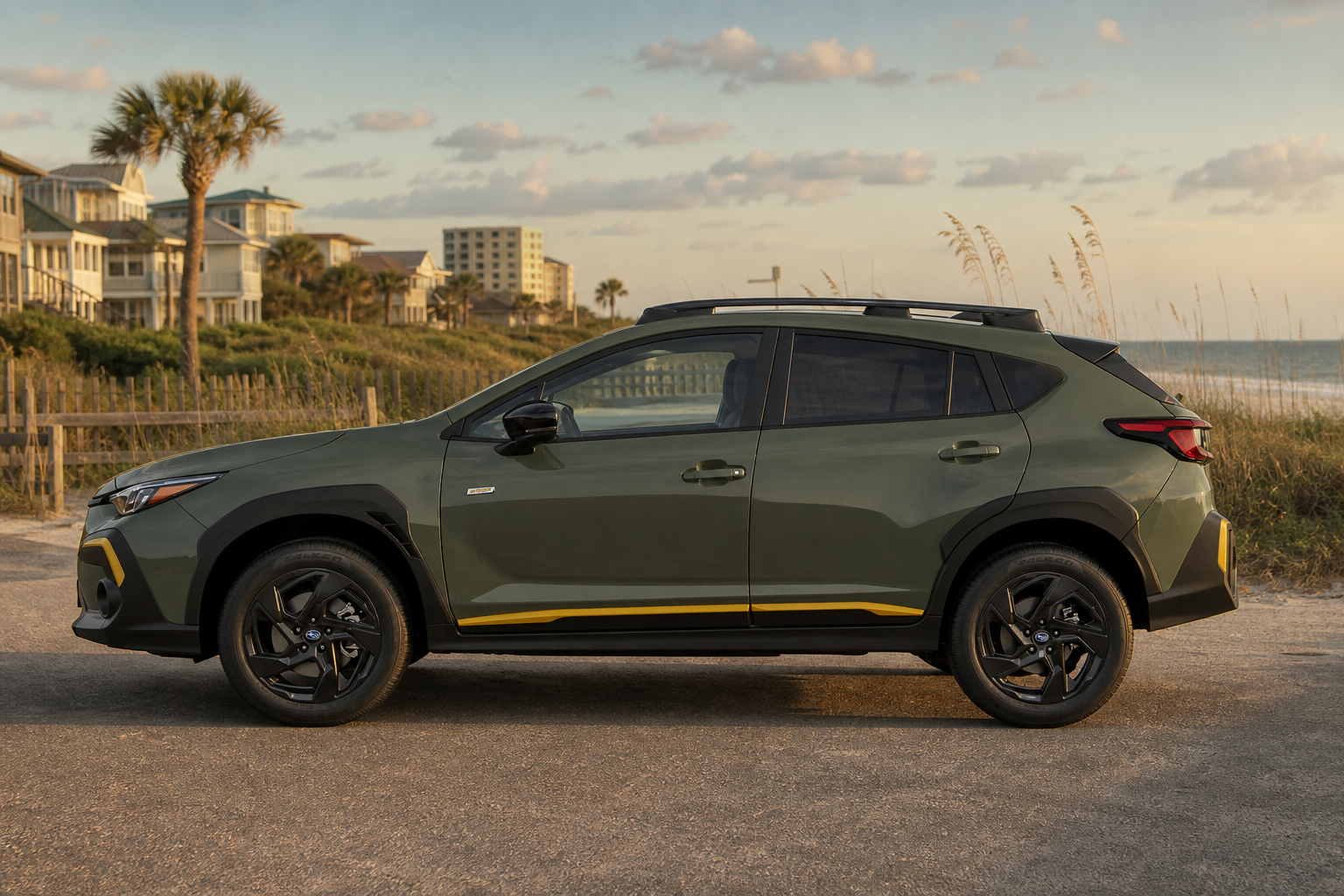
Compact crossover parked on a sandy beach-access road near Jacksonville at golden hour with dunes nearby

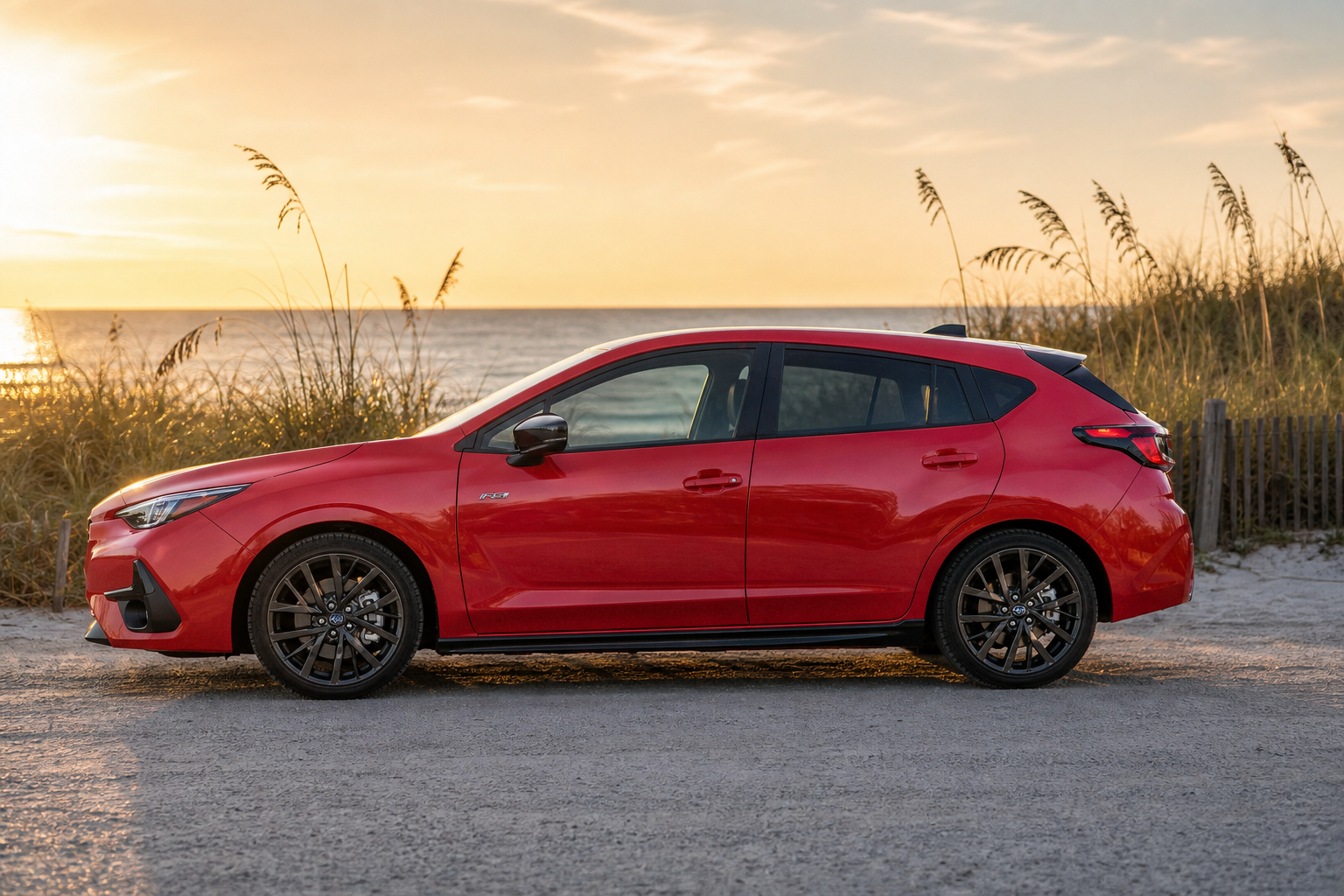
Subaru Crosstrek Gas Mileage: What Jacksonville Drivers Really Get

Gas mileage is one of the first questions we hear at the counter, and it deserves a straight answer instead of a shrug. Below we break down what the Subaru Crosstrek is rated to do, why the two engines behave differently, and what those numbers actually look like on I-295 and around Orange Park. What is the Subaru Crosstrek's gas mileage? The 2026 Subaru Crosstrek with the 2.0-liter engine (Base and Premium trims) is EPA-rated at roughly 27 mpg city, 34 highway, and 29 combined. Trims with the 2.5-liter engine (Sport and Limited) land near 25 city, 29 highway, and 27 combined. The Wilderness trim comes in a touch lower. Every Crosstrek uses all-wheel drive and a continuously variable transmission, which helps the small SUV squeeze usable efficiency out of both engines without the driver thinking about it. 2026 Crosstrek Trim Engine City / Hwy / Combined (MPG) Base / Premium 2.0L 27 / 34 / 29 Sport / Limited 2.5L 25 / 29 / 27 Wilderness 2.5L 25 / 29 / 26 According to fueleconomy.gov, the EPA combined figure is based on a blended test cycle, so your real number moves with traffic, terrain, and how heavy your right foot gets in the Buckman Bridge on-ramp. Why does the 2.0-liter get better mileage than the 2.5-liter? The 2.0-liter engine is smaller and asks for less fuel to keep the Crosstrek moving in everyday driving, so it posts higher EPA numbers. The 2.5-liter trades a few miles per gallon for noticeably more pulling power, which matters for merging, passing, and loaded trips to the coast. Here is how we usually frame the choice for shoppers: Mostly commuting and errands? The 2.0-liter's extra highway mpg adds up over a Jacksonville work week. Regular highway hauls, gear, or a full car? The 2.5-liter feels calmer and less strained, and the mpg gap shrinks under load. Light off-pavement or beach-access trips? The Wilderness leans toward capability over efficiency, and that tradeoff is intentional. How can I get closer to the Crosstrek's rated mileage in Jacksonville? You get closer to the ratings by managing the things the EPA test can't see: tire pressure, smooth acceleration, and steady highway speeds. Our humid heat and stop-and-go stretches on Blanding Boulevard both work against you, so small habits and on-time maintenance make a measurable difference over a tank. A few practical moves that pay off: Check tire pressure monthly; underinflated tires drag mileage down and wear unevenly in Florida heat. Ease off idling with the A/C blasting in long drive-thru lines. Keep up with oil changes and air filter service so the engine breathes clean. Skip the roof-mounted cargo boxes when you don't need them, since they add wind resistance on the highway. Combine errands so the engine spends more time warm and efficient. If your mileage suddenly drops without a change in how you drive, that's worth a look. A tired oxygen sensor, a dragging brake, or low tire pressure can quietly cost you several miles per gallon, and our service team on Wells Road can pin down the cause before it gets expensive. Does all-wheel drive hurt the Crosstrek's gas mileage? All-wheel drive adds a small amount of weight and drivetrain drag, which is part of why a Crosstrek won't match a front-wheel-drive econobox on paper. In exchange you get year-round traction on wet Jacksonville roads and soft beach approaches, and Subaru's system is tuned to keep that mpg penalty modest. For most Northeast Florida drivers, the everyday confidence in summer downpours is worth the handful of miles per gallon. If you want the leanest possible fuel number, choose a 2.0-liter trim and keep up with maintenance; if you want more grunt, the 2.5-liter is the pick and the difference at the pump is smaller than people expect. Have a specific trim in mind? Come drive both engines back to back at Hanania Subaru of Orange Park and see which one fits your commute before you commit.

Lone crossover parked on a sandy beach access road at sunset with dunes and sea oats nearby

The Best Subaru for Jacksonville Beaches: A Local Buyer's Guide

Living near the water in Northeast Florida means your vehicle sees sand, salt air, and the occasional soft-shoulder parking spot at Hanna Park. The good news: most of the Subaru lineup handles our coastal life well. The better news is that a few models fit certain beach routines better than others. Here's a straight look at what actually matters for Jacksonville drivers. Which Subaru handles Jacksonville beach access roads best? For gravel lots, packed-sand access roads, and the occasional soft shoulder around Hanna Park or Amelia Island, the Outback and Forester lead the pack. Both offer 8.7 inches of ground clearance and standard Symmetrical All-Wheel Drive, so you clear rutted approaches and rain-flooded lots without scraping or spinning. If your beach days involve loading coolers, chairs, and a couple of boards, the Outback's longer cargo area and roof rails make it the practical pick. The Forester is a little easier to park at crowded spots like Jacksonville Beach and offers great visibility. The Crosstrek is the compact option that still carries that same 8.7 inches of clearance in a smaller footprint. Outback: Most cargo room, best for gear-heavy beach and camping trips Forester: Tall visibility, easy parking, roomy back seat Crosstrek: Compact, nimble, same clearance in a smaller size Wilderness trims (Outback, Forester, Crosstrek): Extra clearance and rugged tires if you regularly hit rougher access points Do you need all-wheel drive for Florida beach driving? For everyday beach trips on paved and packed surfaces, all-wheel drive is a real advantage but not a permit to drive on open sand. Florida beaches like those in Duval County generally prohibit driving on the sand, so AWD's job here is traction on wet ramps, gravel lots, and rain-slicked A1A, not dune crawling. Every Subaru except the BRZ comes with Symmetrical All-Wheel Drive as standard equipment, which means power goes to all four wheels the moment a tire starts to slip. On a summer afternoon when a Florida thunderstorm dumps two inches in an hour, that steady grip getting out of a flooded lot is where you feel the difference. According to the National Weather Service, Jacksonville averages roughly 52 inches of rain per year, with most of it falling between June and September. That's a lot of wet pavement between you and the sand, and it's the main reason coastal drivers here appreciate standard AWD. How do salt air and sand affect your Subaru near the coast? Salt air and blown sand accelerate corrosion on any vehicle, working into wheel wells, brake components, and undercarriage seams. The fix is simple and cheap: rinse the underbody regularly, especially after beach trips, and keep up with routine service. A Subaru cared for this way holds up well against coastal wear. Here in Orange Park and across Jacksonville, we tell owners to hose down the undercarriage every couple of weeks in summer and to book an occasional inspection of brake lines and suspension hardware. Sand also loves cabin air filters and door seals, so a quick check of those keeps things comfortable. Coastal concern Simple habit Salt on undercarriage Rinse underbody every 1–2 weeks in summer Sand in cabin filter Inspect and replace at scheduled intervals Brake corrosion Ask for a brake inspection at service visits Faded exterior Wash and wax before peak summer sun What does a beach-ready Subaru cost in Jacksonville? Pricing shifts with trim and availability, so we won't quote a naked number. As a general guide, the 2026 Subaru Crosstrek Base is the most affordable way into the lineup, the 2026 Forester Premium hits a middle ground on features and space, and the 2026 Outback Wilderness sits toward the top for gear haulers who want extra clearance. The smartest move is to tell us how you use the beach—quick surf mornings, family cooler runs, or weekend camping toward St. Augustine—and we'll match a specific model year and trim to your budget. Current incentives change monthly, so ask us what's active before you shop. Which Subaru is best for a family beach day versus a solo surf trip? For family beach days with coolers, canopies, chairs, and kids, the 2026 Outback or 2026 Ascent give you the most cargo space and easy loading. For a solo surf morning or a couple heading to Ponte Vedra, the 2026 Crosstrek is compact, fuel-friendly, and simple to park at busy access points. Big family days: Ascent (three rows) or Outback (long cargo bay) Couples and gear: Forester for headroom and roof-rail flexibility Solo or two-person runs: Crosstrek for parking and efficiency Come see them side by side at Hanania Subaru of Orange Park—we'll help you picture your beach setup in each one before you decide.

Contact Us

Fill out this form below and we'll contact you shortly
*Required Fields